Key Takeaways
- Execution fails most often at five points: clarity, ownership, capacity, rhythm and learning.
- Cap strategic initiatives to what each team can truly carry, then defer the rest in writing.
- One owner and one measure per initiative beats any shared dashboard.
- A weekly, monthly and quarterly rhythm catches problems while they are still small.
The strategy slide is usually fine. What goes wrong is what happens in the weeks after the offsite: priorities blur, teams keep doing what they were already doing and nobody can say who decides when two projects compete for the same people. In strategy execution consulting work, I use the same five-part model to find where a plan is leaking, and I describe it here so you can run it yourself.
The model is a blueprint, not a program to buy. Each component has a test you can apply today, a typical failure and a fix. After the model I compare it with frameworks you may already know, give you a diagnostic and explain how to start small.
Why Plans Stall After the Kickoff
In a survey of about 11,000 managers at more than 400 companies, Donald Sull and Rebecca Homkes found that only about one third could correctly name their firm's top three priorities. Even among people who helped develop the strategy, only just over half could. The researchers also reported that senior managers said they could rely on colleagues in other units to deliver less than 10 percent of the time, as reported by London Business School.
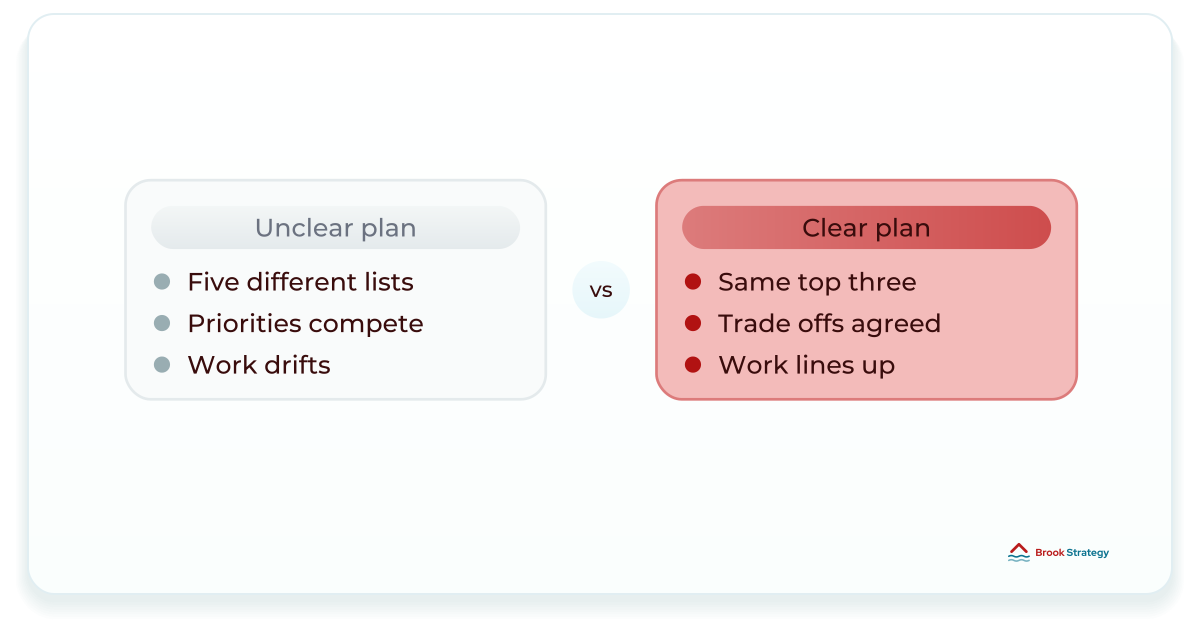
Those figures match what I see in client interviews. When I ask five managers for the top three priorities, I rarely get the same list twice. A framework fixes this by making the priorities, the owners and the checks explicit, so the plan does not depend on memory or goodwill.
The Five-Component Model
Use the table as a quick diagnostic. For each component, read the test, answer yes or no and note where you answer no. Those are your starting points.
| Component | Test question | Typical failure | First fix |
|---|---|---|---|
| 1. Clarity | Can any manager state the top three priorities in 30 seconds? | A long list of equal priorities | Cut to three to five and say what you will stop |
| 2. Ownership | Does every initiative have exactly one named owner? | Committees own results | One owner and one measure per initiative |
| 3. Capacity | Is the plan sized to the hours teams really have? | Plans assume free time that does not exist | Count hours, then fit initiatives into them |
| 4. Rhythm | Is there a fixed review cadence with recorded decisions? | Problems appear at the quarterly meeting | Weekly check-in, monthly review, quarterly reset |
| 5. Learning | Do you change the plan when results or the market change? | Targets drift quietly or never move | Record each change and its reason |
Component 1: Clarity About What Matters Most
Write the strategy so it fits on one page, in words a new hire would understand. Then list the three to five priorities for the next 12 months and, on the same page, the things you will not do. The "not do" list is the part leaders resist and the part managers value most, because it gives them permission to say no.
If you still need to settle the direction, strategy development consulting covers how to get there. Execution work on a plan nobody has fully chosen only produces well-organized confusion.
Component 2: One Owner and One Measure
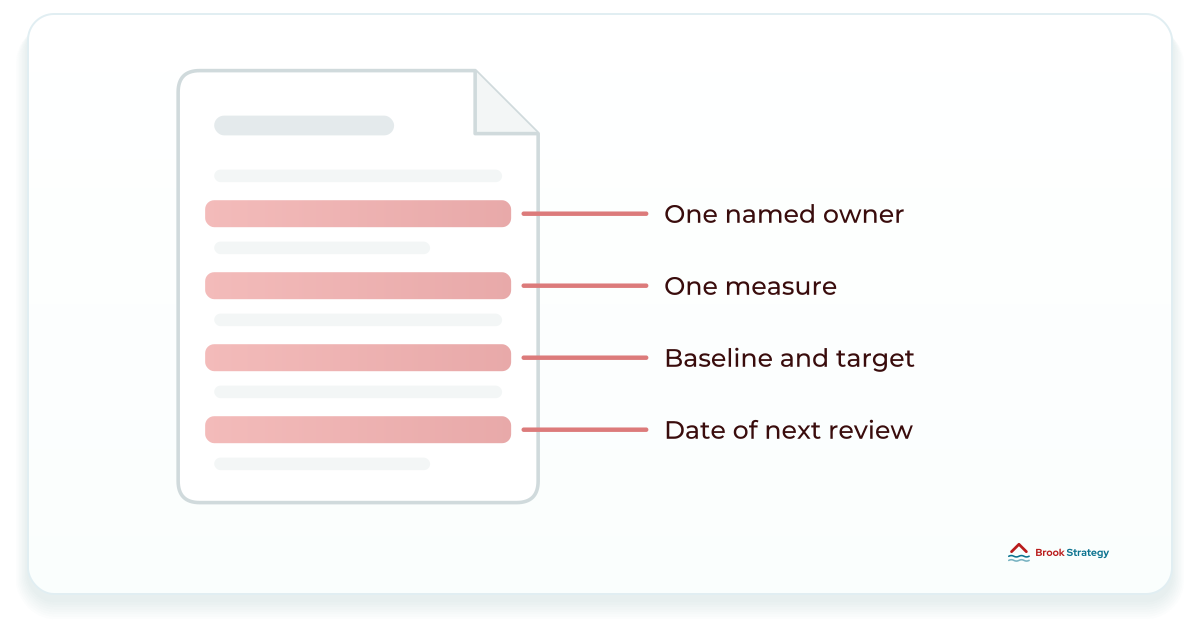
Give every initiative a single person who is accountable for the result and a single measure that shows whether it is working. The owner does not have to do the work. The owner has to know where it stands and call for a decision when it is blocked.
I check this with a simple test: ask the owner "what is the number and when does it move?" If the answer takes more than a sentence, the measure is wrong. Good measures are specific, such as qualified pipeline created per month or days from order to delivery, and each has a baseline and a target date.
Component 3: Capacity Before Ambition
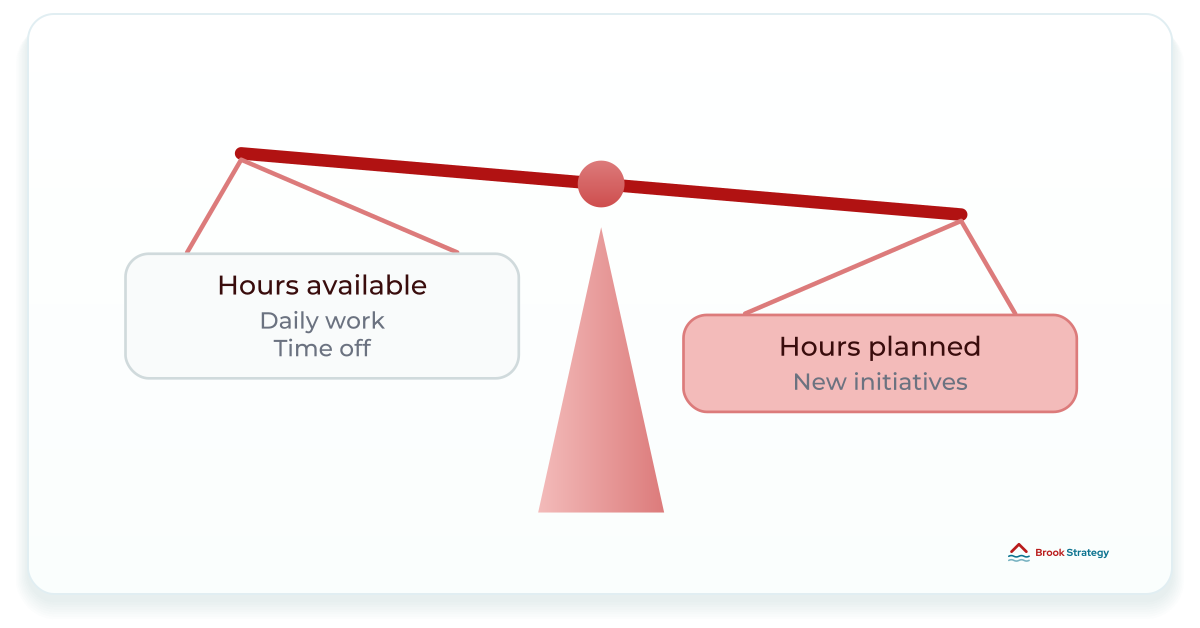
Most plans list more work than the teams can carry. Estimate the hours each team can give to strategic work after daily operations. In my client work this is often 10 to 20 percent of a team's time, which surprises leaders who assumed more. Then size each initiative in hours and fit them into the number.
What does not fit gets a written deferral with a review date. This keeps the idea alive and prevents the hidden work that happens when people quietly try to do everything. It also stops the common pattern where a new request displaces an agreed initiative without anyone deciding that it should.
Component 4: A Rhythm That Fits Your Calendar
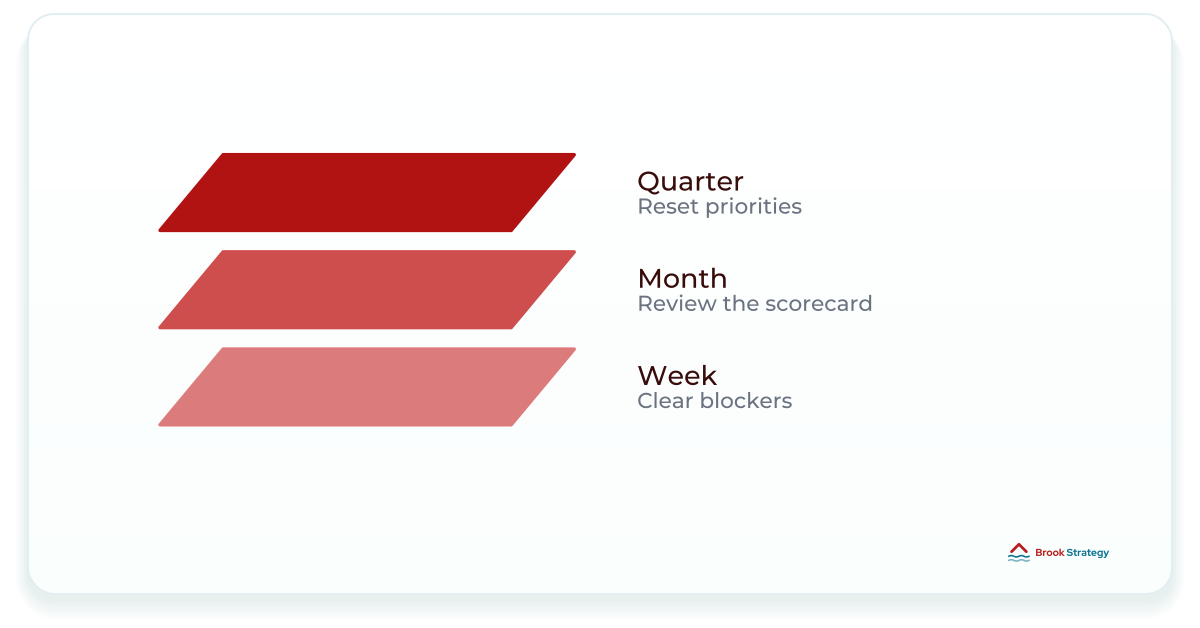
Execution runs on routines. Three layers are enough for most companies. The weekly check-in lasts 15 to 30 minutes per initiative owner and covers progress, blockers and the decision needed. The monthly leadership review looks at the scorecard, settles trade-offs and approves changes. The quarterly reset decides what to start, continue or stop.
Fit the rhythm into meetings you already hold. A new meeting for every layer adds load and gets dropped first. Each meeting ends with decisions written down, so anyone can see later what was settled and why.
Component 5: Learning and Adjusting in the Open
Plans meet reality within weeks. The question is whether you adjust openly or let targets drift. Record each change, the reason and who approved it. After a quarter you will have a short log that shows which assumptions held and which did not, and that log makes the next planning cycle faster and better.
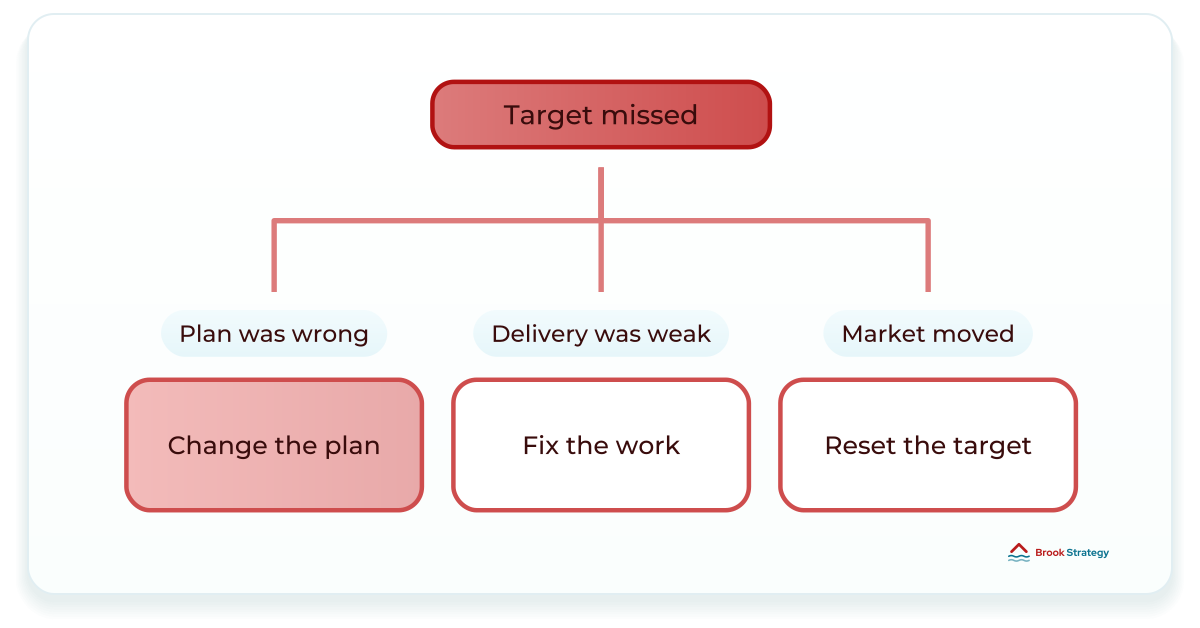
When a target is missed, ask first whether the initiative was wrong, the target was wrong or the execution was weak. Each has a different fix. I have seen companies punish execution for what was really a weak target, and lose their best owners.
How the Model Relates to OKRs and the Balanced Scorecard
You probably know at least one of the established tools. The five components do not compete with them. They show you which part of each tool you are really relying on.
| Tool | Strongest on | Weaker on | Good fit when |
|---|---|---|---|
| OKRs | Clarity and ownership through short-cycle goals | Capacity and long-term balance | Teams that move fast and want stretch goals |
| Balanced scorecard | A balanced view across finance, customers, processes and learning | Rhythm, if reviews are rare | Companies that want a stable set of measures |
| Initiative portfolio | Capacity and trade-offs across projects | Day-to-day accountability | Companies with many parallel projects |
| Simple spreadsheet and weekly meeting | Rhythm and visibility at low cost | Scale and history | Small teams starting out |
Robert Kaplan and David Norton introduced the balanced scorecard in a 1992 Harvard Business Review article, arguing that financial measures alone can mislead managers who are trying to improve and innovate. That argument still holds: whichever tool you pick, measure more than money. If you want software to carry the scorecard, my ranking of strategy execution software compares the main platforms with real prices and ratings.
Run the Diagnostic on Your Own Plan This Week
Set aside 90 minutes with your leadership team and answer these questions on paper before you talk. Compare the answers afterward. The gaps are the work.
- Each leader writes the top three priorities and what you will stop doing.
- Each leader names the owner and the measure for every priority.
- Each team lead estimates the hours available for strategic work next quarter.
- Everyone lists the meetings where progress is reviewed today and what was decided in the last one.
- Everyone names one assumption in the plan that has changed since it was written.
If the lists differ by more than a priority or two, start with component 1. If they match but nothing moves, look at capacity and rhythm. For practical habits that help with each component, I collected the strategy execution best practices that work most often in my projects.
Starting Small and Growing the System
You do not need to launch all five components at once. A realistic first month looks like this. In week one, write the one-page priorities and the stop list. In week two, assign owners and measures and size the initiatives against capacity. In week three, hold the first weekly check-ins. In week four, run your first monthly review and record what you learned.
Resist adding tools until the routines work. I have watched a company roll out a platform before the owners were named and end up with beautiful tracking of unowned work. Once the rhythm holds for two or three months, a tool saves time. Before then, a shared spreadsheet is fine.
Expect friction. Managers who are used to loose targets may dislike a single measure per initiative, and leaders may dislike the stop list. Handle it by showing the first scorecard early and fixing the measures that people say are unfair. The framework needs trust more than it needs precision. To see what the model looks like in real companies, I describe strategy execution examples from a range of sectors, and the common obstacles you can plan for are covered in strategy execution challenges.
Choosing Where to Begin
Match the starting point to your symptom. If managers disagree about priorities, begin with clarity. If deadlines slip and nobody is surprised, begin with ownership and rhythm. If teams complain they are overloaded, begin with capacity. If the plan is old and nobody mentions it, begin with learning and a quarterly reset.
Pick one component, fix it for a quarter and then move to the next. Fixing one well beats improving all five a little.
Questions About Strategy Execution Frameworks
What Is a Strategy Execution Framework?
It is a structure that connects a chosen strategy to daily work. A good one defines which initiatives matter, who owns each one, how progress is measured, how often leaders review it and how trade-offs are decided. The framework does not replace your strategy. It makes sure the strategy gets resourced, tracked and adjusted.
How Is Execution Different from Strategy Development?
Development decides where to compete and how to win. Execution turns those choices into owned initiatives with targets and reviews. Many companies spend months on the first and a single offsite on the second, which is why plans stall. Both need the same care.
How Many Initiatives Should a Team Run at Once?
Fewer than most teams think. In my client work, teams that cap active strategic initiatives at three to five per team finish a far larger share of them than teams running ten. The right number is set by real capacity: count the hours each team can give to strategic work after daily operations, then fit initiatives into that figure.
Should I Use OKRs, a Balanced Scorecard or Something Else?
Pick the one your leaders will read every month. OKRs suit fast-moving teams that want ambitious, short-cycle goals. A balanced scorecard suits companies that want a stable view across finance, customers, processes and learning. The five components below work with either one, and a simple spreadsheet is enough for a first version.
How Often Should Leaders Review Strategy Execution?
I recommend a short weekly check-in per initiative owner, a monthly leadership review of the scorecard and a quarterly reset of priorities. Weekly keeps blockers small. Monthly keeps leaders informed. Quarterly gives you a formal chance to drop, add or reshape initiatives.
How Do I Check the Framework Works?
Look at four signs: the share of initiatives on track, the time it takes to settle a trade-off, how many middle managers can name the top priorities without notes and the number of blockers open for more than two weeks. Review them monthly. If the trend is flat after a quarter, one of the five components needs attention.
Can a Small Company Use a Strategy Execution Framework?
Yes, and it often helps more than at a large firm, because every person carries a larger share of the plan. A small team can run the whole model with one page of priorities, a shared spreadsheet and a 30-minute weekly meeting.
Sources
- London Business School: two thirds of senior managers can't name their firm's top priorities
- Harvard Business Review: The Balanced Scorecard, Measures That Drive Performance
Note: This article is general information, not legal, financial or tax advice. Figures and examples are estimates based on typical projects, so check current details with your providers and advisers before you decide.
Was this article helpful?
Thank you for letting us know.
Russell Tennant
Russell leads the Brook editorial team and works with our consultants to turn real client engagements into practical guides on roadmaps, go-to-market planning, growth and competitive strategy. Before joining Brook, he spent 11 years in strategy and product marketing roles at software and financial services companies. He has since edited more than 300 articles on strategy practice and drawn on roadmaps and growth plans from over 100 client projects. He is based in Denver, Colorado.