Key Takeaways
- A product strategy framework turns open debates into six ordered decisions, from customer to quarterly review.
- Evidence comes before scoring: customer interviews, usage data and sales notes decide what goes on the list.
- A simple formula of value, fit and confidence divided by effort ranks bets without a complicated spreadsheet.
- A strategy is only finished when it names what you will not build and the metric that tells you if a bet works.
Most product teams don’t lack ideas. They lack a way to choose between them that everyone accepts. I have watched planning meetings where a founder’s hunch, a big customer’s request and an engineer’s pet project were all treated as equally valid, and the decision went to whoever stayed longest in the room.
A framework fixes the order of the questions, so the debate happens on evidence. In my product strategy consulting work I use the six phases below, and they hold up from a ten-person startup to a multi-product company. The overview table comes first, then each phase in turn, then a scoring formula with a worked example.
Six Phases in Brief
| Phase | Question it answers | Output | Typical time |
|---|---|---|---|
| 1. Customer and vision | Who do we serve, and what changes for them? | One-page vision and target segment | 3 to 5 days |
| 2. Evidence | What do customers and data actually show? | Evidence table of problems | 1 to 3 weeks |
| 3. Choices | Where will we play, and where won’t we? | Longlist of bets and a not-doing list | 2 to 4 days |
| 4. Scoring | Which bets come first? | Ranked list with scores | 1 to 2 days |
| 5. Commitment | What will we do, and how will we know? | Roadmap, owners and metrics | 1 week |
| 6. Review | Is it working? | Quarterly decision to keep, change or stop | Half a day per quarter |
Phase 1: Name the Customer and the Change You Create
Start with one segment. If you can’t name it in a sentence, you aren’t ready for the later phases. A usable segment states who they are, what they are trying to get done and what stops them today. For example, finance teams at 50 to 200-person software companies who close their books by hand in spreadsheets.
Next write the vision as a change in the customer’s life, not a feature list. “Close the books in two days instead of eight” can be measured and argued with. “The leading platform for finance” can be neither. Keep it to one page, and expect to revise it after the evidence phase.
Phase 2: Collect Evidence Before You Form Opinions
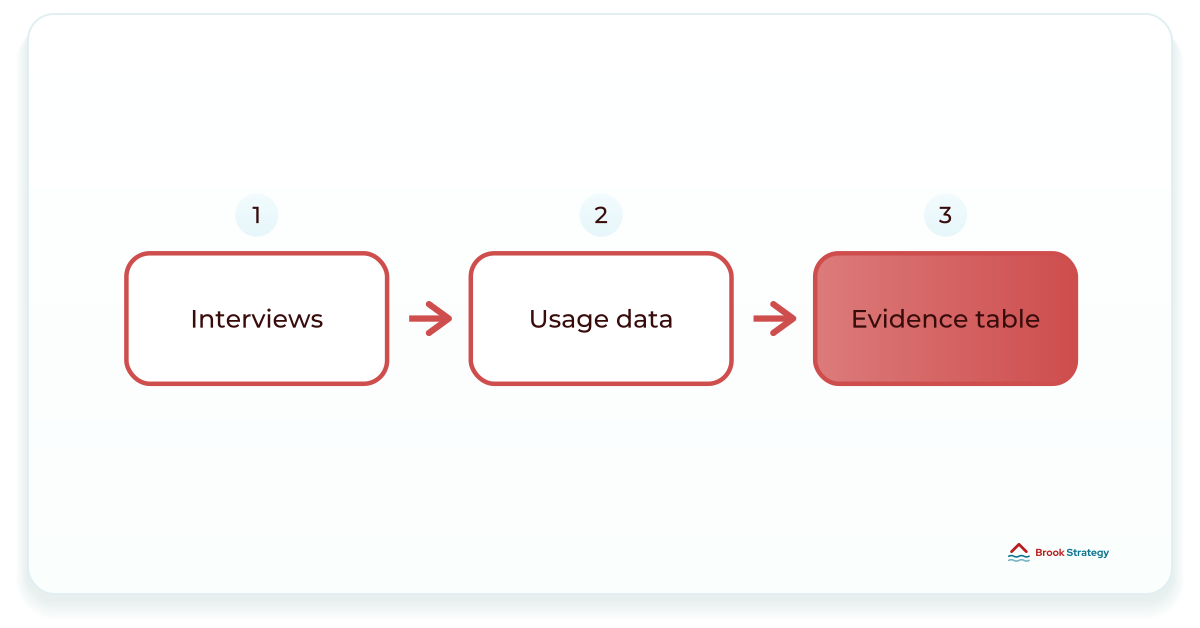
Evidence comes from four places: customer interviews, product usage data, sales and support notes and market context such as competitor moves. Interview eight to fifteen customers in your target segment, and include two or three who left. The people who churned tell you things happy customers never will.
Put what you learn into an evidence table with one row per problem: the problem in the customer’s words, how many sources mention it, which segment feels it most and what proof you have. A problem mentioned by two sales reps and nobody else is a hypothesis. A problem that appears in interviews, support tickets and usage drop-offs is a finding.
Phase 3: Make Choices, Including the Ones You Will Skip
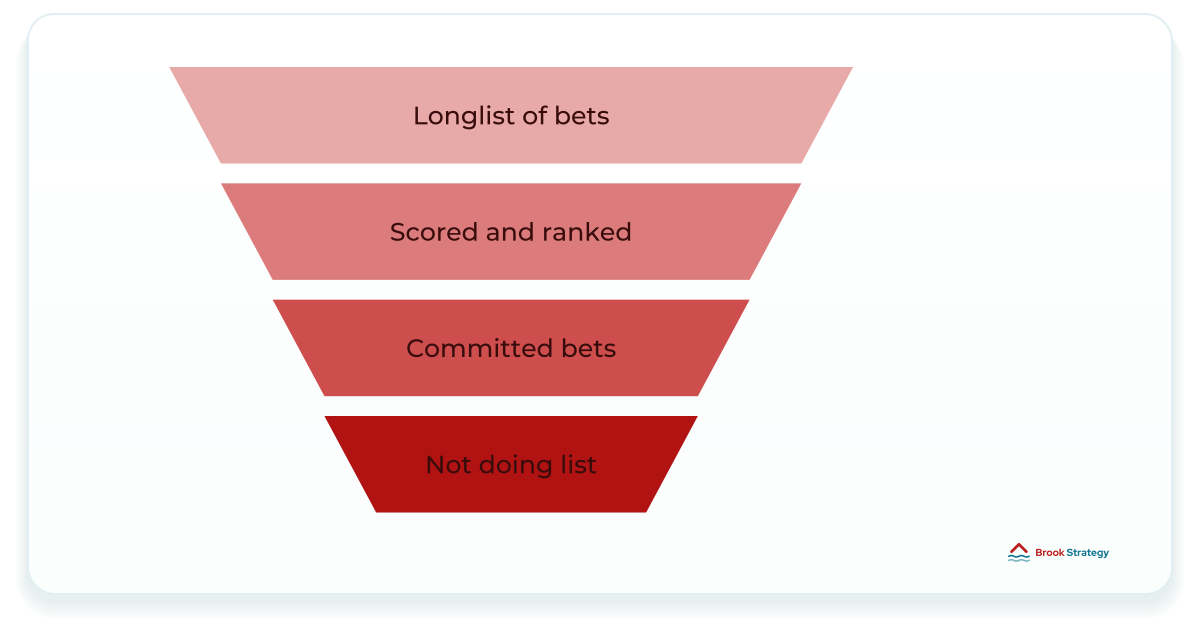
Turn the strongest problems into bets. A bet is a statement you can prove wrong: “If we cut setup from five days to one, activation in our target segment will rise from 38% to 50% within two quarters.” Aim for a longlist of eight to twelve bets.
Then write the not-doing list, which is the part most teams skip. It names customer segments, feature categories and requests you will decline this year, with a reason for each. When a large customer asks for something on the list, you can show them the reasoning instead of improvising a reply. For founders starting out, my guide to product strategy for startups shows how short that list can be at an early stage.
Phase 4: Score the Bets With One Formula
Scoring is only useful if it is quick and visible. The formula I use has four inputs, each rated from 1 to 5:
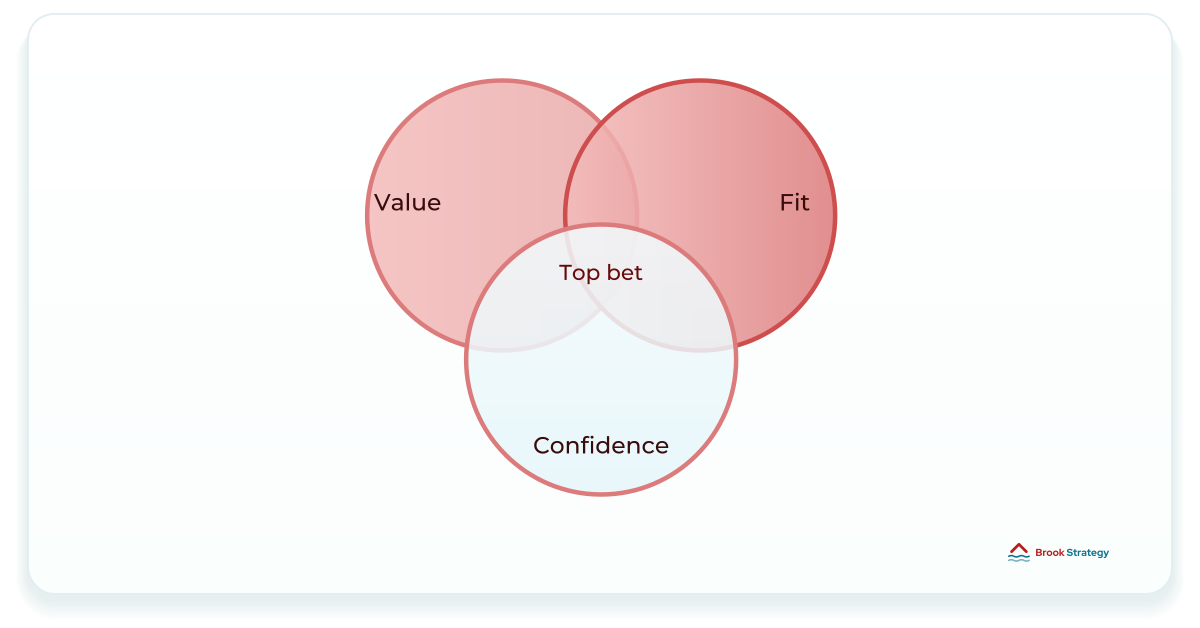
Customer value asks how much the problem hurts the target segment. Strategic fit asks how well the bet supports your vision. Confidence reflects how strong your evidence is, and it is where honest teams lose points. Effort covers engineering, design and go-to-market work, expressed on the same 1 to 5 scale. Here is a worked example for four bets from a fictional invoicing product:
| Bet | Value | Fit | Confidence | Effort | Score |
|---|---|---|---|---|---|
| One-day onboarding | 5 | 5 | 4 | 3 | 33.3 |
| Bank feed integration | 4 | 4 | 5 | 4 | 20.0 |
| Custom report builder | 3 | 3 | 2 | 5 | 3.6 |
| Mobile app | 3 | 2 | 2 | 5 | 2.4 |
The mobile app scores lowest even though several customers asked for it, because fit and confidence are weak. That is the kind of result a formula helps you defend. If you disagree with a score, change the input and write down why. Arguing about the inputs is far more productive than arguing about the ranking.
Phase 5: Commit With Owners, Metrics and a Sequence
Pick the top three to five bets. More than that and your team splits its attention. Each bet gets an owner, a metric with a baseline and target, a review date and a rough sequence that respects dependencies. A metric without a baseline is only a wish.
The sequence becomes your roadmap. If you want a 12-month version with quarters, milestones and decision gates, I lay one out in my product strategy roadmap article. Keep it honest about capacity: a roadmap that fills every engineer’s time leaves nothing for incidents, debt or the next opportunity.
Phase 6: Review Each Quarter and Change the Plan on Purpose
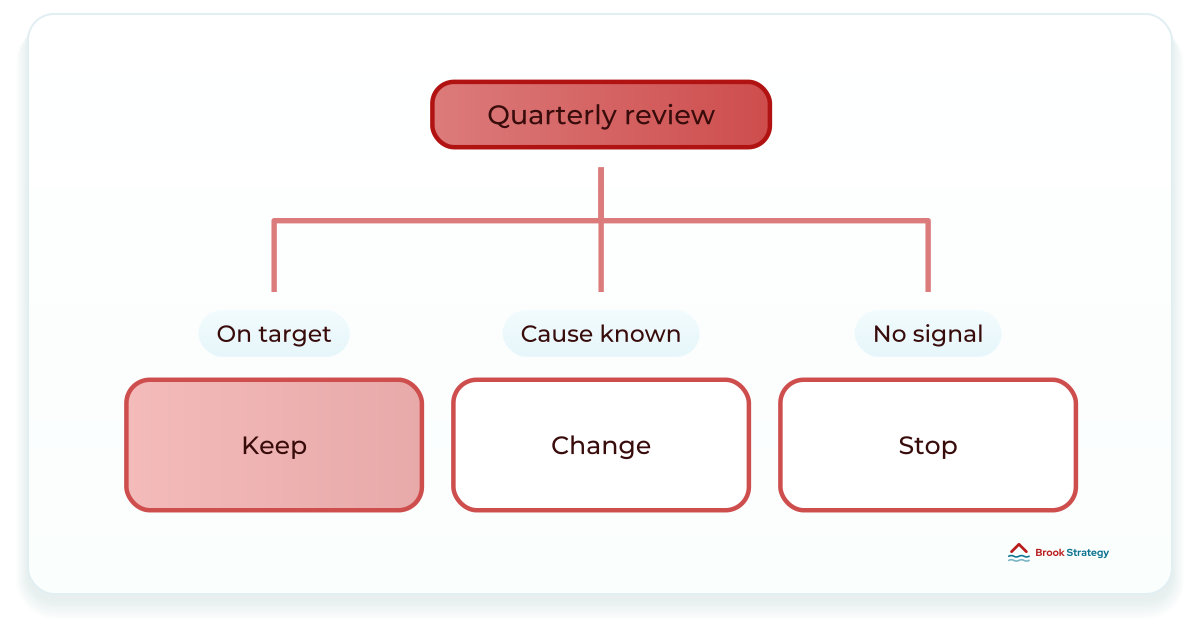
Once a quarter, look at each bet against its metric and make one of three calls: continue, change or stop. Stopping is the hardest and the most valuable, because it returns capacity to the list. Write the decision and the reason on one line so you can revisit it later.
Once a year, revisit phases 1 to 3. Markets move, and a segment that was right two years ago may be crowded now. Seeing how known companies handled such shifts helps, and the product strategy examples I collected show several in detail.
Where Teams Get This Wrong in Practice
In my client work, the framework rarely fails on the scoring. It fails earlier or later. The most common early failure is a vision written in a day by the leadership team, with no customer evidence behind it. The plan then looks tidy and collapses at the first customer call. The most common late failure is a roadmap that nobody reviews, so bets continue long after their metric stopped moving.
A third pattern shows up in companies with several product lines: each line runs the framework alone, and the results compete for the same engineers. If that is your situation, run phases 1 to 4 per product, then hold one joint session for phase 5, where capacity is shared out openly. It adds a few days and saves a quarter of arguments.
Tools That Support the Framework
You can run the whole framework in a spreadsheet and a document. When you outgrow that, choose tools by phase: a feedback board for evidence, a scoring tool for bets and a roadmap tool for commitment. My ranking of product management tools compares the main options with prices and user ratings, and it is worth reading before you buy seats.
How This Framework Compares With Others
You will meet other models, so it helps to know where each one fits. They don’t compete as much as they answer different questions.
| Model | Best at | Gap |
|---|---|---|
| Six-phase framework (this article) | Moving from customer to quarterly review in one structure | Needs real customer evidence to work |
| RICE scoring | Ranking a long feature backlog quickly | Says nothing about vision or segment choice |
| Opportunity solution tree | Continuous discovery with outcomes | Needs a team that interviews every week |
| Jobs to be done | Understanding why customers switch | Doesn’t cover sequencing or metrics |
| Playing to Win cascade | Company-level choices about where to play | Too broad for single-product decisions |
I often combine them: jobs to be done for the interviews in phase 2, RICE-style scoring inside phase 4 and the cascade when the company strategy is still open.
Deciding Where to Begin
You don’t have to run all six phases at once. Match your starting point to your situation:
- No clear segment or vision: start at phase 1 and keep the first pass short.
- A long backlog and constant debate: start at phase 4, then go back and fill in the evidence.
- A plan that exists but never gets reviewed: start at phase 6 and set the quarterly rhythm first.
- A new product line or a market change: run all six, and expect the evidence phase to take the longest.
If your team lacks the time or an outside view, a consultant can run the evidence and alignment phases while your people stay on delivery.
Questions About Product Strategy Frameworks
What Is a Product Strategy Framework?
A product strategy framework is a repeatable structure for deciding which customers you serve, which problems you solve first and how you will know the plan is working. It gives your team the same questions to answer in the same order, so decisions don’t depend on who speaks loudest. The one in this article has six phases, from defining your customer to reviewing results every quarter.
How Is a Product Strategy Framework Different from a Roadmap?
The framework produces the strategy: the vision, the bets and the metrics. The roadmap is one output of it, a time-ordered plan for delivering the bets. If you start with a roadmap, you tend to sequence requests. If you start with the framework, you sequence decisions you can explain.
How Long Does It Take to Build a Product Strategy?
A small team with good data can finish the first pass in two to three weeks. A larger company with several products and many stakeholders needs six to ten weeks, mostly for interviews and alignment. The phases take different amounts of time, and evidence gathering is usually the longest one.
Which Scoring Model Should I Use to Rank Bets?
Use the simplest one your team will apply consistently. RICE and weighted scoring both work. The formula in this article multiplies customer value, strategic fit and confidence, then divides by effort, which keeps four questions in view without a spreadsheet full of columns. Pick a model once per planning cycle and avoid changing it mid-quarter.
How Often Should I Review My Product Strategy?
Review the bets every quarter and the full strategy once a year. A quarterly review checks whether each bet is moving its metric and decides whether to continue, change or stop it. Reopening the vision more often than once a year usually signals a problem with the original choices or with how they were communicated.
Can a Small Team Use This Framework?
Yes. A small team can run all six phases in a few working sessions. Customer interviews drop from thirty to eight or ten, the evidence table fits one page and the scoring takes an hour. The structure stays the same, only the volume changes.
What Are the Most Common Mistakes When Using a Framework?
The most common are scoring without evidence, so the numbers just reflect opinions, choosing too many bets, skipping the list of things you will not do and never reviewing results. A framework gives you a structure, and the discipline of using it every quarter is what makes it pay off.
Note: This article is general information, not legal, financial or tax advice. Figures and examples are estimates based on typical projects, so check current details with your providers and advisers before you decide.
Was this article helpful?
Thank you for letting us know.
Russell Tennant
Russell leads the Brook editorial team and works with our consultants to turn real client engagements into practical guides on roadmaps, go-to-market planning, growth and competitive strategy. Before joining Brook, he spent 11 years in strategy and product marketing roles at software and financial services companies. He has since edited more than 300 articles on strategy practice and drawn on roadmaps and growth plans from over 100 client projects. He is based in Denver, Colorado.