Key Takeaways
- Strong product strategies start with a narrow choice: one customer, one problem and one thing to give up.
- Pivots and resets work when they follow evidence from real usage, not a change of mood in the leadership team.
- The go-to-market model is part of the strategy, as Atlassian and Stripe show.
- You can borrow the method from each example, but copying the outcome rarely works for your market.
Product strategy is easy to describe and hard to see. Most write-ups about famous companies read like a highlight reel, with the hard trade-offs smoothed out. I wanted to look at seven plays where the choices are well documented, and ask in each case what the team gave up.
The examples come from software and fintech, where most of my product strategy consulting clients work. I rely on what the companies and founders have said publicly, and I note where details are thin. If you want the structure behind these choices, my product strategy framework gives you the questions in order.
The Seven Plays at a Glance
| Company | Type of play | The core choice |
|---|---|---|
| 1. Figma | Positioning | Browser-first collaboration |
| 2. Slack | Pivot | Pivot from a game to a workplace product |
| 3. Notion | Reset | Rebuilding the product and the company |
| 4. Stripe | Segment focus | Developer-first payments |
| 5. Atlassian | Go-to-market | Low-touch sales at scale |
| 6. Superhuman | Evidence | Measuring product-market fit and acting on it |
| 7. Intercom | Repositioning | Repositioning around an AI support agent |
Seven Product Strategies and What Each One Teaches
Figma
Figma bet that design belonged in the browser, where several people could work in one file at once. At the time, design tools were desktop applications that passed files around by email. By making multiplayer editing the core of the product, Figma changed who could take part: developers, product managers and executives could open a link and comment without installing anything.
The strategic point is the choice of what to give up. Figma started with a narrow focus on interface design and a free tier for individuals, and let the sharing behavior pull teams in. When Adobe announced a deal to acquire the company in 2022, the product’s position was strong enough for a very large offer. The deal was later called off in December 2023, which is a reminder that a strategy has to hold up without an exit.
How the play unfolds
- Pick the one constraint of the old category that users complain about most.
- Rebuild the product so that constraint disappears for everyone, not only for power users.
- Offer a free entry point for individuals, so one person can bring a whole team.
- Measure adoption by teams per account rather than by seats alone.
- Add adjacent uses, such as whiteboarding and prototyping, only after the core is loved.
Tools for Tracking Team Adoption
Amplitude or Pendo can show adoption by team rather than by seat. Miro boards help you map where the accepted constraints of your category sit.
Slack
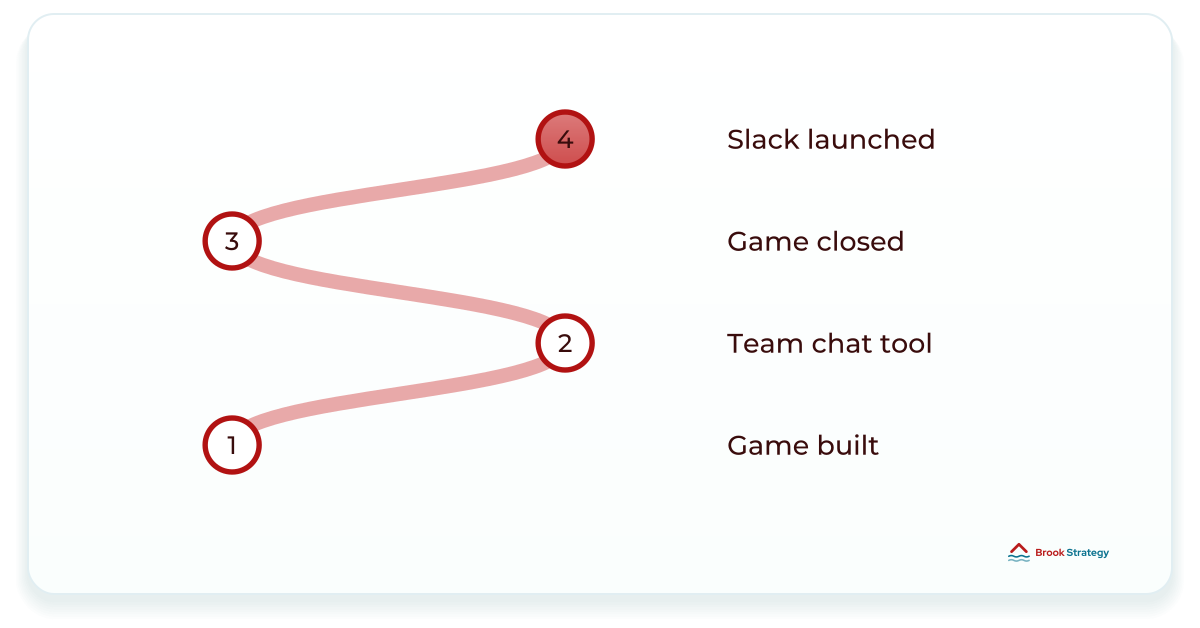
Slack began inside a company called Tiny Speck, which was building an online game called Glitch. The team built an internal messaging tool to coordinate its own distributed work. When the game closed, the team saw that the tool was the stronger product and rebuilt the company around it, launching Slack publicly in 2014.
The strategy lesson is about reading your own usage. The team had used the tool for months, knew its flaws and could feel what was missing, which is a form of customer evidence most companies never get. Slack then paired the product with a free plan that let any team start, with limits that nudged active teams toward paid plans. The pivot worked because the team compared the evidence in front of it with its original plan, and chose the evidence.
Steps behind the pivot
- Review what your team uses daily and what customers use daily, and compare the two lists.
- Ask whether a side project or internal tool solves a bigger problem than your main product.
- Test the new direction with a small group of outside teams before you commit.
- Set the free plan limits around real usage, so active teams reach the paid tier naturally.
- Retire the old plan publicly, so the company stops splitting its attention.
Tools for Reading Your Own Usage
Pendo and Amplitude show which features your own people use every day. Canny helps you compare that with what customers request.
The path shows how small the first signal was.
Notion
Notion went through a reset in its early years. According to the company’s own account, the founders rebuilt the product from scratch after the first version didn’t work technically or commercially, with a small team working in Kyoto, Japan, before they relaunched. The relaunch focused on a flexible building-block approach: pages and databases that a team could shape for notes, tasks and wikis.
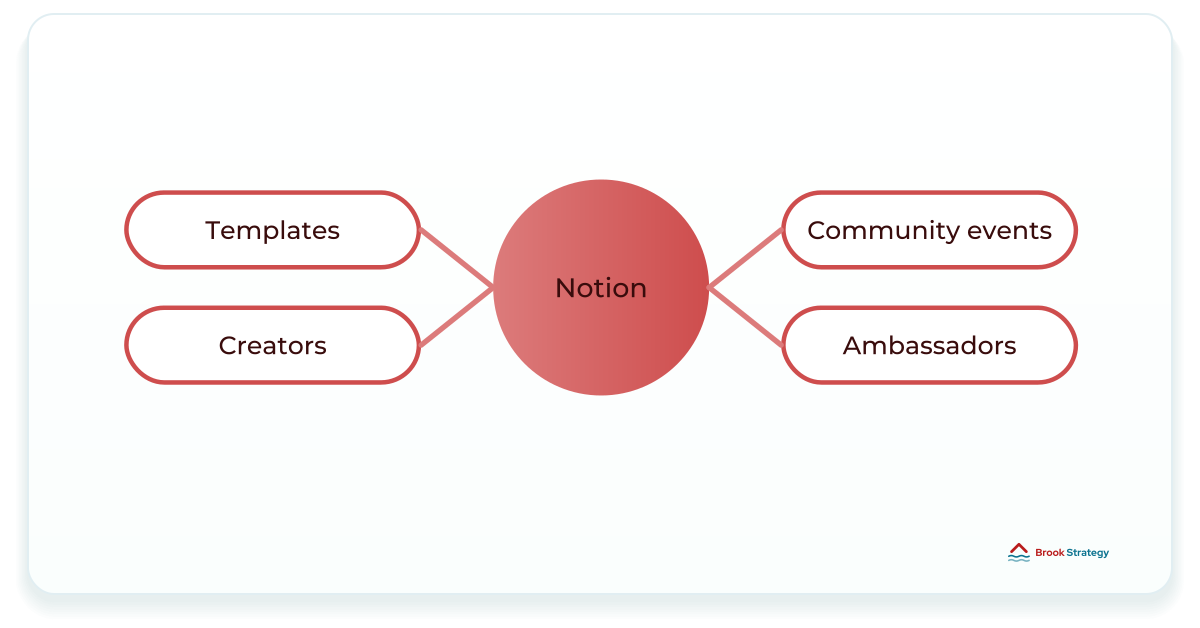
The strategic choice was to grow through community and templates. Users shared how they organized their work, others copied the setups and the product spread through use rather than advertising. That strategy has a cost: because Notion does so many things, it is harder to position than a tool with one job, and the company has had to keep explaining what it is for. For your own product, the takeaway is a trade-off to price in, not a recipe to copy.
Steps in the reset
- Decide which version of the product you would build if you knew what you know now.
- Strip the roadmap to the one building block that makes everything else possible.
- Make the product easy to share, so customers show others what they built.
- Publish templates that show common uses and lower the cost of the first success.
- Keep a short list of use cases to anchor your positioning as features grow.
Tools for Building Templates
Notion itself is a natural place to draft templates, and Miro works for mapping the use cases they serve. Pendo can show which template a new user starts from.
Community assets did the work that ads usually do.
Stripe
Stripe chose developers as its first customer. Before Stripe, accepting online payments meant lengthy contracts with banks and payment gateways and clumsy integration work. Stripe launched in 2011 with an API that a developer could integrate in a short time, and documentation written for the people who would actually use it.
The strategy is a segment choice with a long tail. Developers were small buyers at first, but they decided which payment tool a new business used. As those businesses grew, Stripe grew with them and added products for billing, fraud and, later, financial services. A fintech product team can read this as a case for winning the people who influence the buying decision early, and for letting the first product open the door to the next.
Building the developer path
- Identify who actually picks the tool inside your target customers.
- Remove every step between that person and a working result.
- Treat documentation and sample code as part of the product.
- Price in a way that lets small customers start and large ones scale.
- Add the next product only when the first has a loyal base asking for it.
Tools for Developer Onboarding
Amplitude funnels show how long users take to reach a first working result. Linear or Jira Product Discovery can hold the fixes to documentation and setup.
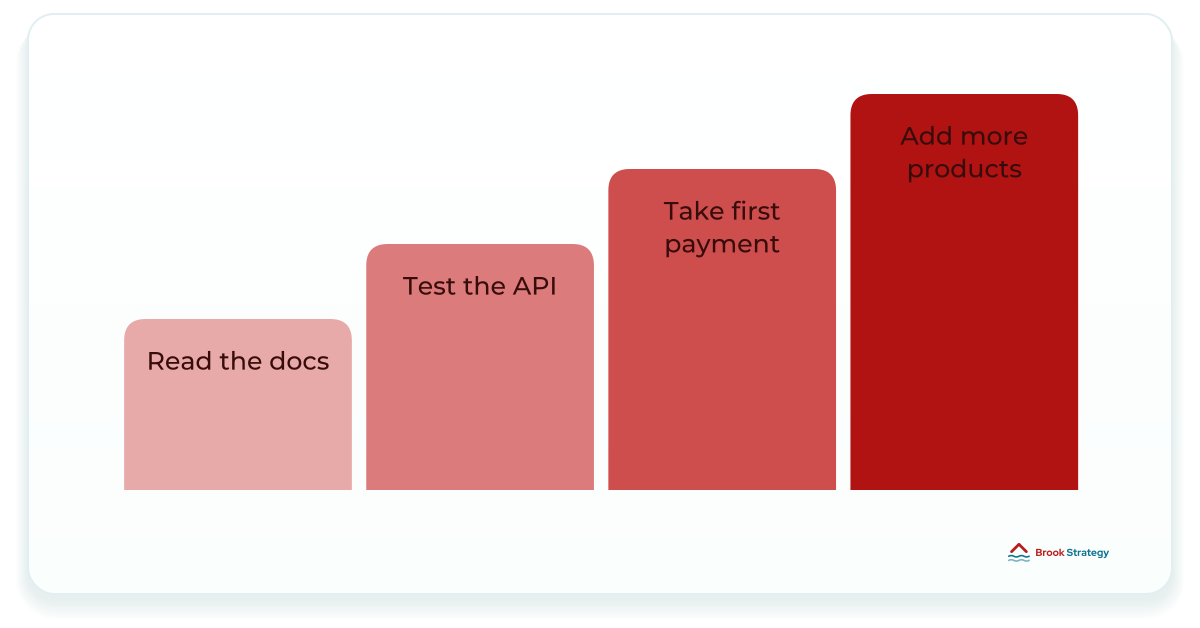
Each step gave the developer a reason to take the next.
Atlassian
Atlassian built a large business on a model that most software companies of its time avoided: no outbound sales team in the early years. Customers found the products, tried them and paid by credit card through the website, with transparent prices. The founders have described this approach publicly as a response to the cost and friction of traditional enterprise selling.
The strategic insight is that the go-to-market model is part of the product strategy. Because the company could not rely on salespeople to explain complex products, it had to build products that explained themselves and that teams could adopt from the bottom up. As customers grew, Atlassian added enterprise features and sales support on top. If your market allows self-serve adoption, the example shows that low-touch can reach large customers when the product spreads inside teams first.
How low-touch selling works
- Check whether the buyer can try the product without talking to anyone.
- Publish prices so a team lead can approve a purchase without a procurement process.
- Design the first week of use so a small team sees value on its own.
- Track expansion inside accounts, since users bring in more teams.
- Add sales support for large accounts after the self-serve base is working.
Tools for Self-Serve Funnels
Amplitude and Pendo track the steps a customer completes without help. Pipedrive or HubSpot can handle the accounts that later need a sales conversation.
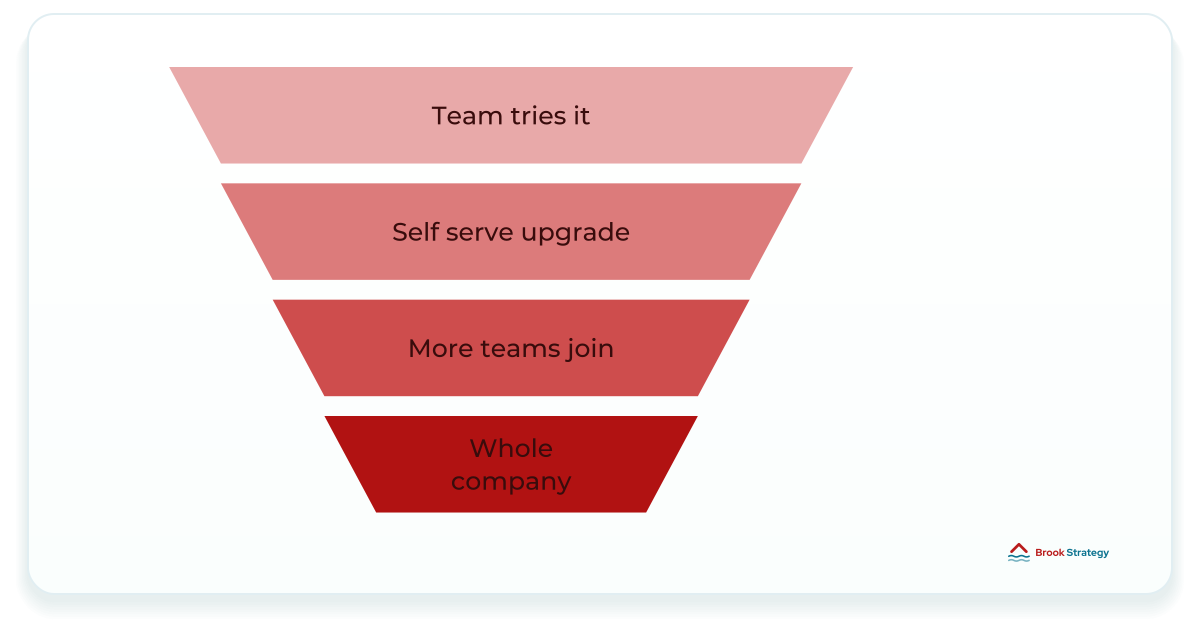
The funnel runs without a sales conversation.
Superhuman
Superhuman, the email client, became known for how it measured product-market fit. Founder Rahul Vohra described the approach publicly: ask users how they would feel if they could no longer use the product, and track the share who say very disappointed. The benchmark of 40% comes from Sean Ellis’s earlier work on startups, and Superhuman used it as a target.
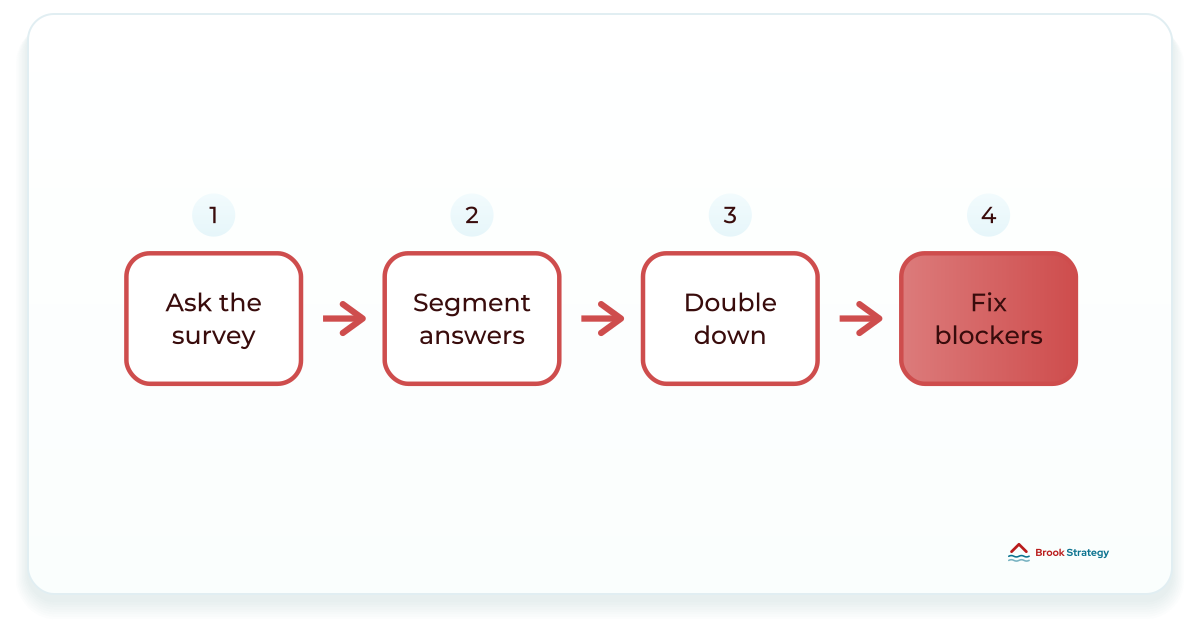
The strategy goes beyond the survey. The team segmented the answers to find which users loved the product, defined that group as the target, and used the reasons that others hesitated to set the roadmap. Half of the effort went to what the loving users valued most and half to the objections of the nearly convinced. The score rose over several quarters, and the team had a number to show for it. The lesson is that a clear measure can turn a vague goal into a sequence of decisions.
Running the survey as a strategy tool
- Ask a representative group of active users how they would feel without the product.
- Calculate the share who answer very disappointed and compare it with the 40% benchmark.
- Study who the very disappointed users are, and define your target around them.
- Collect what the nearly convinced users say is missing.
- Split roadmap time between strengthening the main value and removing the main objections.
Tools for Running the Survey
Pendo has in-app surveys that suit the very disappointed question, and Canny can collect the follow-up requests. Amplitude lets you split the answers by user segment.
The survey only matters if the answers change the roadmap.
Intercom
Intercom started as a messenger for customer conversations and grew into a broader customer service platform. In 2023, shortly after large language models became widely available, the company launched Fin, an AI agent that answers customer questions using a company’s own help content. The company then reshaped its positioning and its pricing around resolved conversations.
The strategic move was to treat a technology shift as a product reset. Intercom had years of conversation data, a base of support teams as customers and a clear job to be done: resolve customer questions. Instead of adding an assistant as a feature, it made the agent the center of the product and aligned pricing with the outcome. The risk of this kind of move is the transition: existing customers and existing revenue lines may not move at the same speed as the new strategy.
Rebuilding around a shift
- List the assets you hold that a new technology makes more valuable, such as data and distribution.
- Define the job the customer wants done, and write the outcome in one sentence.
- Prototype the new approach with a small group of customers.
- Align pricing with the outcome, so customers pay when the job gets done.
- Plan the transition for existing plans and customers before the launch.
Tools for Testing a New Offer
Productboard can tie feedback from pilot customers to the new bet, and Miro supports workshops on pricing options. Amplitude shows whether pilot customers use the new flow.
What the Seven Plays Have in Common
Put side by side, the examples share a pattern. Each team chose a customer narrowly, removed a specific friction and let usage prove the choice before widening the product. None started with a feature list. Each also paid a price: Figma gave up the desktop world, Slack gave up its game, Notion gave up a simple positioning and Intercom accepted a messy transition.
I also see a pattern in how the plays connect to planning. A strategy of this kind has to be turned into dated work, and my product strategy roadmap article shows how to do that over twelve months. Early teams with little budget will find a lighter version in product strategy for startups.
| Pattern | Where you can see it | Check in your own product |
|---|---|---|
| Narrow first customer | Figma, Stripe, Superhuman | Can you name one segment in a sentence? |
| Evidence before commitment | Slack, Superhuman | Which two sources support your top bet? |
| Distribution built into the product | Figma, Notion, Atlassian | Does using the product show it to a second person? |
| A visible trade-off | Notion, Intercom | What are you giving up this year? |
How to Choose Which Example to Learn From
Pick the example closest to your current decision, not the one with the best story. I suggest you match them like this:
- Unsure whether your product is right for the market: Slack and Superhuman.
- Choosing a first customer segment: Figma and Stripe.
- Deciding how customers should buy: Atlassian.
- Facing a technology shift: Intercom.
- Rebuilding after a poor start: Notion.
Once you have an example, check the tools that could support the method. My ranking of product management tools compares options for roadmaps, feedback and analytics, with prices and user ratings.
Questions About Product Strategy Examples
What Makes a Product Strategy Good?
A good product strategy names a target customer, a problem worth solving, a way to win and a list of things you will not do. It also carries a metric, so you can tell if it works. The examples in this article each show one or two of these elements clearly, which is why I picked them.
Which Example Fits an Early-Stage Startup Best?
Slack and Superhuman are the most useful for early teams. Slack shows how to read your own usage and pivot, and Superhuman shows how to measure fit with a simple survey. Both need very little budget. Stripe is also relevant if you sell to developers.
Which Example Fits a Fintech or Financial Services Product?
Stripe is the closest, since it won a regulated, trust-heavy category by choosing one influencer segment and simplifying integration. Intercom is a good second example if you are rethinking your service model around a new technology.
Can I Copy Another Company’s Product Strategy?
Copying the outcome rarely works, because your customers, timing and resources differ. Copy the method: the question each company asked, the evidence it used and the trade-off it accepted. Then test the result with your own customers before you commit budget.
How Do I Find Out What a Company’s Strategy Really Was?
Use first-hand sources: founder interviews, company blog posts, investor letters and talks. Treat journalists’ summaries as secondary, and watch for hindsight, because stories get tidier after success. I stick to what the companies have said themselves and flag where details are unclear.
How Many Strategic Bets Should a Product Team Run at Once?
Three to five is a workable range for most teams. Each of these companies concentrated effort on one or two things at a time: a segment, a pivot or a product. If your list is longer, rank by evidence and cut from the bottom.
Where Should I Start If I Have No Strategy Yet?
Start with the customer you want to serve and one problem they have, then write down the evidence for it. My framework article walks through the order, and a short call with a strategist can speed up the evidence phase.
Note: This article is general information, not legal, financial or tax advice. Figures and examples are estimates based on typical projects, so check current details with your providers and advisers before you decide.
Was this article helpful?
Thank you for letting us know.
Russell Tennant
Russell leads the Brook editorial team and works with our consultants to turn real client engagements into practical guides on roadmaps, go-to-market planning, growth and competitive strategy. Before joining Brook, he spent 11 years in strategy and product marketing roles at software and financial services companies. He has since edited more than 300 articles on strategy practice and drawn on roadmaps and growth plans from over 100 client projects. He is based in Denver, Colorado.