Key Takeaways
- A startup strategy fits on one page: first customer, problem, way to reach them and a list of things you will ignore.
- Talk to eight to fifteen customers before you build, and include people who tried your product and left.
- Build the smallest product that delivers one full result, then measure activation and retention before you add features.
- Review the page every month, and pivot only when a written comparison of evidence supports it.
Founders often get two opposite pieces of advice: write a detailed strategy, and ignore strategy because speed is everything. Both are half right. A thirty-page document written before you have customers is fiction, but running without any written choices means every week brings a new direction, and a small team can’t afford that.
My middle path is a one-page strategy that you test and rewrite often. I have used it with early-stage teams in my product strategy consulting work, and the structure below fits most software and fintech startups. It sets out what to decide, in what order and what to leave for later.
The One-Page Startup Product Strategy
Write these six answers on a single page and share it with everyone on the team. Each answer should be one or two sentences. If it takes a paragraph, you haven’t decided yet.
| Section | Question | Example answer |
|---|---|---|
| First customer | Who is the one group you serve first? | Bookkeepers at small accounting firms in the US |
| Problem | What do they struggle with today? | Chasing clients for documents at tax time |
| Solution bet | What do you believe will fix it? | A shared checklist that clients fill in themselves |
| Way to reach them | Where will you find ten of them? | Accounting forums and a partner’s newsletter |
| Proof you need | What result tells you to continue? | Five firms pay after a 30-day trial |
| Ignore list | What will you not do this quarter? | Mobile app, integrations, enterprise plans |
Choose One Customer and Talk to Them Before You Build
Pick a segment narrow enough that its members have the same problem and hang out in the same places. “Small businesses” is not a segment. “Independent physiotherapy clinics with two to five therapists” is. A narrow segment is easier to interview, easier to reach and easier to build for, and you can widen later.
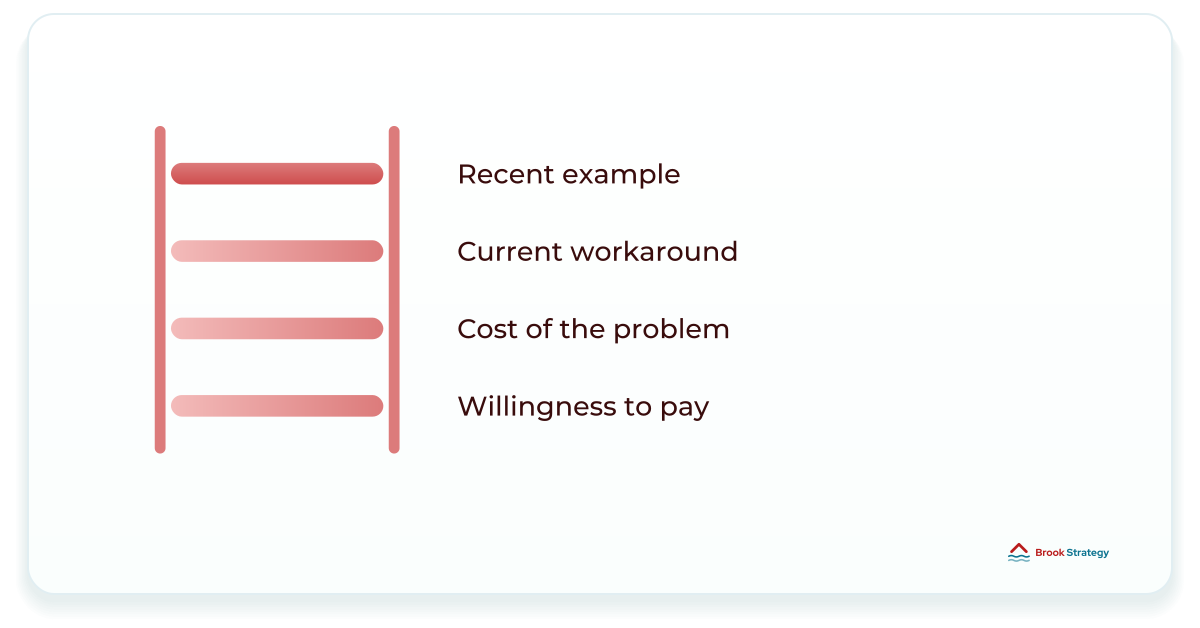
Interview eight to fifteen people. Ask about the last time they faced the problem, what they did, what it cost and what they tried. Avoid asking whether they would use your idea, since people are polite and answers about the future are unreliable. Past behavior tells you what they really do. The founders I advise often learn more from the first five calls than from months of building, and the learning is cheap.
Test the Problem Before You Test the Product
A problem worth building for has three signs: customers already spend money or time on it, they have tried to fix it themselves and the pain shows up in a metric they care about. If you can’t find all three, go back to interviews.
Once you have a problem, test your solution with the cheapest tool that can show real behavior. A landing page with a waiting list, a clickable prototype, a manual service run by you or a pilot with three customers all work. The best test asks customers for something real: time, an introduction or money. A pre-order is stronger evidence than ten compliments.
Build the Smallest Product That Delivers One Full Result
Count the steps from sign-up to the first result a customer cares about, then delete everything that isn’t on that path. A tool that handles one workflow from start to finish beats one that handles five workflows halfway. Customers don’t judge you on the length of your feature list. They judge whether they got the result.
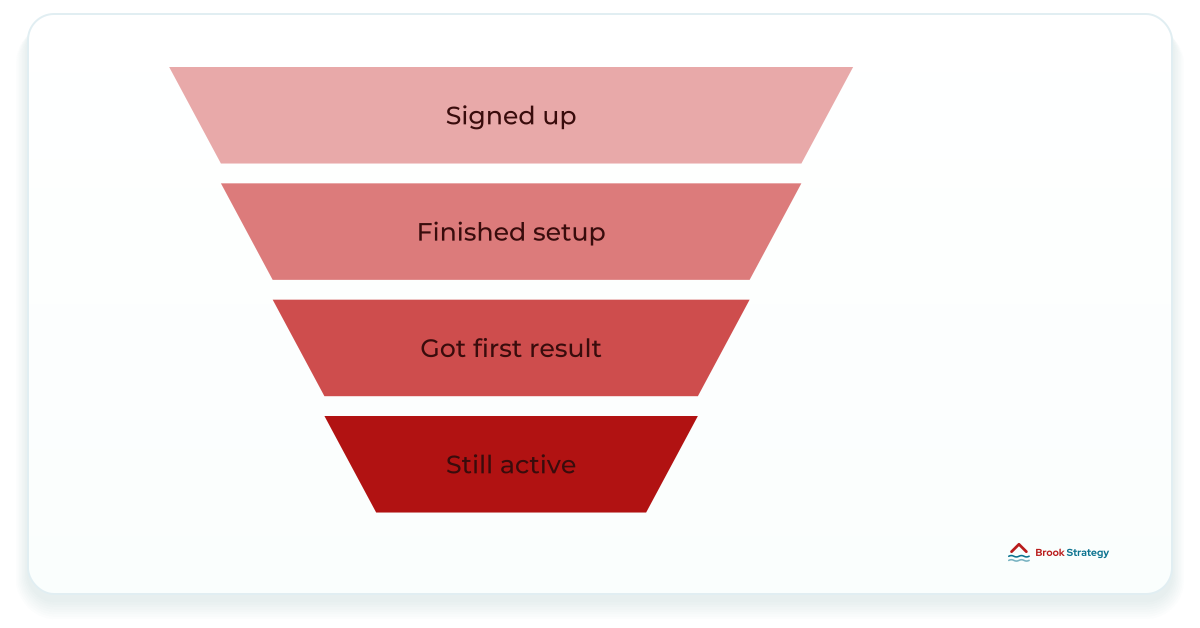
Set three numbers before launch: how many people sign up, how many reach the first result (activation) and how many come back in week four (retention). These tell you more than revenue in the early months. If activation is low, the product or onboarding is the problem. If activation is good and retention is low, the result isn’t valuable enough to repeat.
Decide What You Will Ignore
The ignore list is the most useful part of the page, and the one founders resist. Early customers will ask for integrations, custom reports and extra user roles. Each request feels small, and together they take the whole team for six months. Writing the list means you can say, “That’s on our list for later, and here is what would move it up.”
Review the list monthly and move an item up only when three customers in your first segment ask for it and the request supports your proof metric. That rule is deliberately strict. It keeps you from building for one loud customer, which is how a focused startup becomes a custom software shop.
Put a Price on It Early
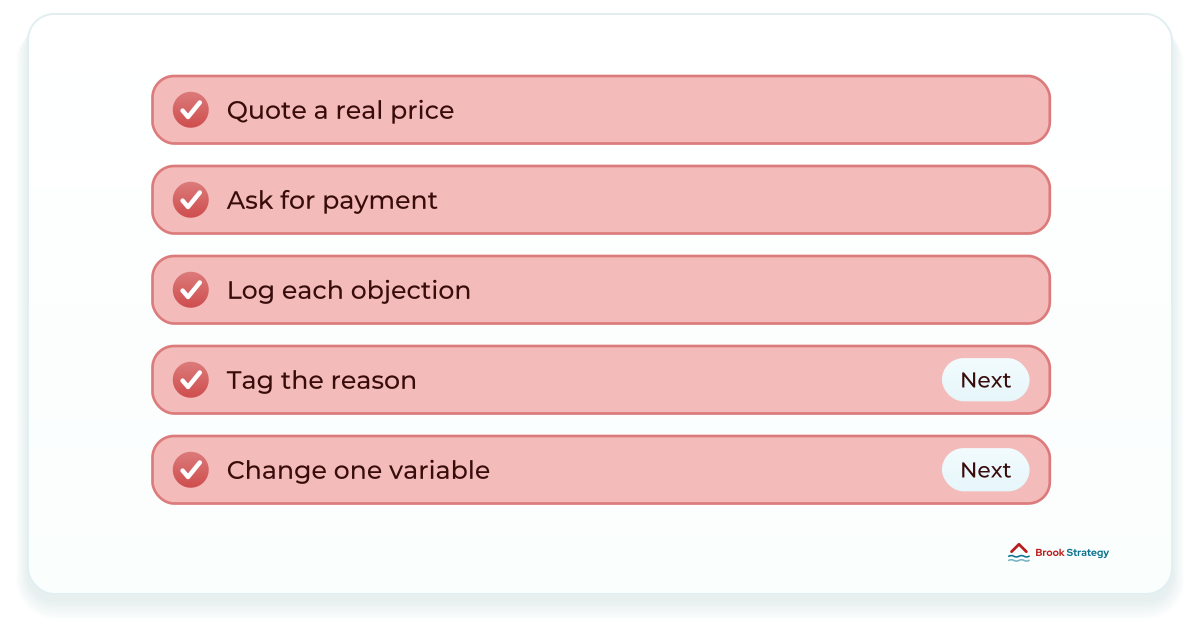
Many founders delay pricing until the product feels finished, and lose their best source of evidence. A price is a question you ask the market: how much is this problem worth? Start with a number that feels slightly uncomfortable and test it with the first ten customers. If nobody objects, you are probably too low.
Keep the structure simple. One or two plans, priced per user or per account, with a clear limit that moves active teams to the higher plan. Complex tiers and usage meters can wait until you know how customers actually use the product. Record every price objection verbatim. After twenty conversations the pattern tells you whether the issue is the price, the packaging or the value you communicate. In my experience it is the last one more often than founders expect.
What to Focus On at Each Stage
Strategy needs change as the company grows. This table shows the main focus, the main metric and the common trap at each stage.
| Stage | Main focus | Metric to watch | Common trap |
|---|---|---|---|
| Idea | Find a real problem in one segment | Interviews completed | Building before talking |
| Prototype | Test the solution with real behavior | Pre-orders or pilots | Counting compliments |
| First customers | Deliver one full result | Activation and week-four retention | Adding features for one customer |
| Early traction | Repeat sales and sharpen positioning | Paid conversion and payback time | Chasing a second segment too early |
| Scaling | Plan bets and sequence a roadmap | Net revenue retention | Skipping a written roadmap |
When you reach the scaling stage, a written plan becomes useful, and my product strategy roadmap article gives you a four-quarter template. Before then, a monthly review of your one page is plenty. If you want a more structured model for choosing between bets once you have several, the product strategy framework covers scoring and review.
Know When to Change Course
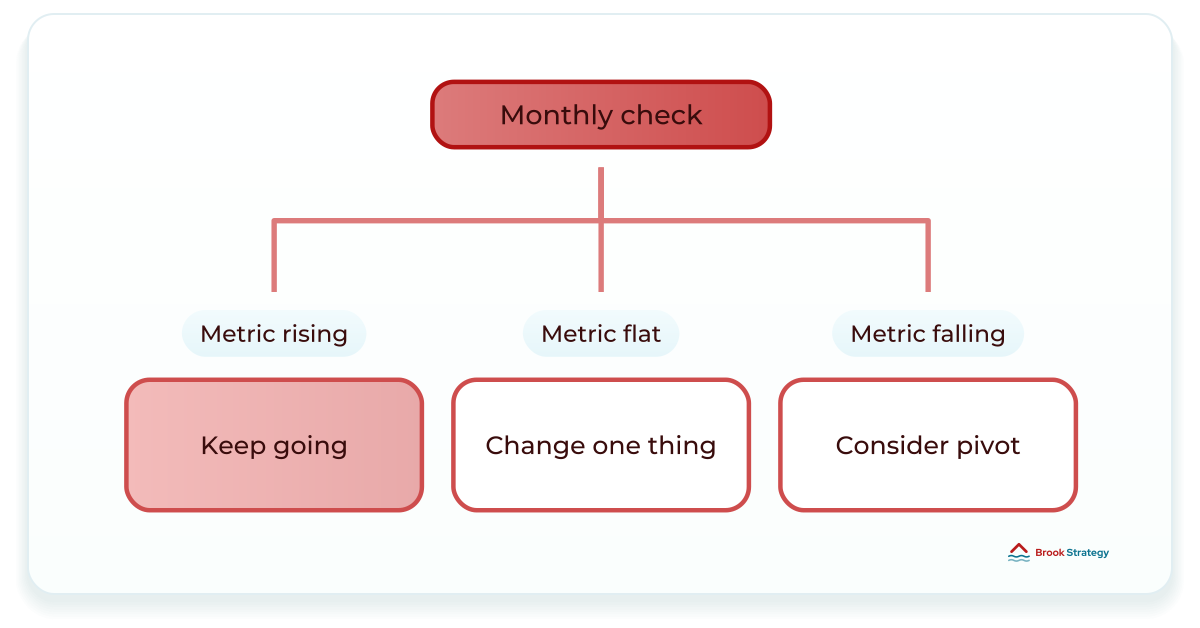
Pivots deserve discipline. Set a decision date when you set the proof metric: “If five firms haven’t paid by March 31, we review.” On that date, write down what you saw, the options and the case for each. Look especially for a use case that customers pull you toward that you didn’t plan, since it is often the stronger business.
Seeing how others made these calls helps. My collection of product strategy examples includes Slack’s change from game to workplace tool, a good study of a pivot that followed evidence.
A last point on cadence. Put a fixed monthly hour in the calendar for the one-page review, and invite the whole team. Read the page aloud, mark every answer that changed since last month and write down why it changed. Over a year this record becomes your most valuable asset, since it shows how your understanding of the customer grew, and it lets a new hire catch up in an afternoon rather than a month.
Lean Tools for a Small Team
Resist the urge to buy a stack. A shared document, a spreadsheet for interviews and a simple tracker are enough to start. When you need more, free tiers go a long way: Linear and Notion both have free plans, and Miro suits workshops. I rank the main options, with prices and ratings, in my review of product management tools.
The Mistakes That Waste the Most Runway
From the teams I have worked with, five mistakes cost the most. Building for months before speaking to a customer is the first. Choosing a segment so broad that no message fits anyone is the second. Treating feature requests as strategy is the third. Tracking revenue only, when activation and retention would warn you earlier, is the fourth. Skipping the written ignore list is the fifth, and it feeds the other four.
How to Choose Your Next Step
Pick the step that matches where you are:
- No customers yet: write the one page and book your first five interviews.
- Interviews done: choose one problem and design the cheapest test.
- A product with weak activation: map the path from sign-up to first result and cut what isn’t on it.
- Early revenue but scattered requests: write the ignore list and the three-customer rule.
If you want an outside view on your page, a short call with a strategist can find gaps in an hour.
Questions About Product Strategy for Startups
Does a Startup Need a Product Strategy?
Yes, but a short one. In the early days a strategy is a few written answers: who your first customer is, which problem you solve for them, how you will reach them and what you will ignore for now. If you can write those on one page and update the page monthly, you have enough.
How Is Startup Product Strategy Different from Big-Company Strategy?
A startup has less data, less money and more freedom to change course. The strategy therefore leans on fast tests with real customers rather than long analysis. Big companies spend more effort on alignment and portfolio choices. A startup spends it on finding out whether anyone cares enough to pay.
When Should a Founder Hand Over Product Decisions?
Usually when the product has a clear direction and the founder is the bottleneck, which often happens between ten and thirty people. Before handing over, write down the strategy page and the decision rules, so the new product lead inherits the reasoning and not only the backlog.
How Many Customer Interviews Do I Need?
Eight to fifteen interviews in one segment usually reveal the main patterns. If answers vary widely, your segment is too broad, so narrow it and interview again. Keep going until new interviews stop teaching you anything new, and include at least a few people who tried the product and left.
What Is the Right Number of Features for an MVP?
As few as it takes to deliver one complete result for one customer type. Count the steps from sign-up to the first result, and remove everything that isn’t on the path. A smaller product that works end to end teaches you more than a wide product that does everything halfway.
How Do I Know When to Pivot?
Look at the evidence: customers who use the product but won’t pay, a metric that stays flat for three or four tests, or a stronger signal from a use case you didn’t plan. A pivot should follow a written comparison of the current plan and the alternative, based on what you saw, not on fatigue.
What Should I Track in the First Year?
Pick one metric per stage: activation for early users, retention for fit and revenue or paid conversion once fit shows. Three or four numbers reviewed weekly beat a dashboard of twenty. Add a metric only when you know which decision it will inform.
Note: This article is general information, not legal, financial or tax advice. Figures and examples are estimates based on typical projects, so check current details with your providers and advisers before you decide.
Was this article helpful?
Thank you for letting us know.
Russell Tennant
Russell leads the Brook editorial team and works with our consultants to turn real client engagements into practical guides on roadmaps, go-to-market planning, growth and competitive strategy. Before joining Brook, he spent 11 years in strategy and product marketing roles at software and financial services companies. He has since edited more than 300 articles on strategy practice and drawn on roadmaps and growth plans from over 100 client projects. He is based in Denver, Colorado.