Key Takeaways
- Competitor trackers such as Prisync and Price2Spy are the quickest way for online sellers to see where they stand on price.
- ProfitWell Metrics is a free way for subscription businesses to measure plan performance before changing prices.
- Enterprise platforms such as Pricefx, PROS, Vendavo and Zilliant suit complex B2B pricing, and take months to implement.
- Write down your pricing strategy first, because a tool only applies the rules you give it.
The Best Pricing Strategy Tools at a Glance
| Tool | Type | Best for |
|---|---|---|
| 1. Prisync | Competitor price tracking | Online sellers tracking rivals daily |
| 2. Price2Spy | Price monitoring and repricing | Retailers and brands watching prices and MAP compliance |
| 3. ProfitWell Metrics by Paddle | Subscription analytics | SaaS teams that want free revenue metrics |
| 4. Competera | Retail pricing platform | Retailers with large catalogs and pricing teams |
| 5. Omnia Retail | Dynamic pricing for retail | Retailers and brands that want rule-based repricing at scale |
| 6. Pricefx | Enterprise pricing software | Mid-size and large B2B firms with complex price lists |
| 7. PROS | AI pricing and revenue optimization | Large enterprises in complex or fast-moving markets |
| 8. Vendavo | B2B pricing and margin management | Manufacturers and distributors managing margin |
| 9. Zilliant | B2B price optimization | Mid-size B2B firms wanting guided deal pricing |
| 10. Chargebee | Subscription billing and plan management | SaaS firms testing plans and billing models |
The 10 Best Pricing Strategy Tools, Ranked
I start with tools that suit the widest range of teams and move toward enterprise platforms, so you can stop reading once you find your fit. Keep in mind that the tool is only part of the result: in pricing strategy consulting projects, deciding what to charge and why matters more than the software that records it. If you have not set that logic yet, start with my pricing strategy framework.
Prisync
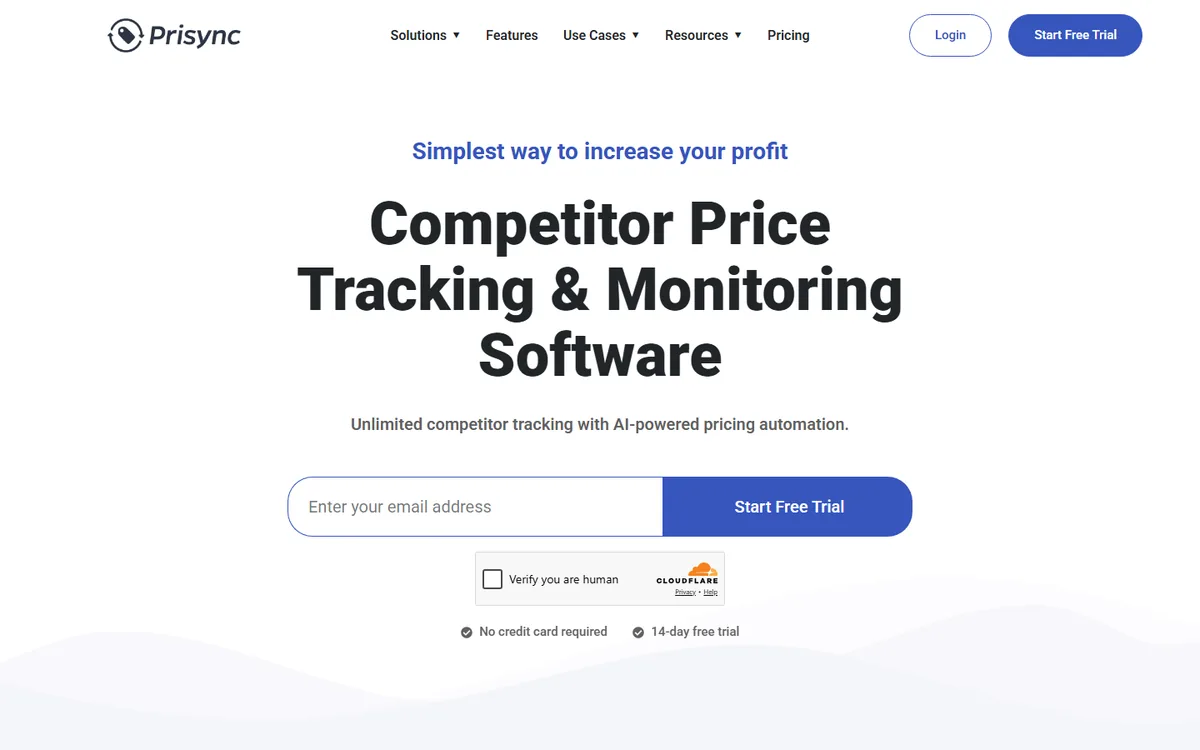
A Straightforward Competitor Price Tracker for Online Sellers Who Want Alerts and Repricing Rules
Prisync tracks competitor prices and stock levels across the web and adds dynamic pricing rules on top.
Prisync monitors competitor product pages, sends daily alerts and reports and lets you set rules that reprice your own products. It is built for ecommerce teams that need to know when a rival changes a price, and what to do about it.
In my experience, it suits small and mid-sized shops best, because setup is simple and plans are priced by the number of products you track. The catch is upkeep. You have to maintain the competitor URLs you follow, and some sites block tracking or return a wrong price, so plan a weekly check of your matches. It tells you what rivals charge, and it does not tell you what your own price should be, which is where your strategy comes in.
Pros of Prisync
- Clear flat plans based on the number of products
- Daily alerts and reports that show competitor moves
- Repricing rules you can apply once your strategy is set
Cons of Prisync
- Setting up and maintaining competitor URLs takes time
- Some sites block tracking or show the wrong price
Prisync Pricing
Prisync lists three flat-rate plans: Professional at $99 per month for up to 100 products, Premium at $199 per month for up to 1,000 products and Platinum at $399 per month for up to 5,000 products. A free trial is available.
Prisync Reviews
- G2: 4.7/5 average (from +170 reviews)
- Capterra: 4.8/5 average (from +120 reviews)
Price2Spy
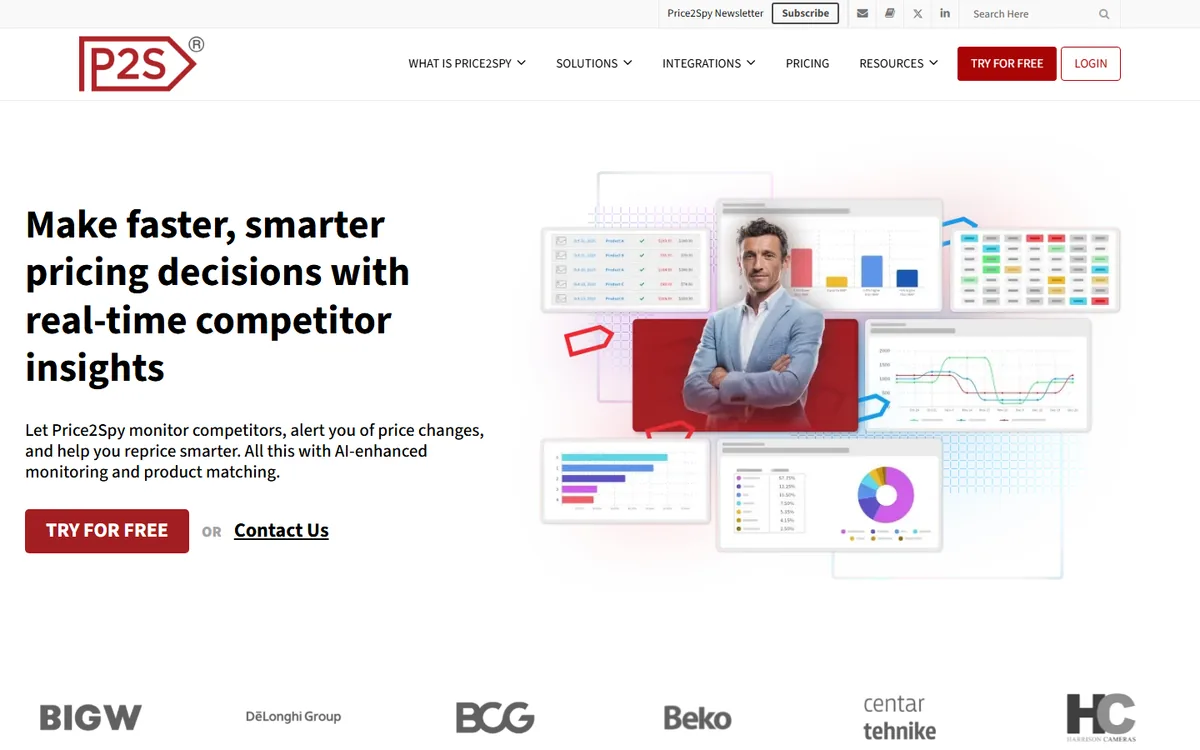
A Flexible Price Monitoring Service for Retailers and Brands That Track Many Competitors
Price2Spy monitors competitor prices and promotions and supports repricing and brand price compliance.
Price2Spy collects prices from competitor sites and marketplaces, then shows how you compare, with alerts when something changes. It also offers repricing rules and tools for brands that want to watch how resellers advertise their products.
I point retailers with large catalogs to Price2Spy when they need more flexibility than a basic tracker gives. Plans scale with the number of products and how often you check them, which helps if you only need frequent checks on part of your range. The trade-off is that the many options take some time to learn, and the price rises quickly if you track a large catalog at high frequency.
Pros of Price2Spy
- Plans scale by product count and check frequency
- Covers repricing and brand price compliance
- Strong user ratings on both G2 and Capterra
Cons of Price2Spy
- Many options mean a longer learning curve
- Costs can climb with large catalogs and frequent checks
Price2Spy Pricing
Price2Spy has no permanent free plan, but a free trial is available. G2 lists a Basic plan at $157.95 per month and a Premium plan at $947.95 per month. Prices change with product count and check frequency, so confirm the current figure on the vendor site.
Price2Spy Reviews
- G2: 4.8/5 average (from +100 reviews)
- Capterra: 4.7/5 average (from +100 reviews)
ProfitWell Metrics by Paddle
The Best Free Starting Point for SaaS Teams That Need Clean Subscription Metrics Before They Change Prices
ProfitWell Metrics is a free subscription analytics tool that now sits under Paddle.
ProfitWell Metrics connects to your billing system and reports revenue, churn, upgrades and customer segments in real time. For pricing work, those numbers show which plans bring in revenue, where customers downgrade and how a change affects retention.
I recommend it as the first tool for any subscription business that has not looked at its plan data in months, because it costs nothing and takes little setup. It does not recommend prices or run experiments for you, so treat it as the measuring stick you use before and after a change. Paddle also sells a payments and billing platform, so expect some product messages along the way.
Pros of ProfitWell Metrics by Paddle
- Free to use, with real-time subscription metrics
- Segment views show which plans and customers drive revenue
- Useful baseline before and after a price change
Cons of ProfitWell Metrics by Paddle
- It reports on pricing and does not recommend prices
- Best suited to subscription businesses only
ProfitWell Metrics by Paddle Pricing
Paddle describes ProfitWell Metrics as real-time subscription analytics that is 100% free. Paddle's own payments platform is separate, with pay-as-you-go pricing of 5% plus 50 cents per checkout transaction and custom pricing for high-volume businesses.
ProfitWell Metrics by Paddle Reviews
- G2: 4.5/5 average (from +230 reviews for Paddle)
- Capterra: 3.0/5 average (from +20 reviews for Paddle)
Competera
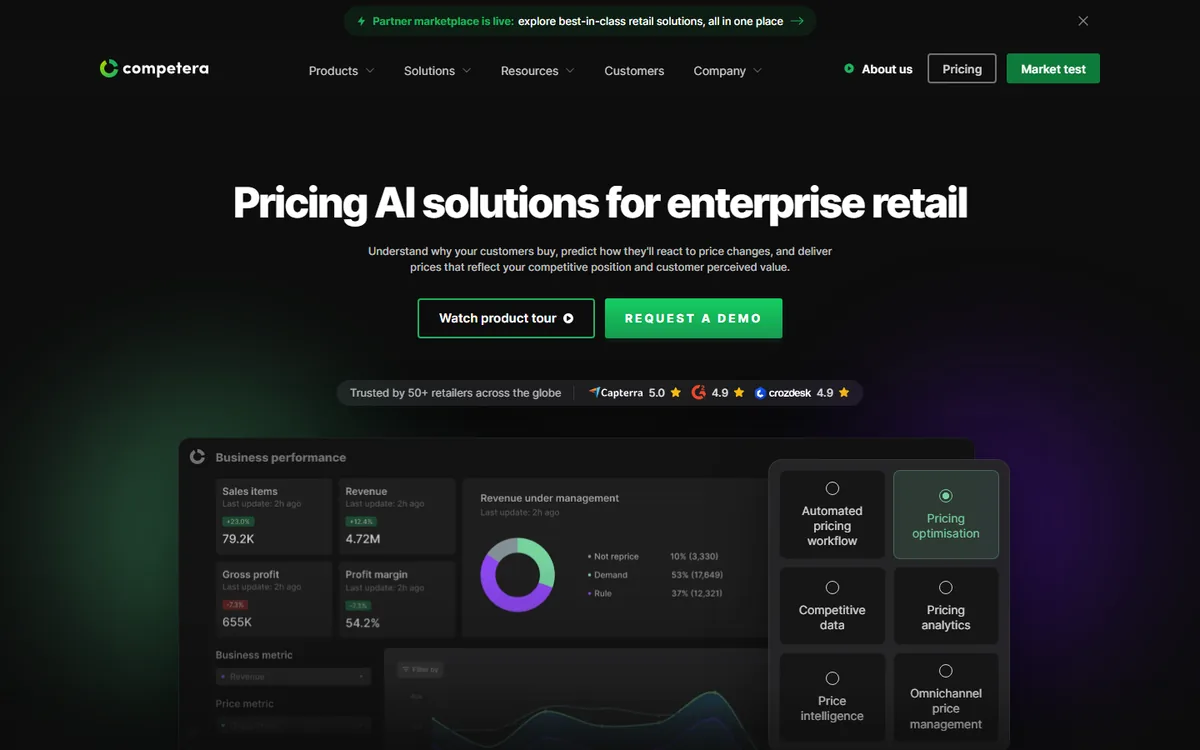
A Retail Pricing Platform for Teams That Want Demand-Based Recommendations, Not Just Competitor Alerts
Competera combines competitor data with demand modeling to recommend prices for large retail catalogs.
Competera pulls in competitor prices, then models how demand responds to price for each product and suggests changes that fit your goals and rules. It is built for retailers with large catalogs and a dedicated pricing team.
In my view, it is a step above plain price tracking, since it tries to estimate what a price change will do to sales and margin. That comes with trade-offs: it needs a clean product and sales history, a pricing team to use it and a budget to match. For a small shop, a tracker is usually enough. For a retailer with thousands of products and tight margins, the modeling can be worth the cost.
Pros of Competera
- Recommends prices using demand and not just rival prices
- Rules let you set margin and price position limits
- Very high rating from a small number of G2 reviewers
Cons of Competera
- Priced by custom quote, so budgeting takes a sales call
- Needs a clean sales history and a team to run it
Competera Pricing
Competera does not publish prices. G2 directs buyers to request a custom quote, so expect to book a demo and share your catalog size before you see a number.
Competera Reviews
- G2: 4.9/5 average (from 14 reviews)
Omnia Retail
A Dynamic Pricing Platform for Retailers That Want Rules and Competitor Data in One Place
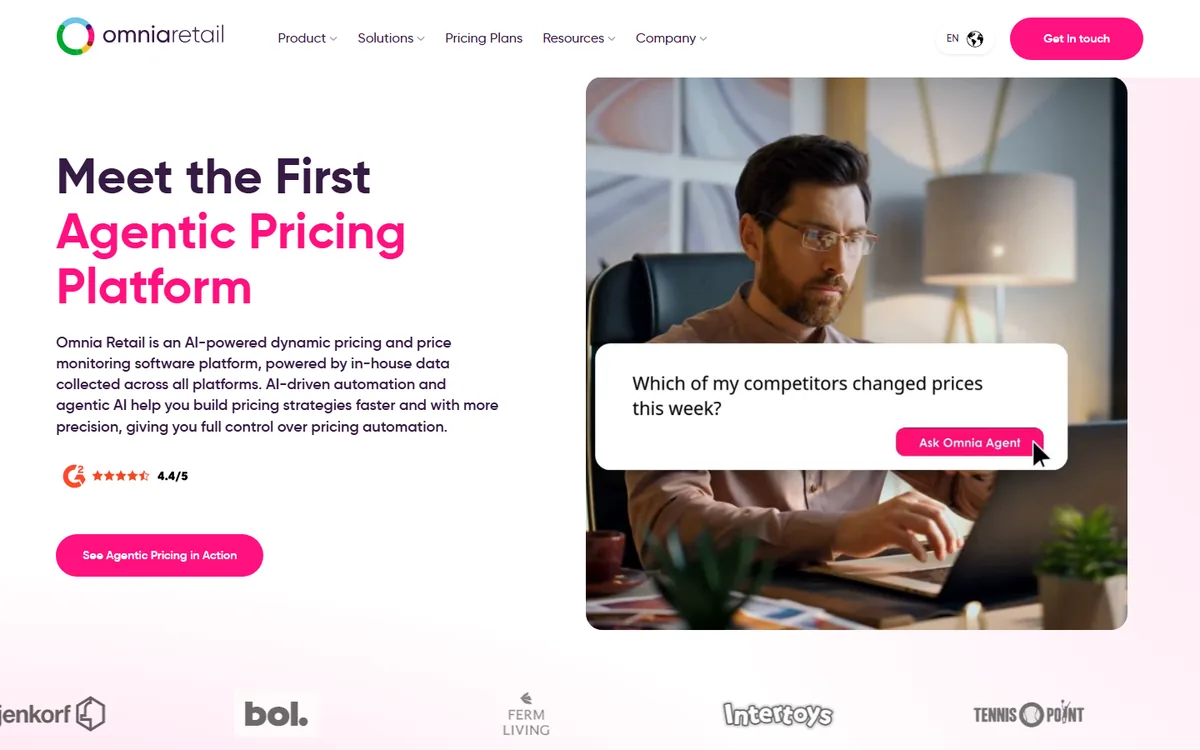
Omnia Retail combines competitor price data with rule-based repricing for retailers and brands.
Omnia Retail collects competitor prices and lets you build repricing rules around them, such as matching a rival within a margin limit or holding a price on key products. The platform is aimed at retailers and brands that manage many products across channels.
Reviewers on G2 praise the support team and the ease of setup more than any single feature. That fits what I see: the value comes from setting clear rules first, then letting the platform apply them. Without a clear pricing strategy, the rules simply automate old habits. It is quote-based and priced for teams, so smaller shops may find a simpler tracker a better fit.
Pros of Omnia Retail
- Strong marks from reviewers for quality of support
- Rule-based repricing across large catalogs
- Setup is rated as easy by G2 reviewers
Cons of Omnia Retail
- Pricing is not published
- Rules reflect your strategy, so weak strategy means weak results
Omnia Retail Pricing
Omnia Retail does not publish prices. G2 shows Contact Vendor for pricing, with plans billed per year, and rates perceived cost at the top of its scale. Expect a demo and a custom quote.
Omnia Retail Reviews
- G2: 9.1 out of 10 for quality of support (from 72 responses, no overall star rating confirmed)
Pricefx

A Flexible Pricing Platform for B2B Companies With Complex Price Lists, Rebates and Quotes
Pricefx covers price setting, quotes, rebates and optimization for B2B manufacturers and distributors.
Pricefx is a cloud pricing platform that handles list prices, customer-specific prices, quotes, rebates and price optimization in one system. It is built for B2B companies with thousands of products and many customer deals.
Reviewers describe it as expensive but very flexible, and note that development and support can cost extra. G2 shows an average of about six months to implement and 17 months to return on investment. That matches the pattern I see with enterprise pricing projects: the software is the smaller part, and the real work is cleaning price data and agreeing rules across sales, finance and product teams.
Pros of Pricefx
- Flexible enough to model complex B2B pricing
- Covers quotes, rebates and optimization in one platform
- Used by large manufacturers and distributors
Cons of Pricefx
- Seen as expensive, with extra cost for development and support
- Implementation takes months and internal effort
Pricefx Pricing
Pricefx does not publish prices. Capterra and G2 both say to contact the vendor, and G2 rates perceived cost at the top of its scale, with reviewers noting an average discount of about 11%.
Pricefx Reviews
- G2: 4.4/5 average (from +130 reviews)
- Capterra: 4.1/5 average (from 10 reviews)
PROS
An Enterprise Pricing and Revenue Platform for Large Companies With Complex, Fast-Moving Pricing
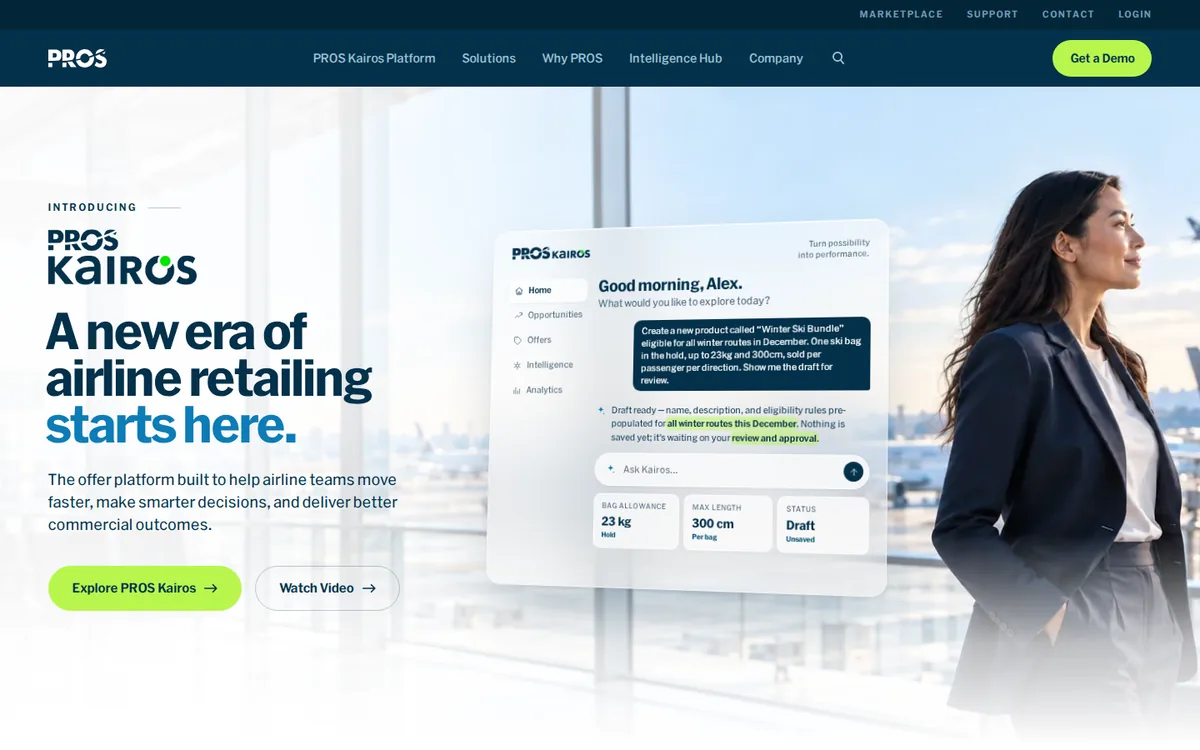
PROS applies optimization models to pricing, quoting and revenue management for large companies.
PROS offers pricing, configure-price-quote and revenue optimization software for large organizations in industries such as airlines, distribution and manufacturing. Its models recommend prices and discount limits based on deal and demand data.
PROS fits when pricing decisions are frequent, high in value and too complex for a spreadsheet. G2 shows an average of about eight months to implement and 21 months to see a return, so it is a long-term commitment. I would not recommend it to a company that has not yet cleaned up its price data or agreed who owns pricing decisions.
Pros of PROS
- Optimization models for complex pricing decisions
- Covers pricing, quoting and revenue management
- Recognized by reviewers in the enterprise pricing category
Cons of PROS
- Long implementation and slow return on investment
- Priced and scoped for large enterprises only
PROS Pricing
PROS does not publish prices. G2 lists perceived cost at the top of its scale and links to a quote request. Plan for a scoping process and a multi-month implementation.
PROS Reviews
- G2: 4.2/5 average (from +190 reviews)
Vendavo
A B2B Pricing and Margin Platform Built for Manufacturers and Distributors
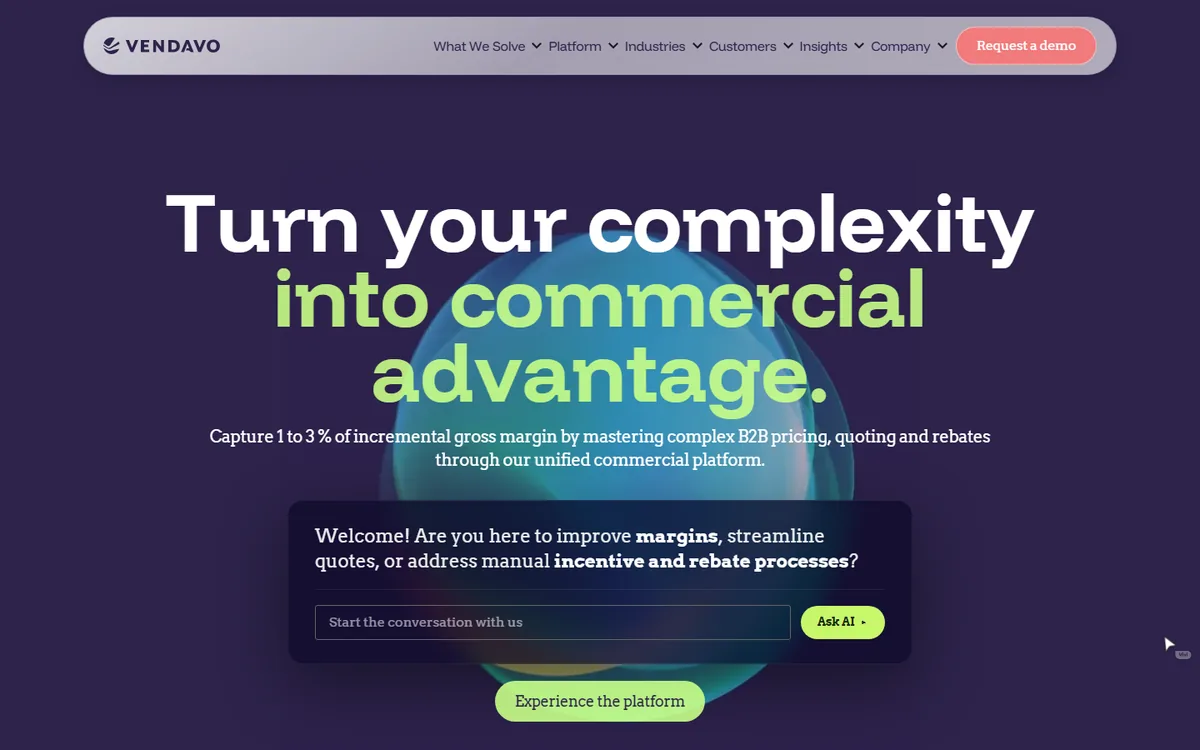
Vendavo helps industrial B2B companies manage price lists, deal pricing and margin leakage.
Vendavo focuses on B2B pricing for manufacturers, distributors and chemical companies. It helps teams set prices, guide deal quotes with data and find margin leakage across customers and products.
I see it chosen by industrial firms where pricing sits across thousands of products and a large sales force quotes daily. Reviewers say customization and implementation can be expensive, which matches the enterprise profile. Vendavo offers a free trial according to G2, which is unusual at this level and worth asking about early.
Pros of Vendavo
- Focus on B2B and industrial pricing
- Helps find margin leakage across customers and products
- A free trial is listed on G2
Cons of Vendavo
- Reviewers report costly customization and implementation
- Review count is smaller than larger rivals
Vendavo Pricing
Vendavo does not publish prices. G2 notes a free trial, and rates perceived cost at the top of its scale. Request a quote and ask what implementation and customization include.
Vendavo Reviews
- G2: 4.3/5 average (from +60 reviews)
Zilliant
A B2B Price Optimization Platform for Teams That Want Guided Pricing at the Point of Quote
Zilliant offers price optimization and guidance for B2B quotes and deals.
Zilliant gives B2B sales teams price guidance when they quote, based on deal history and customer data, plus tools for setting list prices and rules. The aim is to bring consistent, data-based pricing to the moment a rep builds a quote.
It works best where reps have a lot of price freedom and results vary from deal to deal. Reviewers on G2 report about six months to implement and about six months to see a return, which is shorter than some enterprise rivals. Like the others in this tier, it needs clean data and a clear pricing owner to deliver.
Pros of Zilliant
- Price guidance appears in the quoting flow
- Reported time to return is shorter than some rivals
- Suited to mid-size B2B teams
Cons of Zilliant
- No public pricing
- Smaller review base than the biggest platforms
Zilliant Pricing
Zilliant does not publish prices. G2 says buyers must contact the vendor for a quote and rates perceived cost at the top of its scale.
Zilliant Reviews
- G2: 4.4/5 average (from +60 reviews)
Chargebee
A Subscription Billing Platform That Makes It Easier to Launch and Change Plans and Pricing Models
Chargebee is a billing platform where you configure plans, usage pricing and quotes without new code.
Chargebee manages recurring billing, plans, add-ons, usage-based charges and quotes. It is not a pricing research tool. It matters for pricing strategy because it lets you launch a new tier, change a charging metric or run a test without rebuilding your billing.
I include it because the ability to change plans quickly often limits how fast a company can improve its pricing. Teams stuck with hard-coded plans wait weeks for each change. Chargebee reduces that wait. It will not tell you what to charge, and costs grow with your invoicing volume, so pair it with research from your own customers.
Pros of Chargebee
- Plans, add-ons and usage pricing are configurable
- Quotes and billing live in one system
- The largest review base in this list
Cons of Chargebee
- It manages price changes and does not recommend them
- Costs rise with invoice volume and add-ons
Chargebee Pricing
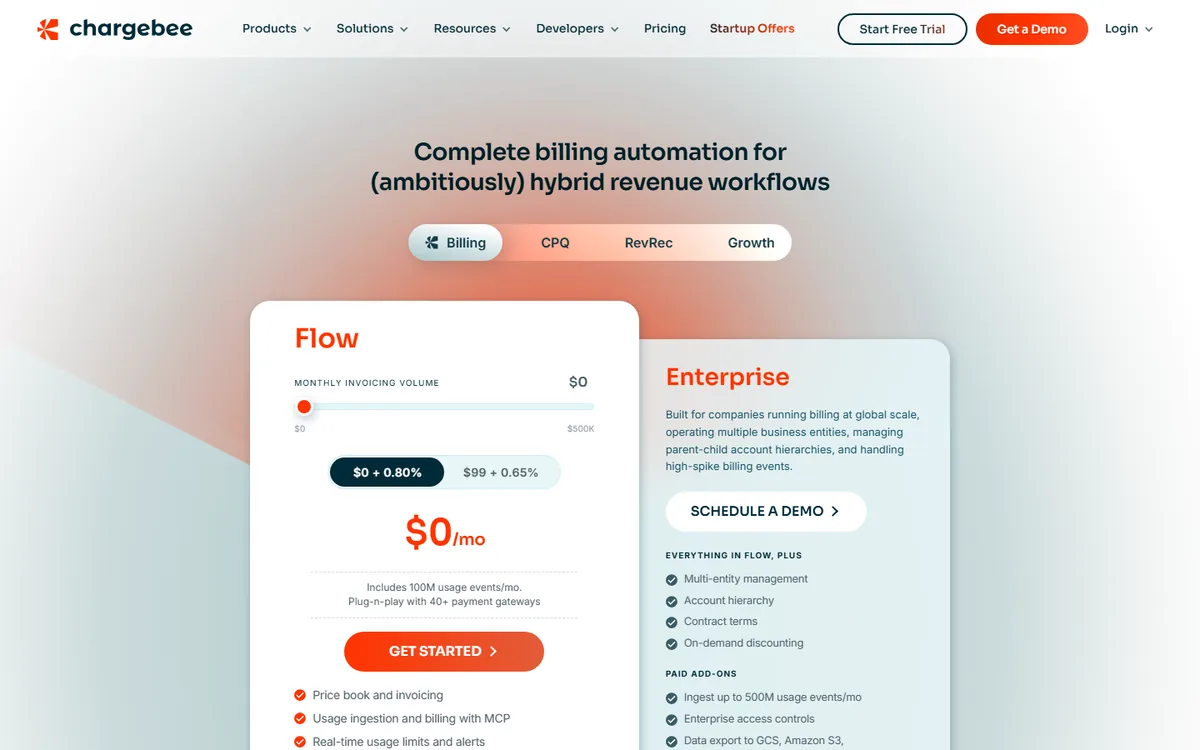
Chargebee's pricing page lists a Flow plan at $0 plus 0.80% of invoiced volume, moving to $99 plus 0.65% at higher monthly volumes, with custom pricing for Enterprise. Other products such as CPQ and revenue recognition are priced separately.
Chargebee Reviews
- G2: 4.4/5 average (from +1,000 reviews)
Estimate the Return on a Pricing Tool
Before you pick a plan, check whether the numbers work for you. Enter the manual hours the tool would take over, such as checking competitor prices by hand, and its monthly price, and you will see what it could return in a year.
Will the Tool Pay Off for You?
Use the sliders to enter your workload and the plan you are considering.
How to Choose the Right Pricing Strategy Tool
In my experience, fit with your pricing questions decides more than any feature list. Before you compare vendors, I suggest you answer four questions:
- Do you need to see competitor prices, measure your own plans or recommend new prices?
- How many products, customers or quotes does your team manage?
- Is your price and sales data clean enough for a model to use?
- Who will own pricing decisions after the tool goes live?
If you sell online and mostly need to track rivals, start with Prisync or Price2Spy. If you run a subscription business, use ProfitWell Metrics to measure first and Chargebee when billing changes slow you down. Retailers with large catalogs should look at Competera or Omnia Retail, and B2B firms with complex price lists at Pricefx, PROS, Vendavo or Zilliant. If you are still learning the basics, my pricing strategy guide explains the approaches in plain language.
Small teams do not need an enterprise platform, and my advice on pricing strategy for small business shows what to do first. Founders at an early stage will find a lighter path in pricing strategy for startups.
Questions About Choosing Pricing Strategy Tools
What Is the Best Pricing Strategy Tool for a Small Business?
For most small online sellers I recommend Prisync, because the plans are flat and start at $99 per month. For a small software company, ProfitWell Metrics is free and gives you the subscription numbers you need before you change any plan. A spreadsheet and customer interviews also take you far.
Do Pricing Strategy Tools Set Prices for Me?
Some recommend prices, such as Competera, Pricefx and PROS, but they work from rules and data you provide. Tracking tools such as Prisync and Price2Spy only show what competitors charge. In every case, the strategy, meaning your goals, segments and limits, has to come from your team.
Are There Free Pricing Strategy Tools?
ProfitWell Metrics is free for subscription analytics. Several tracking tools offer free trials, and a spreadsheet plus customer interviews cost nothing. Free tools cover measurement and research, while price optimization and competitor tracking at scale generally cost money.
What Is the Difference Between Price Monitoring and Price Optimization?
Price monitoring collects competitor prices and shows how you compare. Price optimization models demand and margin to recommend what you should charge. Monitoring is cheaper and quicker to start. Optimization needs more data and usually a dedicated team.
How Much Do Pricing Tools Cost?
Published prices in this list range from free to about $950 per month for monitoring tools. Enterprise platforms such as Pricefx, PROS, Vendavo and Zilliant do not publish prices, and G2 rates all four at the top of its cost scale. Expect a custom quote and months of implementation.
Which Tool Fits a B2B Company with Many Products and Quotes?
Pricefx, PROS, Vendavo and Zilliant are built for that situation. They handle customer-specific prices, quote guidance and rebates. Before you buy, confirm that your price data is clean and that one person owns pricing decisions.
Should I Buy a Tool Before I Have a Pricing Strategy?
I suggest you do not. A tool applies the rules you give it, so unclear rules produce unclear results. Define your goal, segments and value metric first, using a framework such as the one in my pricing guides, then pick the tool that supports it.
Heads up: vendors change prices, plans and ratings often. Everything was checked at the last update date, but confirm on each vendor’s website first. This article is not legal or financial advice.
Was this article helpful?
Thank you for letting us know.
Russell Tennant
Russell leads the Brook editorial team and works with our consultants to turn real client engagements into practical guides on roadmaps, go-to-market planning, growth and competitive strategy. Before joining Brook, he spent 11 years in strategy and product marketing roles at software and financial services companies. He has since edited more than 300 articles on strategy practice and drawn on roadmaps and growth plans from over 100 client projects. He is based in Denver, Colorado.