Key Takeaways
- A supply chain strategy decides which suppliers, locations and service levels support your growth plan, and which risks you accept.
- Every company that relies on outside providers has a supply chain, including software and financial services firms.
- Pick one main goal, efficiency, responsiveness or resilience, and accept the costs that come with it.
- Start with a map of your critical suppliers, name an owner and set a monthly review.
Supply chain strategy sounds like a topic for factories and shipping lines. In my experience, software and financial services teams need it just as much, because they depend on cloud capacity, payment providers, data vendors and outsourced teams that can fail or raise prices. If you want a partner to build one with you, my supply chain strategy consulting team starts with the steps in this guide.
I wrote it for three kinds of readers: someone starting from nothing, a manager who has a working process and wants a clear plan, and a senior leader who needs to challenge an existing one. Each section tells you what to do at each level.
What a Supply Chain Strategy Is
A supply chain strategy is a set of choices about how the business gets what it needs and delivers what it sells. Those choices cover suppliers, locations, inventory or spare capacity, transport, technology and risk. The strategy is good when the choices fit your growth plan and support each other, so that cost, speed and reliability are in a balance you picked on purpose.
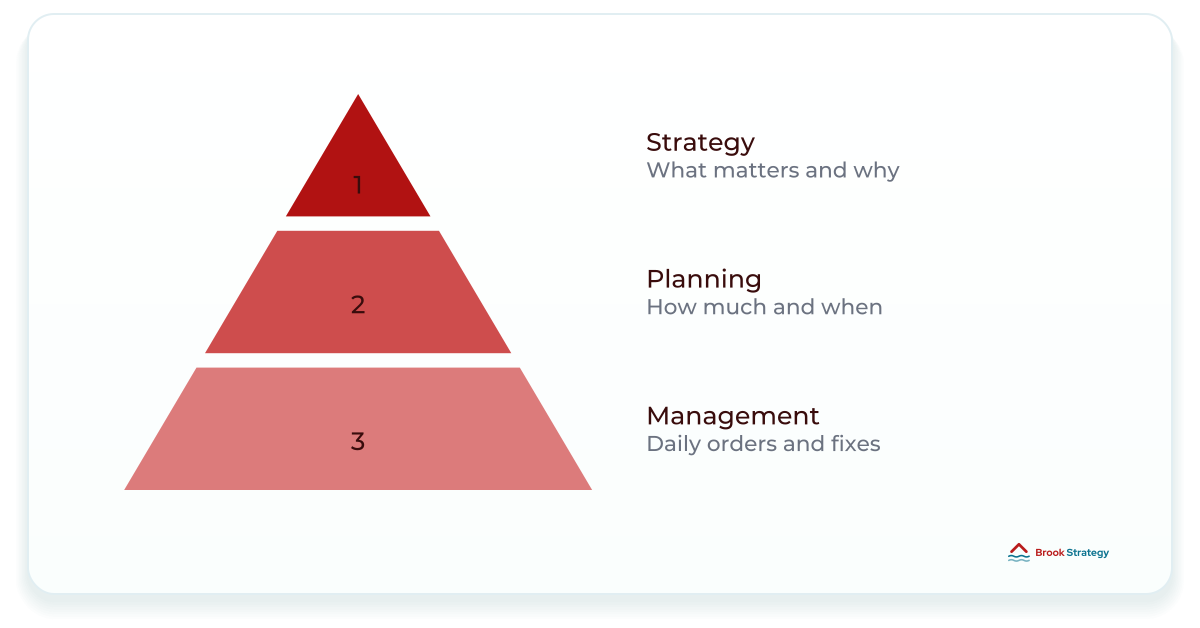
It differs from day-to-day management. Management places orders and fixes late shipments. Strategy decides which suppliers you want in three years and how much dependence on any one of them you can accept. The SCOR Digital Standard from ASCM shows the same split: plan, order, source, transform, fulfill and return are the working processes, and orchestrate sits above them to set strategy, contracts, technology and risk.
How a Supply Chain Strategy Works Step by Step
The logic is the same at any size. First you state what the business needs: the volumes, the markets and the service promise in the growth plan. Then you map what you depend on to deliver it. Next you find the gaps and the exposures, list options to close them and choose, with costs and trade-offs in view. Finally you assign owners and review progress.
Each step feeds the next. If the first step is vague, every later decision becomes an argument. If the map is incomplete, you choose options that miss the real weak point. I find that teams skip the map most often, since they think they already know their suppliers. A quick test: can you name who supplies your largest supplier's critical input? Most cannot.
The Three Main Goals: Efficiency, Responsiveness and Resilience
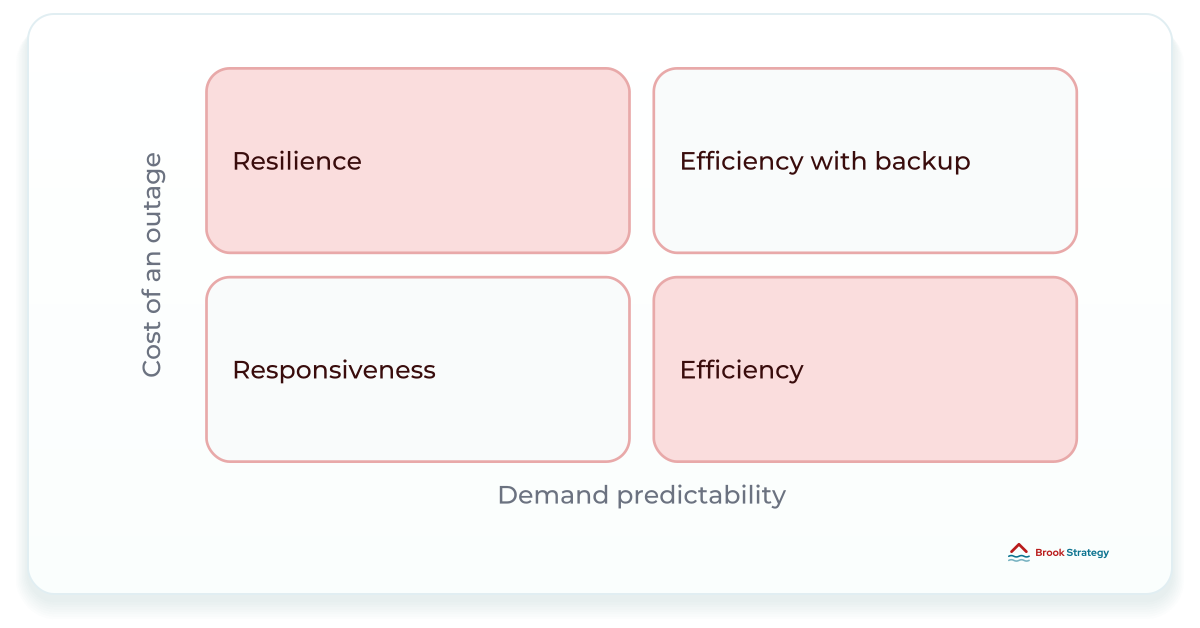
Most strategies lean toward one goal. Efficiency aims at the lowest cost for a stable demand. Responsiveness aims at speed and flexibility when demand is uncertain. Resilience aims at staying in business when something breaks. You can have some of each, but not the most of all three.
| Goal | Fits when | Typical choices | Cost you accept |
|---|---|---|---|
| Efficiency | Demand is steady and products are similar | Fewer suppliers, large orders, low stock | Exposed to disruption |
| Responsiveness | Demand is hard to predict | Flexible capacity, near markets, small batches | Higher cost per unit |
| Resilience | An outage costs far more than backup | Second sources, buffer stock, tested recovery plans | Idle capacity and fees |
Pick the main goal by asking what a customer notices. If they notice price, lean toward efficiency. If they notice delays, lean toward responsiveness. If they notice outages, lean toward resilience. My supply chain strategy examples show companies that made each choice.
The Parts You Have to Decide
Five decisions make up the strategy. You decide which suppliers to use and how to contract with them, where to do the work and how much capacity to hold, how much buffer to keep and what service to promise, which risks to cover and how, and what data and tools you need. I describe how these fit into a repeatable structure in my supply chain strategy framework, including roles and a review rhythm.
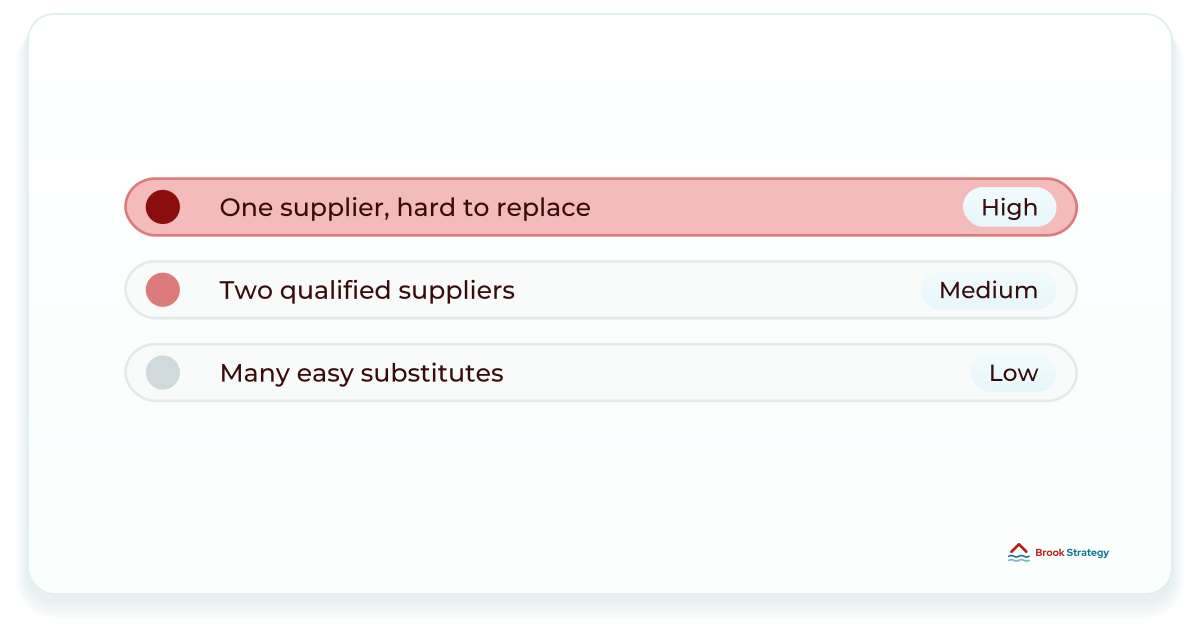
Sourcing deserves the most early attention. A good test is whether any single supplier carries more than you could absorb if it disappeared. For most firms, a handful of suppliers account for most of the risk. That is where a second source, a longer contract or a stock buffer pays off first.
Beginner to Pro: Four Levels of Maturity
You do not need a mature program on day one. The ladder below shows where most companies sit and what the next step looks like.
| Level | Example | Next step |
|---|---|---|
| 1. Beginner | Suppliers managed by individual teams, no shared list | Build one supplier map and name an owner |
| 2. Working | Central list, rough risk ranking, ad hoc reviews | Set measures and a monthly review |
| 3. Managed | Owners, scorecard and regular review, plans for top risks | Test recovery plans and share demand data with key suppliers |
| 4. Pro | Strategy tied to the growth plan, scenario planning, refreshed yearly | Use scenarios to decide where extra resilience pays |
If You Are Starting Out
Keep it small. List ten critical suppliers, write what each supports and mark single-source items. This takes an afternoon and usually finds one surprise. Then pick one owner and one monthly meeting of thirty minutes.
If You Have a Process and Want a Plan
Add a risk ranking and two or three measures: on-time delivery, cost to serve and share of spend with a single source. Look at the trend each month. Use the ranking to choose one initiative per quarter, such as qualifying a second source for your riskiest input.
If You Need to Challenge an Existing Program
Ask whether the strategy still matches the growth plan, and when it was last tested. Run two or three scenarios, such as a supplier failure, a demand jump or a price rise, and check what each does to cost and service. Where the answers surprise you, you have found your next investment.
How to Rank Your Suppliers Before You Decide Anything
Not every supplier deserves the same attention. A simple two-by-two sorts them by how much you spend and how hard they would be to replace. Suppliers with high spend and low replaceability are strategic: they get partnership, shared forecasts and executive contact. High spend with easy replacement is leverage, so you compete them on price. Low spend with hard replacement is a bottleneck, and the answer is usually a safety stock or a second source. The rest are routine, so keep the rules simple.
| Group | Spend | Hard to replace? | Your approach |
|---|---|---|---|
| Strategic | High | Yes | Partnership and shared planning |
| Leverage | High | No | Competitive bidding |
| Bottleneck | Low | Yes | Buffer stock or a second source |
| Routine | Low | No | Simple rules and automation |
This sorting is often called the Kraljic matrix. In software and financial services firms, a cloud provider is usually strategic, a data vendor may be a bottleneck, and office suppliers are routine. Review the grouping once a year, since a supplier can move from one box to another as your business changes.
Common Mistakes at Each Stage
Beginners often try to map every supplier, run out of energy and finish nothing. Stop at ten. Teams with a working process often track too many measures, and the monthly meeting becomes a data review. Keep it to three. Experienced programs have a different problem: the strategy was right two years ago and nobody has challenged it since. Put a yearly refresh in the calendar and invite the people who would disagree.
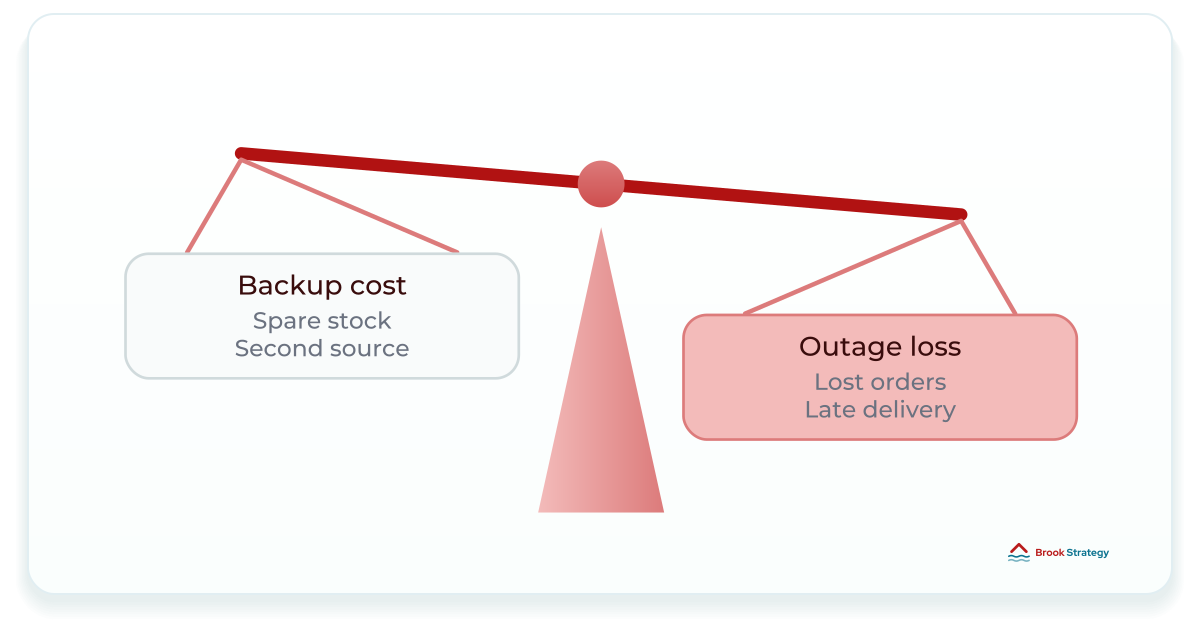
One more mistake crosses all levels: treating resilience as free. Every backup supplier, buffer or recovery test costs money, so decide how much protection a risk deserves. A simple rule is to compare the cost of an hour of downtime with the yearly cost of the backup, and buy the protection where the gap is clear.
Where Software Fits In
Software supports a strategy and does not replace it. A spreadsheet is enough at level one. As suppliers, locations and orders multiply, planning and visibility tools start to pay for themselves. Pick the tool after you know which decisions you need to support, so you buy for a real need. If you are at that stage, my ranking of supply chain management software compares the main platforms and how each one charges.
Before buying, ask three questions: what decision will this tool improve, who will use it weekly and what data does it need. If you cannot answer all three, wait. Many teams buy a platform to solve a problem that was really about ownership.
A Starter Checklist for Your First Quarter
- Write the growth plan's demands on suppliers and capacity in three sentences.
- Map your ten most critical suppliers and what each supports.
- Mark every single-source item and estimate the revenue at risk.
- Name one owner and schedule a monthly review.
- Pick two or three measures and record a baseline.
- Choose one initiative for the first quarter and give it a date.
Do this in order. In my experience the list takes four to six weeks when one person owns it, and much longer when it belongs to a committee.
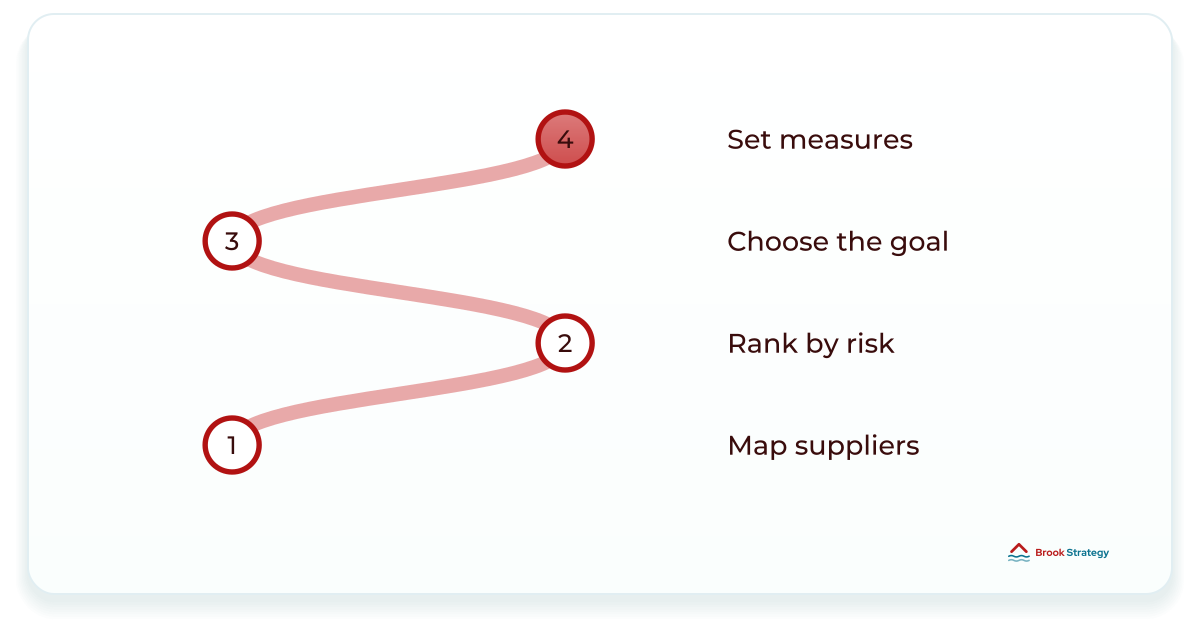
How to Choose Your Next Step
Your next step depends on what hurts most today. If a supplier failure would stop delivery, start with the supplier map and a backup plan. If costs grow with each new market, review your network and locations. If customers complain about delays, look at inventory and service levels. If you are unsure, an outside review can settle the question in a few weeks.
Questions About Supply Chain Strategy
What Is a Supply Chain Strategy in Simple Terms?
It is your plan for how you get what you need, make or hold it, and deliver it to customers, tied to what the business wants to achieve. It decides which suppliers you rely on, where work is done, how much buffer you keep and how much risk you accept.
Is Supply Chain Strategy Only for Companies That Sell Physical Products?
No. Any company that depends on outside suppliers to serve customers has a supply chain. For a software firm it includes cloud providers, data vendors and outsourced support. For a bank it includes payment networks, data providers and service partners.
What Is the Difference Between Supply Chain Strategy and Supply Chain Management?
Management runs the daily flow: orders, shipments, suppliers and stock. Strategy decides the long-term shape, such as which suppliers, locations and service levels support the plan. Good strategy gives management clear targets.
What Are the Main Types of Supply Chain Strategy?
The common ones are efficient, which aims at low cost, responsive, which aims at speed and flexibility, and resilient, which aims at surviving disruption. Most firms blend them, with one as the main goal. Choose the main goal first, then see what you can afford of the others.
How Do I Start If I Have No Supply Chain Team?
List your ten most critical suppliers and what each one supports, then find out which would stop delivery if it failed. Name one owner and put a monthly review in the calendar. That gives you a working start in a few weeks.
How Long Does It Take to Build a Supply Chain Strategy?
A first version takes six to twelve weeks for a mid-sized firm. Interviews and data take most of that time. A smaller firm can do it faster with a lighter scope.
When Should I Hire Outside Help?
When leaders disagree on priorities, when a disruption has shown a gap, or when growth is stretching the current setup. An outside team can run interviews and compare options without taking sides.
Sources
Note: This article is general information, not legal, financial or tax advice. Figures and examples are estimates based on typical projects, so check current details with your providers and advisers before you decide.
Was this article helpful?
Thank you for letting us know.
Russell Tennant
Russell leads the Brook editorial team and works with our consultants to turn real client engagements into practical guides on roadmaps, go-to-market planning, growth and competitive strategy. Before joining Brook, he spent 11 years in strategy and product marketing roles at software and financial services companies. He has since edited more than 300 articles on strategy practice and drawn on roadmaps and growth plans from over 100 client projects. He is based in Denver, Colorado.