Key Takeaways
- Strong supply chain strategies pick one purpose, such as speed, cost, resilience or access, and accept what it costs.
- Software and financial services firms have supply chains too: cloud, payments, data and service partners.
- Map your critical suppliers first, since almost every firm finds a dependency nobody wrote down.
- Price resilience against the revenue it protects, and buy it where the gap is large.
A supply chain strategy shows itself in choices: where you place inventory, which suppliers you rely on and how much you pay for resilience. The twelve examples below cover retail, manufacturing, software and financial services, and each one shows what the company decided and what it gave up. If you want help applying one to your own business, my supply chain strategy consulting team begins with exactly this kind of review.
I describe the examples in general terms and avoid figures I cannot verify. Where a company has written about its approach, I link the source. For the structure behind these choices, see my supply chain strategy framework.
What Separates a Supply Chain Strategy From a Set of Tactics?
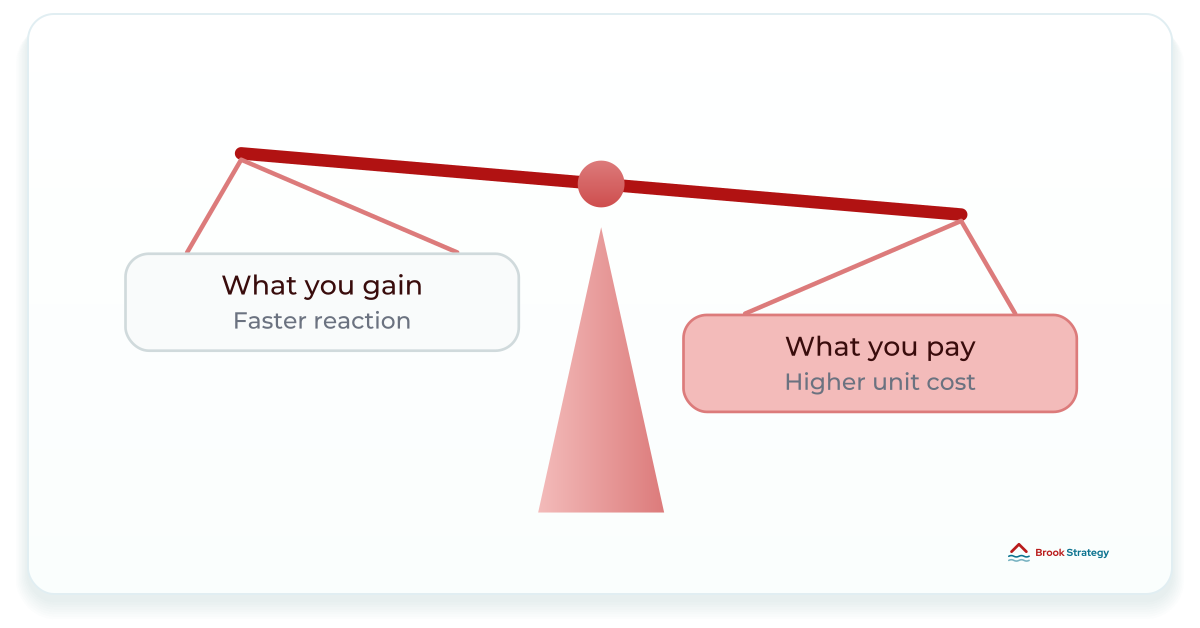
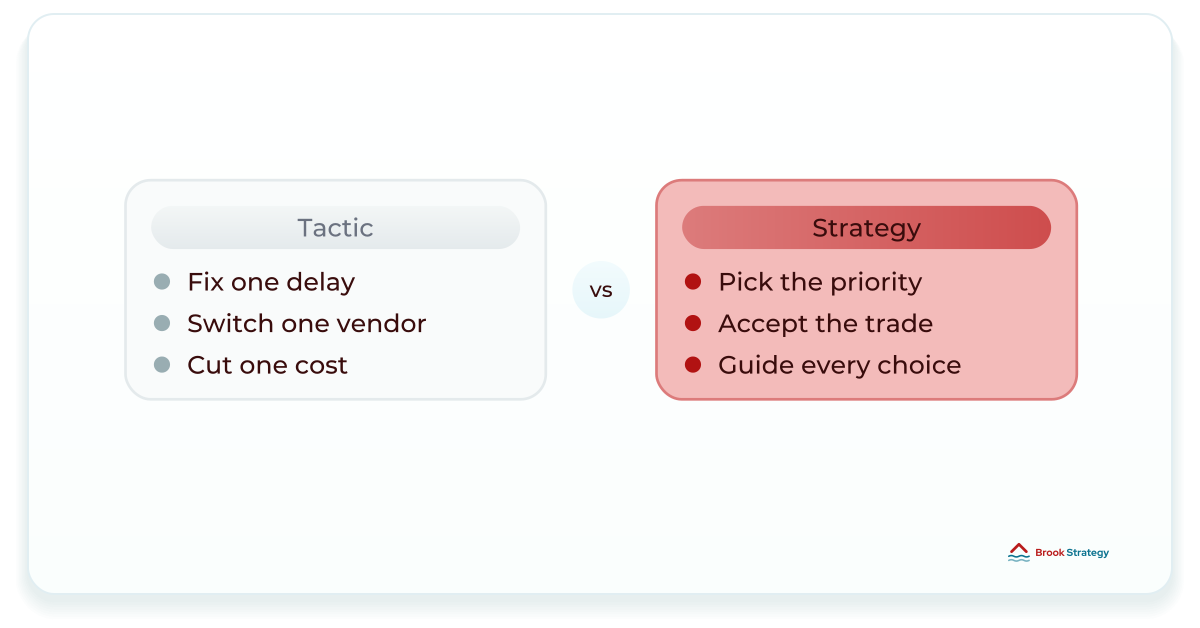
A tactic fixes a problem, such as a late delivery. A strategy chooses what the supply chain is for: speed, cost, resilience or flexibility. Walmart chose cost and flow, Zara chose speed, and Toyota chose quality and, later, visibility. Each choice meant giving something up.
That is why copying a tactic rarely works. You have to copy the choice and the trade-off together. The examples below are grouped loosely, from network design to sourcing to resilience, so you can see how the same logic appears in different industries.
12 Supply Chain Strategy Examples and What They Teach
The table gives you the choice and the idea you can borrow from each example. The sections below show how each one works and how to test it in your own business.
| Example | Strategic choice | What you can borrow |
|---|---|---|
| 1. Toyota's Supplier Map After 2011 | Know every supplier tier before a disaster | Map sub-tier suppliers |
| 2. Walmart's Cross-Docking and Shared Sales Data | Move goods without storing them and share data with suppliers | Link supplier planning to real sales |
| 3. Zara's Quick-Response Network | Pay more per unit to react faster | Shorten the loop where demand is uncertain |
| 4. Amazon's Regional Fulfillment Network | Fulfill from the nearest region, not from anywhere | Redesign the network around delivery distance |
| 5. Apple's Long-Term Supplier Commitments | Secure scarce capacity early with big commitments | Lock in what is scarce before you need it |
| 6. Automakers Buying Chips Directly | Move up the chain to the scarce component | Contract with the source, not just the tier-one supplier |
| 7. Maersk's Move to End-to-End Logistics | Offer door-to-door instead of port-to-port | Own more of the customer's journey |
| 8. Dropbox Moves Storage In-House | Own the infrastructure that is the core cost | Bring a critical, high-volume input under your control |
| 9. Capital One and the Exit From Its Own Data Centers | Rent scalable capacity instead of owning it | Treat a cloud provider as a strategic supplier |
| 10. Costco's Narrow Range | Sell fewer items in much larger volumes | Reduce complexity to gain buying power |
| 11. Nvidia and the Fabless Model | Design the product and rely on partners to build it | Focus on the capability that makes you different |
| 12. A Fintech Adds a Second Payment Provider | Pay for redundancy where an outage stops revenue | Match resilience spend to revenue at risk |
Toyota's Supplier Map After 2011
After the 2011 earthquake in Japan, Toyota struggled to tell quickly which parts came from which damaged sites. It later built a database of suppliers, locations and parts, so the company can see within days where a disruption will hit. The strategy moved from lean at any cost to lean with a map of what can break.
You do not need Toyota's size to copy the habit. A list of your critical suppliers, what they provide and who sits behind them gives your team a head start the next time something fails. In my experience, most firms find at least one hidden dependency the first time they build it.
Steps to Map Your Tiers
- List the ten suppliers or services you could not do without.
- Ask each one who provides their own critical inputs.
- Record locations and contract terms in one sheet.
- Mark every single-source item.
- Review the sheet every six months.
Where to Keep It
A shared spreadsheet is enough to start. Move to a supplier risk tool only when the list grows too long to maintain by hand.
Zara's Quick-Response Network
Zara, owned by Inditex, keeps a large share of its fast-moving production near its home market and works in small batches. New designs reach stores quickly, and items that do not sell are not repeated. The company accepts a higher cost per garment in exchange for fewer markdowns and less unsold stock.
A firm selling software or financial services can use the same trade. If demand swings and forecasts are often wrong, pay for flexible capacity before you pay for a better forecast. A small flexible team can cost more per hour than a fixed one and still cost less overall.
Steps to Test a Quick-Response Setup
- Measure the time from a demand signal to a delivered response.
- Find the steps where work waits for approval.
- Create a small flexible team for one product or region.
- Compare cost per unit and cost of waste with the old setup.
- Expand only where the total cost drops.
Tools That Help
A simple value stream map shows where time goes. A weekly review between sales and delivery keeps decisions short.
Amazon's Regional Fulfillment Network
Amazon reorganized its United States network into regions, so that most orders are filled from a warehouse in the customer's own region. Shorter distances mean faster delivery and lower transport cost per package. The change took years of investment and a rethink of how inventory is placed.
The lesson for a smaller firm is to ask where your service is delivered from, and whether that location still makes sense. A support team in one time zone, or a data center far from customers, are the same kind of problem. Moving the work closer often improves cost and service together.
Steps to Review Your Network
- Map where each customer group is served from.
- Estimate the cost and delay caused by distance.
- Test one nearer location for one customer group.
- Compare service levels and cost per case.
- Decide whether to extend the change.
What You Will Need
Delivery times and cost per order by region are the core data. Most firms can pull them from their existing systems.
Apple's Long-Term Supplier Commitments
Apple is known for committing to suppliers early, sometimes with prepayments and exclusive capacity on new components. Rivals that wait for a launch to place orders find the best capacity already taken. The strategy pays when a component is scarce and your product depends on it.
It also concentrates risk, so Apple pairs it with close supplier engagement and active work to widen the supplier base. If one input decides whether you can ship, treat it as a strategic purchase and not a routine order.
How to Protect a Scarce Input
- Identify the one input your plan cannot do without.
- Check how many suppliers can provide it.
- Offer a longer contract in exchange for reserved capacity.
- Qualify a second source in parallel.
- Reassess when supply loosens.
Questions for Your Team
Ask what happens to revenue if the input is late by a quarter. If the answer is large, the contract deserves leadership attention.
Automakers Buying Chips Directly
During the 2021 chip shortage, several car makers found that their tier-one suppliers could not deliver chips because the car makers had no direct relationship with the chip makers. Afterward, some signed direct supply agreements and began planning chip needs years ahead. The change gave them a voice in the queue.
If an item decides your output and you buy it only through a distributor, you are at the back of the line. A direct relationship does not always make sense, but you should know where it would. It also forces better forecasts, because a chip maker expects a plan.
Steps to Go Closer to the Source
- Find the components that stop delivery when missing.
- Trace them to the original maker.
- Estimate the volume you could commit to.
- Open a conversation about a direct or shared plan.
- Keep your existing channel as a backup.
Watch For
Direct deals bring minimum volumes and longer commitments. Have finance review the exposure before you sign.
Maersk's Move to End-to-End Logistics
Maersk, long known for container shipping, set out to become an integrator that also handles warehousing, inland transport and customs. The aim was to give customers one provider for the whole journey, and to make better use of the data that moves with each shipment. The change reshaped acquisitions, partnerships and the way the company is organized.
Whether you buy or sell logistics, the point is that a supply chain strategy can include a change in what you offer. A supplier that takes over more steps can reduce handoffs for customers. A buyer can ask for the same from partners, and sometimes cut cost by doing so.
How to Assess an Integrated Offer
- Map the steps between your supplier and your customer.
- Count the handoffs and who is accountable at each one.
- Ask whether one partner could take two or more steps.
- Compare the total cost, not the price per step.
- Pilot with one product or lane.
Where to Look
Your contracts and service reports show how many partners you use. Fewer partners can lower coordination effort, although it adds dependence.
Dropbox Moves Storage In-House
Dropbox moved the bulk of its file storage from a public cloud to its own data centers around 2015 and 2016, after building a storage system for its needs. For a company whose main cost is storage, owning the infrastructure lowered the unit cost and gave more control. It kept using public cloud for other workloads.
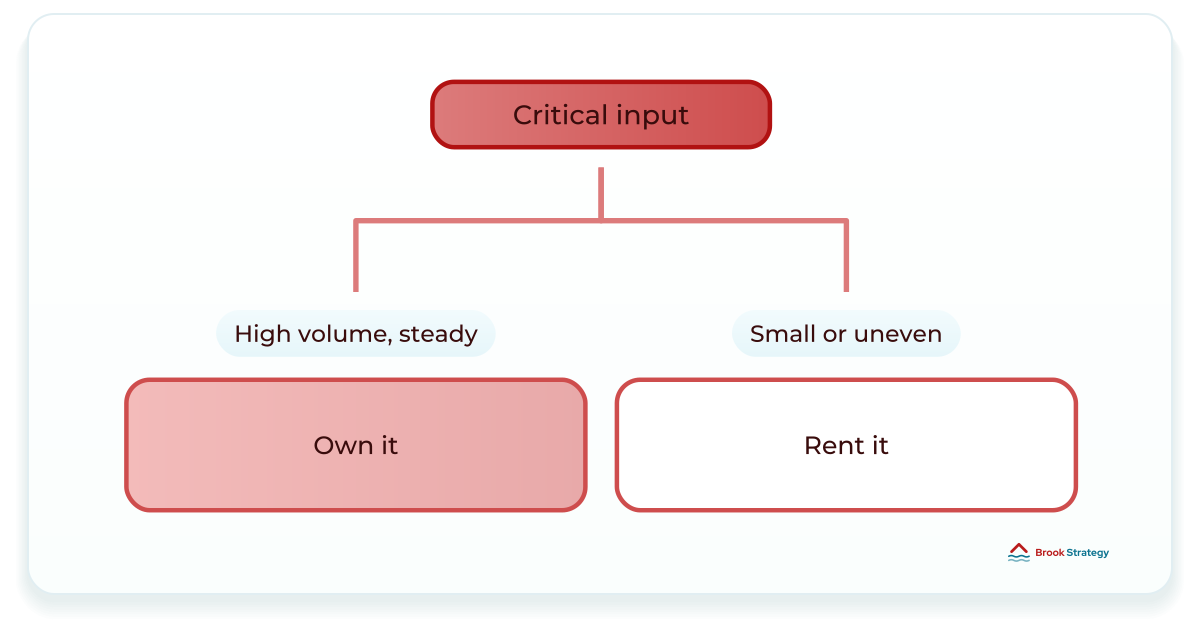
For a software company, cloud capacity is a supply chain. When one input is large and predictable, owning or contracting it differently can change the margin. When it is small or unpredictable, renting is usually smarter. The rule is to match the sourcing choice to the shape of the demand.
Steps to Review a Cloud Sourcing Choice
- List your largest infrastructure costs.
- Check which ones are steady and which ones swing.
- Estimate the cost of owning, committing or renting each.
- Include staff and exit costs in the comparison.
- Choose a different model for the steady items only.
Related Reading
My <a href="/cloud-strategy-consulting-services/">cloud strategy consulting</a> page covers how this decision links to your wider technology plan.
Capital One and the Exit From Its Own Data Centers
Capital One announced a move to the public cloud and closed its own data centers by 2020. The bank concluded that speed and flexibility were worth more than owning the hardware. It also had to build strong controls, because a provider now sat inside its operations.
This is the other side of the Dropbox example, and the difference is the shape of the workload and the regulatory setting. For a financial services firm, the supplier strategy must include audit rights, exit plans and concentration limits. Moving to a provider is a sourcing decision, and it needs the same care as any critical contract.
Steps to Manage a Critical Provider
- Classify workloads by how critical they are.
- Write exit and recovery plans for the critical ones.
- Agree audit and reporting rights in the contract.
- Test the recovery plan once a year.
- Track the share of spend with each provider.
Check with Advisers
Regulators in your market may have rules for outsourcing critical services. Confirm the current requirements with your compliance advisers.
Costco's Narrow Range
Costco stocks a limited range compared with a typical supermarket. Fewer items mean larger orders per product, better terms from suppliers and faster stock turns. Customers accept less choice in exchange for lower prices.
Many firms carry more variety than customers value. Each extra plan, product or contract adds supplier work, inventory and exceptions. If you cut the tail, the supply chain gets simpler almost everywhere at once.
Steps to Trim the Tail
- Rank products or services by revenue and by cost to serve.
- Mark the bottom group that few customers use.
- Check which of them are tied to key accounts.
- Retire the rest in stages.
- Track total cost and customer complaints.
Data to Pull
Sales by item and cost to serve by item are enough. If you cannot get cost to serve, use handling time as a stand-in.
Nvidia and the Fabless Model
Nvidia designs chips and relies on foundry partners to make them. This lets it put its money into design and software, and avoid the capital cost of factories. The strategy works only while partners keep capacity available, which is why the relationship is managed at a very senior level.
A fabless model is a version of make, buy or partner. It suits firms where the value sits in design, data or service and not in the physical step. The price is dependence, so the plan needs a view of how much dependence you can accept.
Steps to Test Make Versus Partner
- List the steps in your delivery chain.
- Mark the steps that make you different.
- Keep those in-house.
- Partner for steps that are common across firms.
- Set a limit on how much work depends on any one partner.
Questions to Ask
Ask which step a competitor could copy fastest if they had your partner. That is the step to protect.
A Fintech Adds a Second Payment Provider
In one client engagement, a fintech relied on a single payment provider for almost all of its revenue. A short outage the previous year had cost more than a year of the second provider's fees. I compared the cost of a backup with the revenue at risk, and the company signed with a second provider and set an automatic switch for failures.
The point is the size of the exposure, not the technology. Write down what an hour of downtime costs, and compare it with the price of redundancy. When the gap is large, the decision is easy.
Steps to Size Resilience Spend
- Estimate revenue per hour for each critical supplier.
- Estimate how often and how long outages last.
- Price the backup option.
- Compare expected loss with the backup cost.
- Choose the cases where the backup pays.
What to Document
Keep the assumptions in one page so leaders can revisit them. Update the numbers each year.
What These 12 Supply Chain Strategies Have in Common
Looked at together, the examples show four patterns. The first is a single purpose, stated plainly. The second is data shared across the chain, whether it is demand data with suppliers or a map of sub-tier suppliers. The third is a deliberate cost, such as higher unit prices for speed or long commitments for capacity. The last is a regular review, because supply markets change faster than annual plans.
| Focus | Examples | Main trade-off |
|---|---|---|
| Speed | Zara, Amazon | Higher cost per unit |
| Cost and flow | Walmart, Costco | Less variety |
| Resilience | Toyota, automakers, fintech | Extra inventory or fees |
| Access to scarce supply | Apple, Nvidia | Large commitments, dependence |
| Infrastructure sourcing | Dropbox, Capital One | Control versus flexibility |
Dropbox and Capital One share the last row and made opposite choices. The difference is how much of the input each one uses and how steady that use is.
How to Choose the Example That Fits Your Business
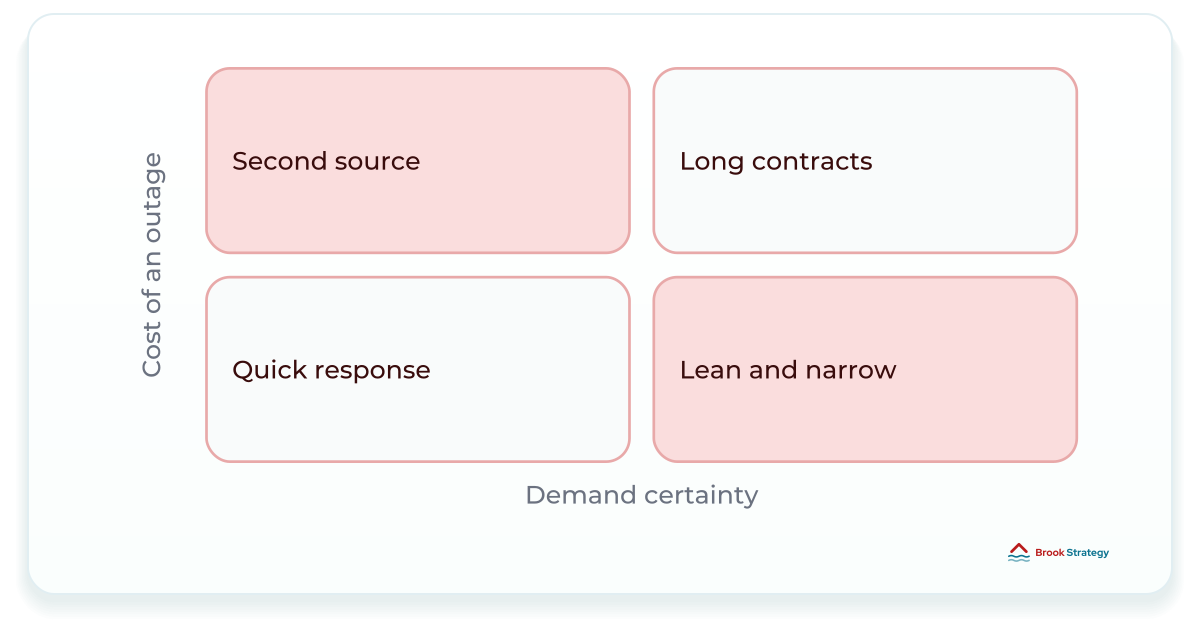
Do not start from the most famous name. Start from the problem that costs you the most today, and look for the example that addresses it. Four questions help narrow the list:
- Which supplier or service would stop your delivery if it failed?
- Where does demand surprise you most often?
- Which inputs are scarce, or growing in price?
- Which steps make you different, and which are common to every firm?
Your answers point to resilience, speed, access or focus. The supply chain strategy guide explains how these goals fit together, and the supply chain management software ranking helps once you know which tools you need. A short call is often the fastest way to sort the list.
Questions About Supply Chain Strategy Examples
What Are Examples of Supply Chain Strategy?
Walmart's cross-docking, Zara's quick-response network and Toyota's supplier map are three well-known ones. Each is a clear choice, such as speed, cost or resilience, backed by activities that support it. Software and financial firms can apply the same thinking to cloud capacity, payment providers and service partners.
How Is Supply Chain Strategy Different from Supply Chain Management?
Management runs the daily flow of orders, shipments and suppliers. Strategy decides what the network should look like in a few years and what to invest in. A good strategy gives management clear targets.
Does Supply Chain Strategy Matter for Software and Financial Services Firms?
Yes, because both rely on outside providers for infrastructure, data, payments and service delivery. If a provider fails, your customers feel it. The same questions about concentration, cost and resilience apply.
What Is the First Step to Improve My Supply Chain Strategy?
Map your critical suppliers and what each one supports. Most firms find at least one dependency nobody had written down. That list becomes the base for every later decision.
How Much Resilience Is Enough?
Compare the cost of an outage with the cost of protection. If an hour of downtime costs more than a month of backup fees, redundancy is likely to pay. If the gap is small, accept the risk and monitor it.
Should I Make, Buy or Partner?
Keep in-house the steps that make you different, and partner for the steps that are common across firms. Review the choice when your volume or your supplier market changes.
How Often Should I Review My Supply Chain Strategy?
Review progress monthly and the underlying choices once a year. Review earlier after a disruption, a new market launch or a major supplier change.
Sources
Note: This article is general information, not legal, financial or tax advice. Figures and examples are estimates based on typical projects, so check current details with your providers and advisers before you decide.
Was this article helpful?
Thank you for letting us know.
Russell Tennant
Russell leads the Brook editorial team and works with our consultants to turn real client engagements into practical guides on roadmaps, go-to-market planning, growth and competitive strategy. Before joining Brook, he spent 11 years in strategy and product marketing roles at software and financial services companies. He has since edited more than 300 articles on strategy practice and drawn on roadmaps and growth plans from over 100 client projects. He is based in Denver, Colorado.