Key Takeaways
- A sales strategy answers four questions: who you sell to, what you offer, how you reach buyers and how you measure results.
- Pick one target customer, one offer and one main channel before you add anything else.
- Your sales model should match your price and buying complexity, not your preferences.
- Write it in a few pages, share it with reps and review it every quarter.
A sales strategy is the set of choices that decides how your company wins customers. It sits above the daily work of calling, demoing and following up, and it explains why you do those things for some buyers and skip them for others.
This guide starts from zero. For a hands-on engagement, sales strategy consulting covers the full process from interviews to a written plan. If you already run a team and want a more structured view, my sales strategy framework goes deeper on the layers.
What a Sales Strategy Actually Contains
People often confuse a strategy with a target. "Grow revenue by 30 percent" is a goal. A strategy explains how you will get there: which customers, which offer, which channels and which sequence of steps. The target only tells you the size of the gap.
A complete strategy has six parts, and each one answers a question a new rep would otherwise have to guess.
| Part | Plain-language meaning | Example |
|---|---|---|
| Target customer | The type of buyer you win and keep most easily | Finance teams at companies with 50 to 300 staff |
| Value statement | Why that buyer should choose you | Close the books two days faster without new headcount |
| Sales model | How buyers reach you and who talks to them | Inside sales with a free trial |
| Process | The stages a deal passes through | Qualify, discover, propose, close |
| Goals | What you want to reach, by when | 40 new customers in the next four quarters |
| Metrics | The few numbers that show progress | Win rate, average cycle, pipeline coverage |
Start With One Customer You Can Describe
The first decision is who you are selling to. Look at your best five customers: the ones who bought fast, paid on time and would recommend you. What do they have in common? Industry, size, the problem that pushed them to buy and the job title of the person who signed.
That shared description is your ideal customer profile. It will feel narrow, and it should. Narrow targeting makes every other part easier: messages land, reps spot good fits sooner and marketing stops chasing leads that never close.
Say Why Someone Should Buy From You
The value statement is the reason a buyer picks you instead of the alternatives, including doing nothing. Good ones name a specific problem, a result and a proof point. Weak ones list features or lean on words like "innovative" and "end-to-end".
In my interviews with customers, the real reason for buying is often different from what the sales deck says. A buyer who says "your onboarding was quicker than the other two" is handing you your value statement. Ask five recent buyers why they chose you, and write down their words, not yours.
Choose a Sales Model That Matches Your Price
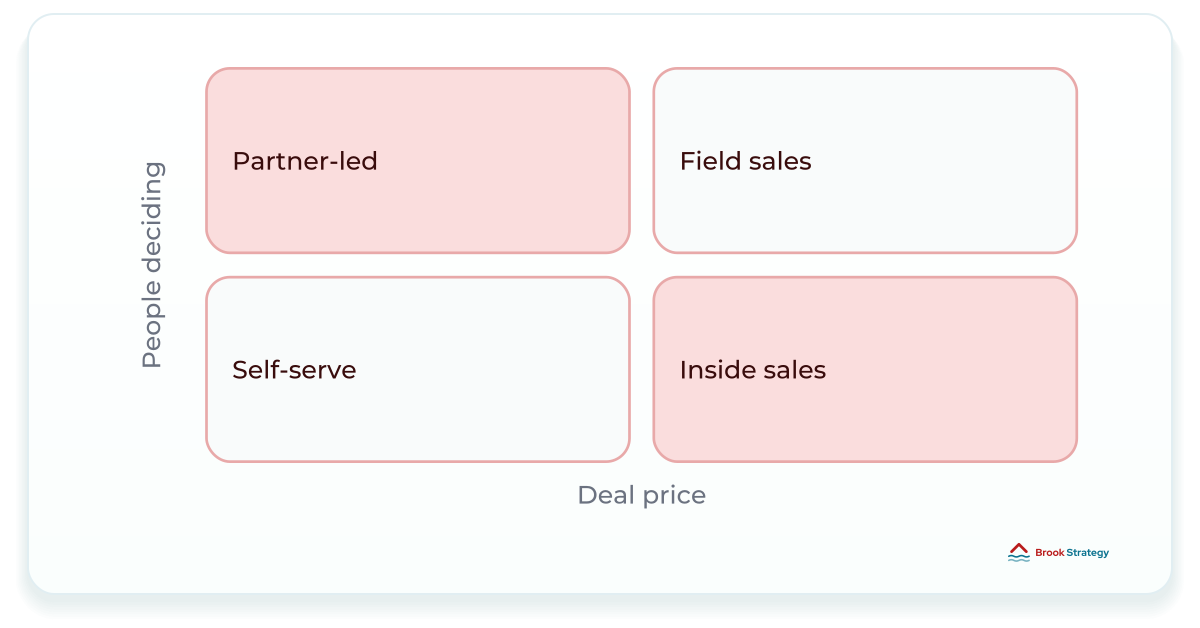
A sales model is how deals get done. The right one depends mostly on what you charge and how many people are involved in the decision.
| Model | Typical price point | Who sells | Main risk |
|---|---|---|---|
| Self-serve | Low, often monthly | The product and website | Few upgrades to larger plans |
| Inside sales | Mid-range | Reps by phone and video | Thin pipeline |
| Field sales | High, multi-year | Senior reps and specialists | Slow ramp, high cost per deal |
| Channel partners | Varies | Resellers and advisors | Little control over the message |
Many companies pick a model because a founder liked it or a competitor used it. I suggest you work backwards from the buyer: how do they research, who else gets a say and how much time will they spend before committing?
Draw the Path From First Contact to Signed Deal
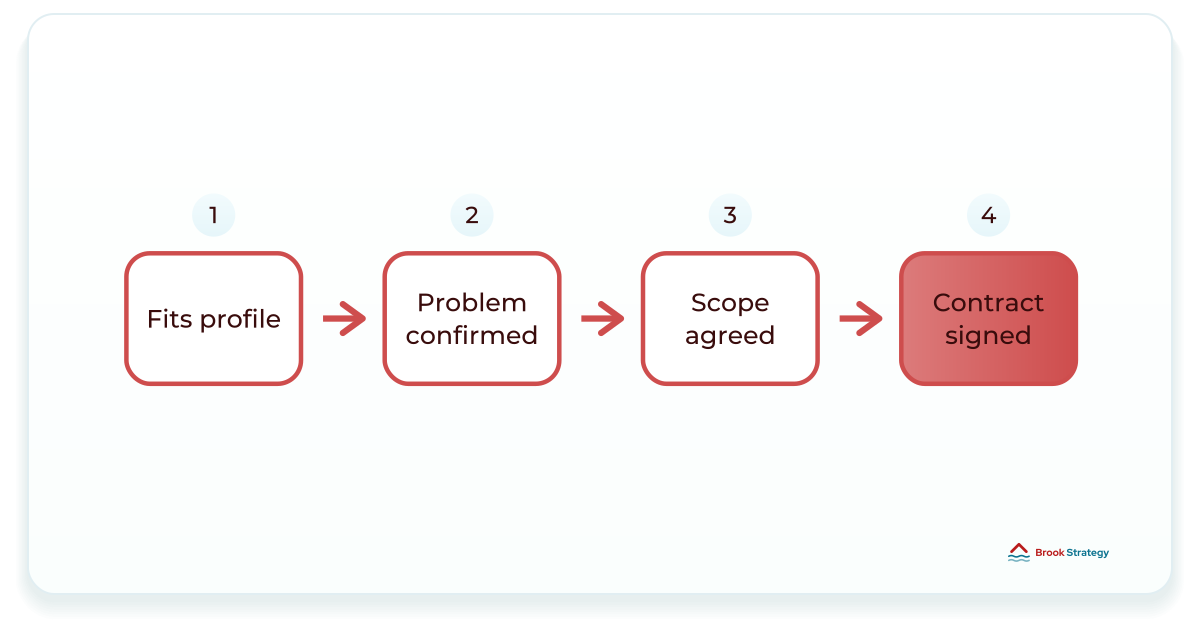
The process is a short list of stages. Four or five is usually enough for a first version. Each stage needs one thing: an exit rule that tells the rep when a deal may move forward.
For example, a deal moves from "discover" to "propose" only when the buyer has confirmed the problem, named who approves the budget and agreed on a rough timeline. Rules like these look strict at first and then save hours, because reps stop writing proposals for deals that were never going to close.
Handoffs Are Part of the Process
Note who passes the deal to whom: marketing to sales, sales to implementation. A deal that arrives at customer success without notes about what was promised creates the first unhappy customer conversation.
Set Goals You Can Trace Back to Activity
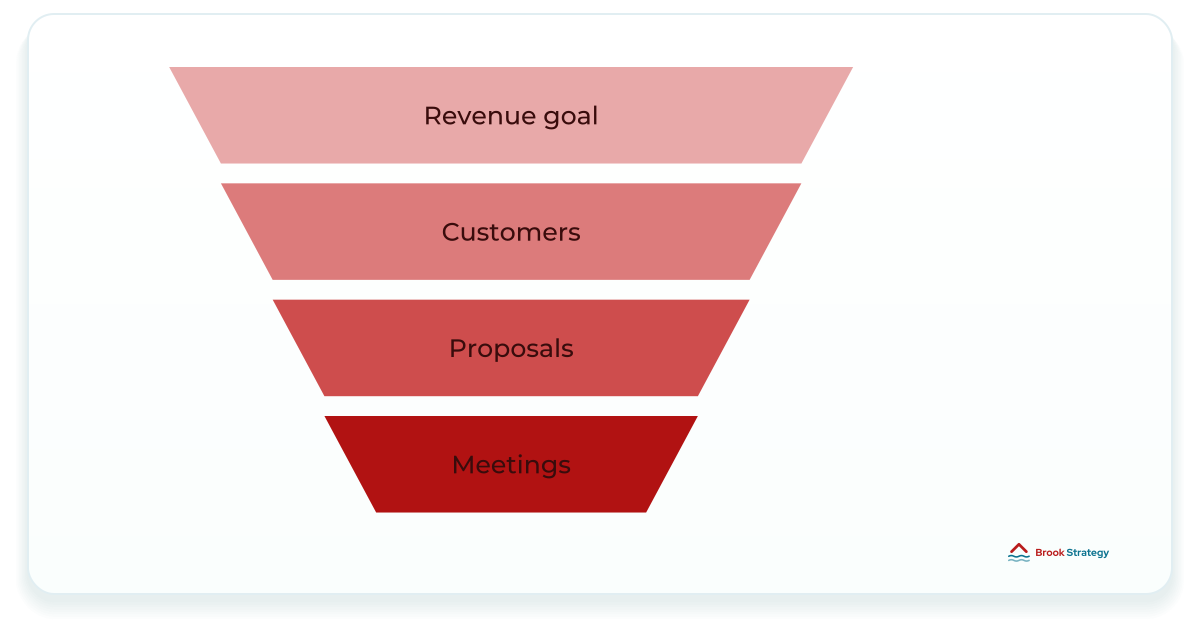
A goal like "double revenue" is fine for a board slide, but reps need a version they can work with. Convert it backwards: revenue target, divided by average deal size, gives the number of deals. Divide by your win rate for the number of qualified opportunities, and again by your meeting-to-opportunity rate for the number of meetings.
Those conversion rates will not be perfect in year one, so use your best guesses and replace them with real data after a quarter. For a longer view of how to sequence the work across a year, my sales strategy roadmap lays out the phases.
Pick Metrics That Change What You Do
Choose five to eight numbers. Pipeline coverage (open pipeline as a multiple of your target), win rate, average deal size, sales cycle length and quota attainment cover most of it. Add one leading indicator, such as meetings booked with the target profile.
Each metric needs an owner and a trigger. "If win rate drops below 20 percent, review the last ten lost deals" is a trigger. A chart on a screen is not.
Sales Terms You Will Meet in the First Week
Sales has its own vocabulary, and unfamiliar terms make a strategy feel harder than it is. These are the ones that come up most.
| Term | What it means |
|---|---|
| Lead | A person or company that has shown some interest but has not been checked for fit |
| Qualified opportunity | A lead that fits your target profile, has a real problem and can buy |
| Pipeline | All open opportunities, grouped by stage |
| Win rate | Share of opportunities that end in a signed deal |
| Sales cycle | Days from first meeting to signature |
| Quota | The revenue a rep is expected to close in a period |
| Forecast | Your estimate of what will close this period |
You will also hear about "top of funnel" and "bottom of funnel". These only describe how early or late a buyer is. Early buyers need education, late ones need proof and a clear next step, and your strategy should say who provides each.
What One Page Looks Like in Practice
Here is a condensed example for an imaginary accounting software vendor, to show how short a first draft can be. The target is finance leads at companies with 50 to 300 employees who still close their books in spreadsheets. The value statement is faster month-end close with no new hires. The model is inside sales with a 14-day trial.
The process has four stages: qualified, trial active, proposal and closed. A deal moves from "trial active" to "proposal" only when the buyer has loaded real data and named an approver. The goal is 40 new customers in four quarters, which at a 25 percent win rate needs about 160 qualified opportunities, or 40 a quarter. The metrics are win rate, trial-to-proposal rate, cycle length and pipeline coverage, with owners named.
That is under a page, and every line can be checked against data after a quarter. Notice what it leaves out: a second segment, a partner channel and a long list of tactics. Those can come later.
A Checklist to Build Your First Strategy
Work through the list in order. Each item takes an afternoon or less if you already have the deal data.
- List your last twenty won deals and five lost ones, with size, industry and reason.
- Write the target customer profile in three sentences.
- Ask five recent buyers why they chose you, and record their words.
- Pick one main sales model and one supporting channel.
- Define four or five stages, each with a buyer-based exit rule.
- Convert your revenue goal into deals, opportunities and meetings.
- Choose five to eight metrics, each with an owner and a trigger.
- Share the draft with two reps and one person from marketing before finalizing.
Mistakes That Make a First Strategy Fail
The most common one is breadth. A new strategy tries to cover three segments, four channels and two products, and the team has resources for one of each. Choose the smallest version that could work, and add on only after it does.
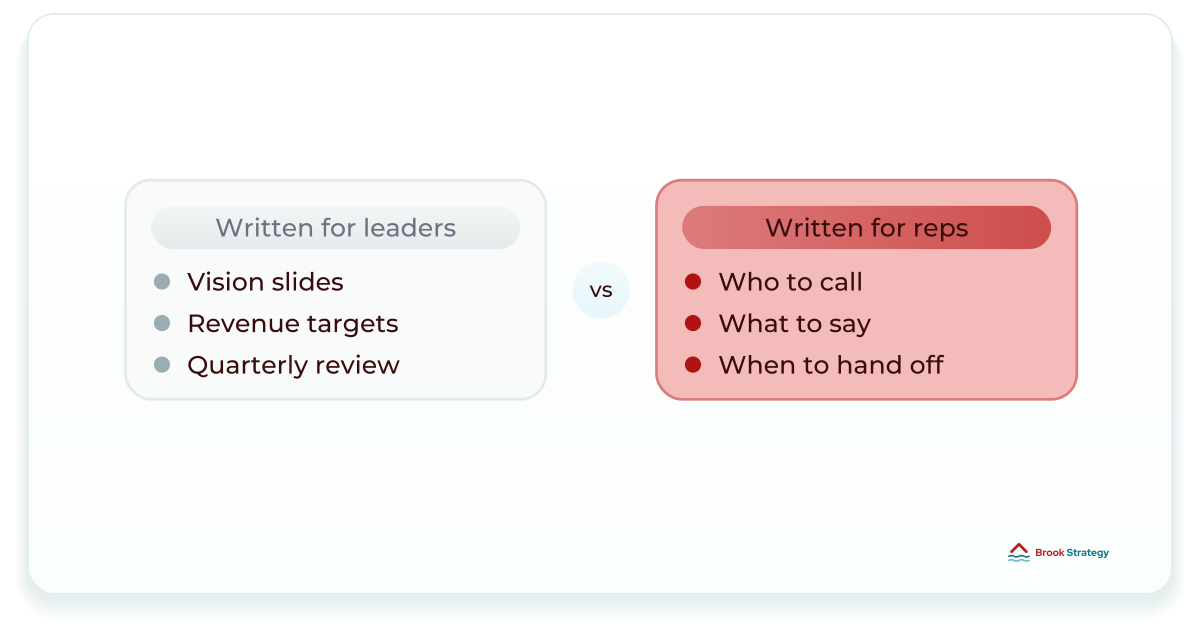
The second is writing for leadership. Reps are the audience, and if a rep cannot say in a minute who to call and what to say, the document has failed. The third is skipping the review date: schedule the first revision before you publish.
A company with only a few reps should not copy enterprise practice; the sales strategy for small business piece shows what to cut.
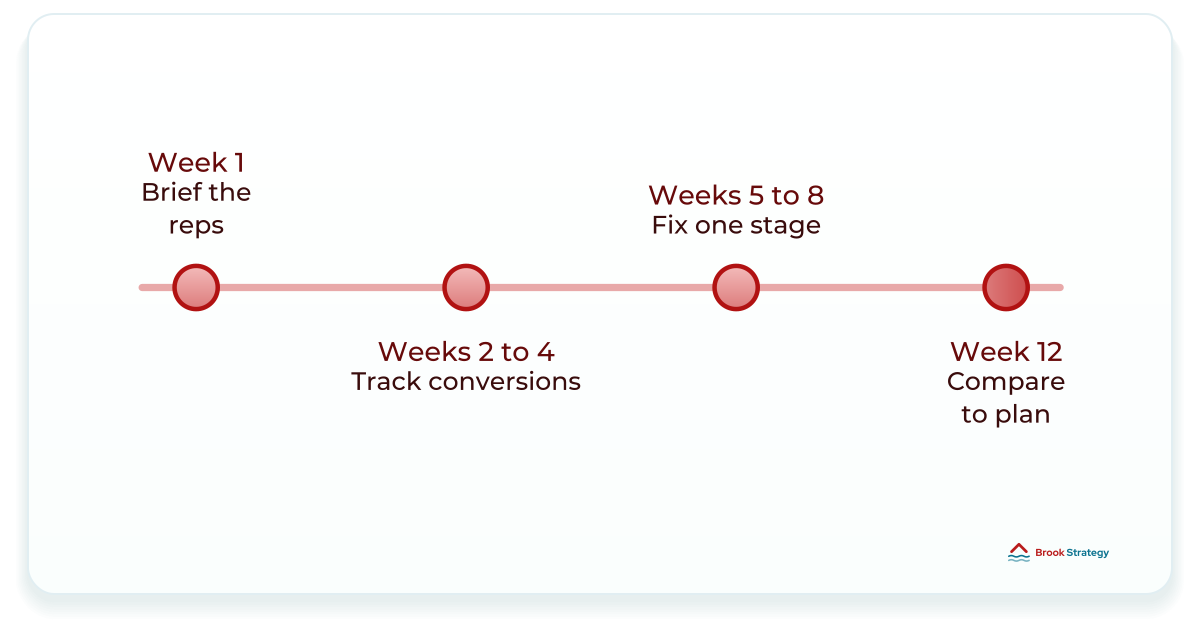
What to Do in the First 90 Days After Writing It
Run the strategy as written for one quarter before you change much. Hold a short weekly review of pipeline and stage movement, and a monthly look at win rate and cycle length. Write down every exception reps want to make, because a pattern of exceptions is how you learn where the strategy is wrong.
At the end of the quarter, compare the actual conversion rates with your guesses and update the goal math. That single revision usually improves forecast accuracy more than any tool change.
How to Choose Your Next Step
If you have no process at all, build the six parts above in a week and run them for a quarter. If you have a process that is not producing, find which part is weak with the table at the top. If the strategy is sound and your tooling is the bottleneck, compare options in my ranking of sales tools after you have written down what the tool must support.
Questions About Building a Sales Strategy From Scratch
What Is a Sales Strategy in Simple Terms?
A sales strategy is your written answer to four questions: who you sell to, what you offer them, how you reach them and how you will know it is working. Everything else, from scripts to commission plans, follows from those answers.
What Are the Main Parts of a Sales Strategy?
The parts I include are a target customer profile, a value statement, a sales model, a defined process, a set of goals and a short list of metrics. If one of them is missing, reps fill the gap with personal habits, and results vary by person.
How Long Should a Sales Strategy Be?
Short enough that a new rep can read it in their first week, which usually means three to six pages. Long strategy documents tend to describe everything and decide nothing.
How Is a Sales Strategy Different from a Marketing Strategy?
Marketing strategy decides how you create demand and shape perception. Sales strategy decides how you turn that demand into signed deals. They overlap at lead quality and handoff, which is why the two teams should review the same ideal customer profile.
How Often Should I Revisit My Sales Strategy?
Check the numbers every month and rewrite the strategy once or twice a year. Change it earlier if your best segment changes, a competitor resets prices or a new channel starts driving most of your pipeline.
Do I Need a CRM Before I Write a Sales Strategy?
No. Write the strategy first, then pick a CRM that fits your process. Buying software first tends to lock a messy process into a tool.
What Is the Biggest Mistake in a First Sales Strategy?
Trying to sell to everyone. A first strategy works best when it names one customer type, one offer and one main channel, and leaves everything else for later.
Note: This article is general information, not legal, financial or tax advice. Figures and examples are estimates based on typical projects, so check current details with your providers and advisers before you decide.
Was this article helpful?
Thank you for letting us know.
Russell Tennant
Russell leads the Brook editorial team and works with our consultants to turn real client engagements into practical guides on roadmaps, go-to-market planning, growth and competitive strategy. Before joining Brook, he spent 11 years in strategy and product marketing roles at software and financial services companies. He has since edited more than 300 articles on strategy practice and drawn on roadmaps and growth plans from over 100 client projects. He is based in Denver, Colorado.