Key Takeaways
- A workable sales strategy framework has five layers: market, offer, motion, process and measurement.
- Each layer should force one or two decisions you can write down in a sentence.
- Most failures start in the top two layers, long before a rep picks up the phone.
- Review the numbers monthly and the framework twice a year, and name one owner.
Most sales problems I get called about look like execution problems: reps miss quota, pipeline is thin, deals stall. When I sit down with the team, the cause is usually upstream. Nobody has written down who the best-fit buyer is or why that buyer should pick this company over three alternatives.
A framework fixes that by giving every decision a place. This is the five-layer structure I use in sales strategy consulting work, with the questions each layer has to answer and the mistakes I see most often.
The Five Layers at a Glance
Think of the framework as a stack. Each layer rests on the one above it, so a weak market definition shows up later as a weak pipeline, no matter how good your reps are.
| Layer | Question it answers | Written output | Typical failure |
|---|---|---|---|
| 1. Market | Who buys, and who buys fastest? | Ideal customer profile and segment ranking | Selling to everyone |
| 2. Offer | Why choose you? | Value statement, packages and proof points | A feature list in place of a reason |
| 3. Motion | How do buyers reach you? | Channel mix and sales model | Every channel at once, none done well |
| 4. Process | How does a deal move? | Stages, exit criteria and handoffs | Stages that describe rep activity, not buyer progress |
| 5. Measurement | How do you know it works? | Five to eight metrics with owners | Thirty metrics and no decisions |
Layer 1: Choose the Market Before the Message
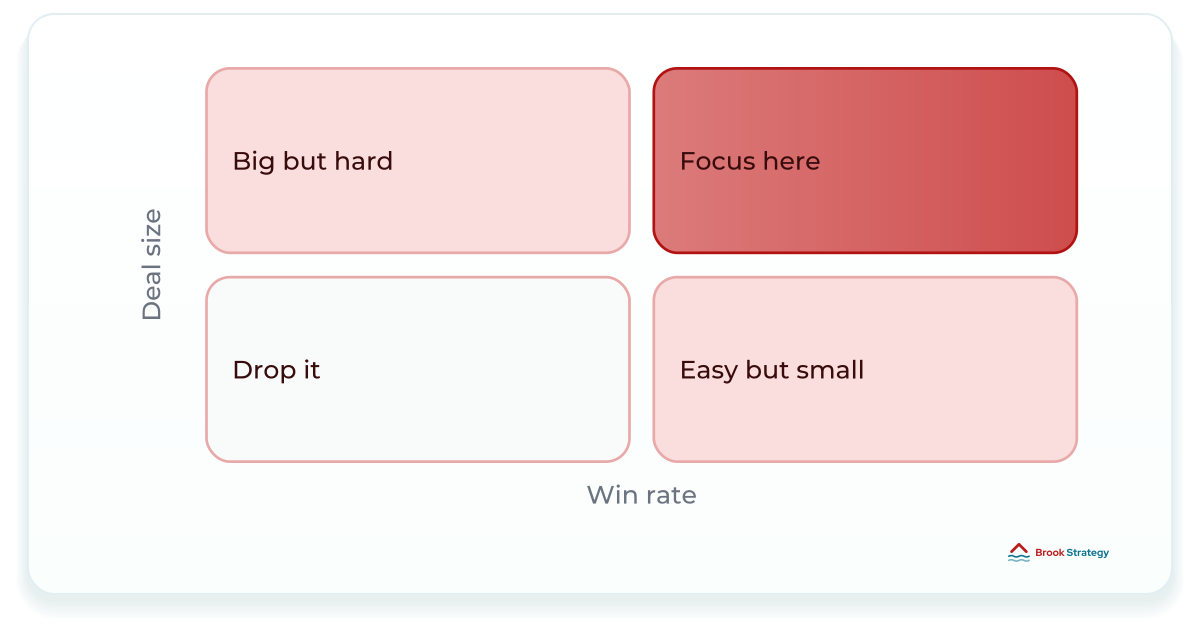
Start with who you sell to, and be stricter than feels comfortable. An ideal customer profile names the industry, company size, trigger event and buying role of the people who close fastest and stay longest. If you cannot describe your last ten wins in one paragraph, you have a market problem.
In a typical engagement I pull closed-won and closed-lost deals from the last twelve to eighteen months and sort them by segment. The pattern is almost always lopsided: two segments produce most of the revenue and a long tail eats time. Writing that down is the first real decision in the framework, and it often means saying no to a segment a founder likes.
Your go-to-market plan sits on this layer. If you are launching into a new segment rather than tuning an existing one, my go-to-market strategy consulting page explains how that work differs.
Layer 2: Turn the Offer Into a Reason to Buy
The offer layer answers a buyer's silent question: why you, and why now? It holds three things: a value statement in the buyer's words, the packages or tiers you sell and the proof that backs them up, such as outcomes, references and a clear implementation path.
I see the same failure repeatedly. The deck describes what the product does and skips what changes for the buyer. A useful test is to read the value statement aloud to someone outside the company. If they cannot repeat it back in their own words, it is not finished.
Packaging belongs here too, because how you bundle and price shapes who buys. When tiers have grown messy and discounting has become the norm, a separate pricing review is worth the effort, and pricing strategy consulting covers that scope.
Layer 3: Pick One Sales Motion and Fund It
A sales motion is the repeatable way a buyer goes from stranger to customer: self-serve, inside sales, field sales, partners or a mix. The right one follows from deal size, buyer complexity and how much education the product needs.
| Motion | Fits when | Watch for |
|---|---|---|
| Self-serve | Low price, quick value, simple setup | Weak conversion to larger accounts |
| Inside sales | Mid-size deals, a short cycle, remote buyers | Rep turnover and thin pipeline |
| Field or enterprise | High price, many stakeholders, long cycles | High cost per deal and slow ramp |
| Partner-led | Others already own the relationship | Little control over message and quality |
Most companies run a main motion and one supporting motion. Three or more usually means a team is spread across channels and none gets enough budget to work. If you are unsure how demand reaches your reps in the first place, the wider go-to-market picture is a separate piece of work, and growth strategy consulting covers where new revenue should come from next.
Layer 4: Write Stages Around the Buyer
A sales process is a list of stages with a clear exit rule for each. The mistake I see is stages named after rep activity, such as "demo done" or "proposal sent". Those tell you what the rep did, and nothing about what the buyer decided.
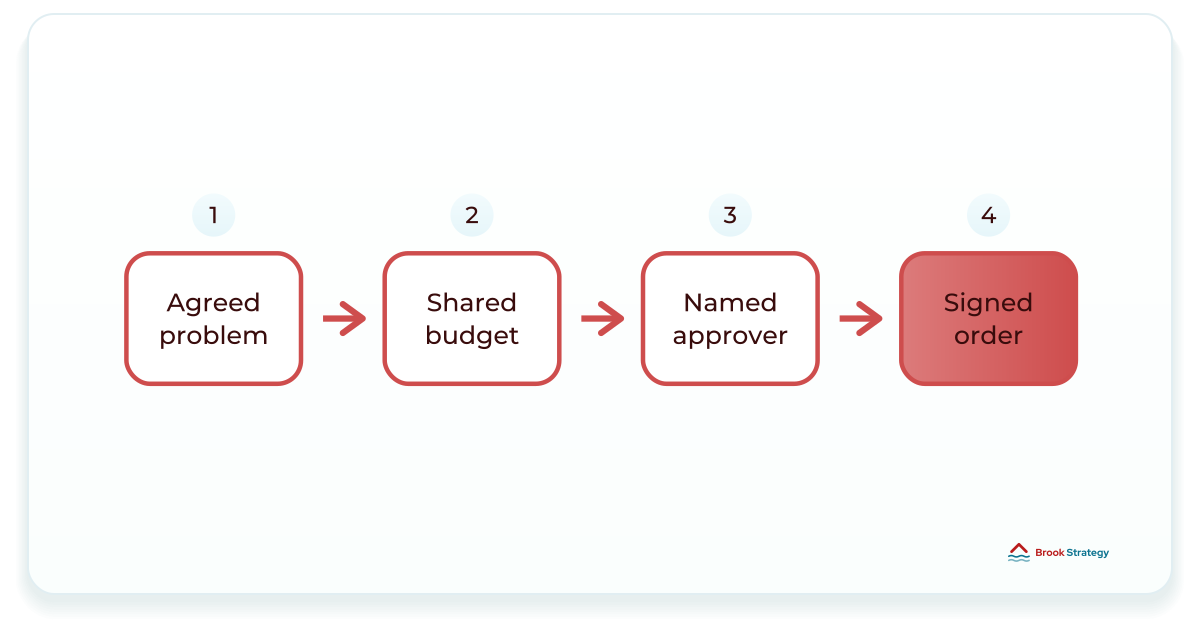
Stages work better when each one ends with a buyer action: agreed a problem exists, named a budget owner, confirmed a timeline, signed off on terms. When a deal sits in one stage for twice its normal time, that is a signal to look at the deal, and you only get that signal if the exit criteria are specific.
Handoffs Deserve Their Own Paragraph
Deals fail at the edges: marketing to sales, sales to customer success, sales to finance. Write down who owns the deal at each edge and what information moves with it. A one-page handoff note often removes more friction than a new tool.
Layer 5: Measure Fewer Things and Act on Them
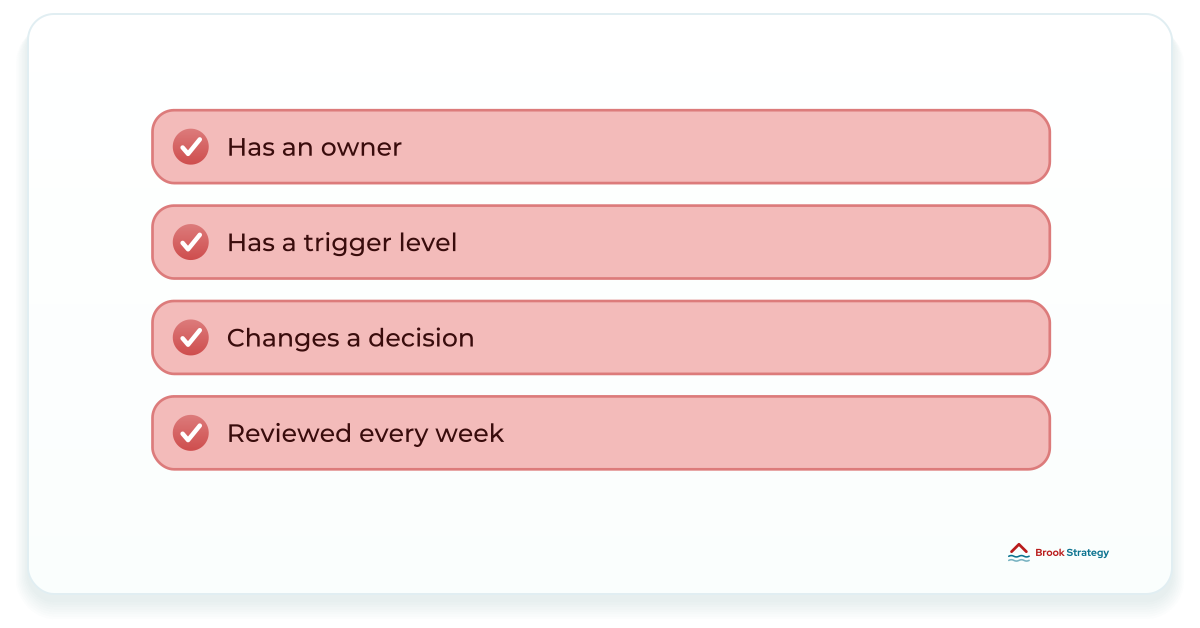
The measurement layer picks a short list of numbers, each with an owner and a threshold that triggers action. Five to eight is plenty: pipeline coverage, win rate by segment, average sales cycle, average deal size, quota attainment and one leading indicator such as qualified meetings booked.
A metric earns its place only if someone changes a decision when it moves. If win rate in your top segment falls below a set level, the owner reviews lost deals within a week. Without the trigger, a dashboard is decoration.
A Worked Example: Twelve Reps and a Flat Pipeline
Here is a composite of a pattern I have seen several times in B2B software. A company with twelve reps and a flat pipeline believed it had a lead problem. Marketing had doubled spend over a year with little change in closed deals.
Walking the layers top-down showed something different. The market layer was loose: the team sold to companies from ten to five thousand employees. A deal review showed that firms between 50 and 400 employees closed in about half the time and renewed more often. The offer layer described features, and customers kept asking for a reason to move from spreadsheets. The process had nine stages, three of which no rep used consistently.
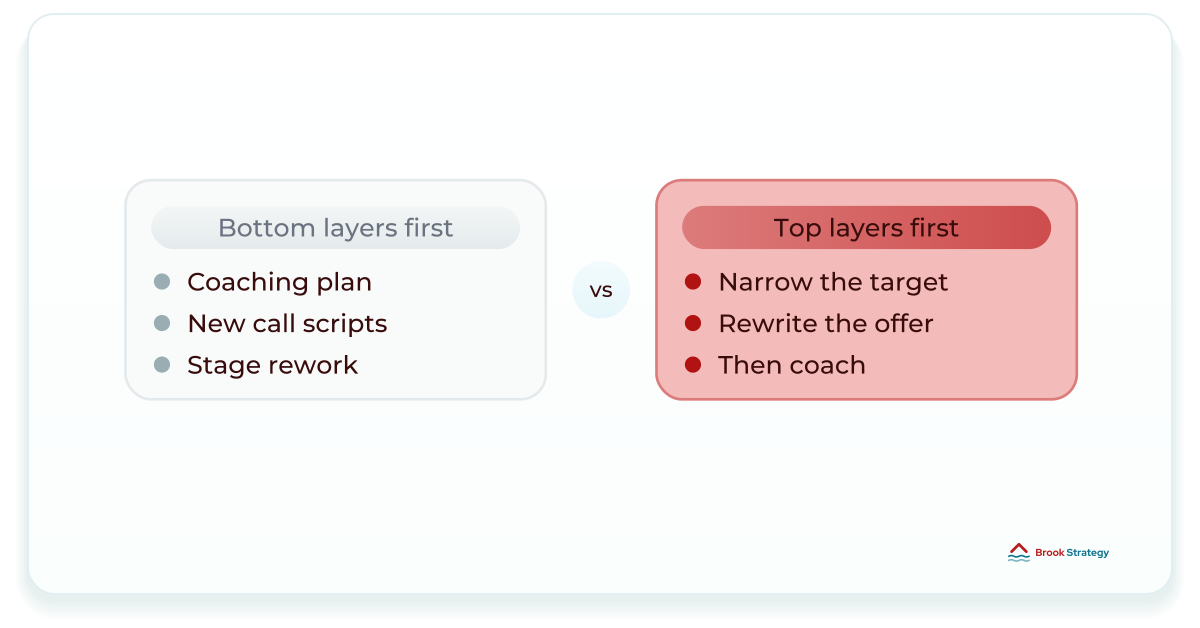
The fixes were not exotic. The team narrowed the target to the 50 to 400 band, rewrote the value statement around the spreadsheet problem, cut the process to five stages with buyer-based exits and reduced the dashboard to six numbers. Nothing changed in marketing spend. Within two quarters the average cycle in the target band got shorter and forecast accuracy improved, because stage data finally meant something.
The lesson is the order. Fixing the bottom layers first would have cost months and left the real issue untouched.
Four Ways Frameworks Go Wrong
Even a good structure fails when it is used badly. These are the patterns I see most.
- The document is written once by leadership and never shown to reps, so nobody follows it.
- Layers are filled with wishes. "Enterprise" appears as a target segment with no enterprise wins to show for it.
- Measurement gets built before the process, so the data is clean but means nothing.
- The framework has no owner, and the quarterly review quietly stops happening.
How to Use the Framework Without Writing a Binder
I suggest you build it in a shared document with one section per layer and a limit of one page each. Fill it in the order above, because each layer depends on the one before. Then test every layer with the people who live in it: a rep for the process, a customer success lead for the handoff and a finance partner for the numbers.
If your plan covers a full year with several initiatives competing for the same people, the sales strategy roadmap shows how to sequence the work. For a newer team starting from nothing, my sales strategy guide explains each term in plain language. A company with a handful of reps should read the sales strategy for small business version, which strips the framework to its essentials.
Deciding Where to Begin
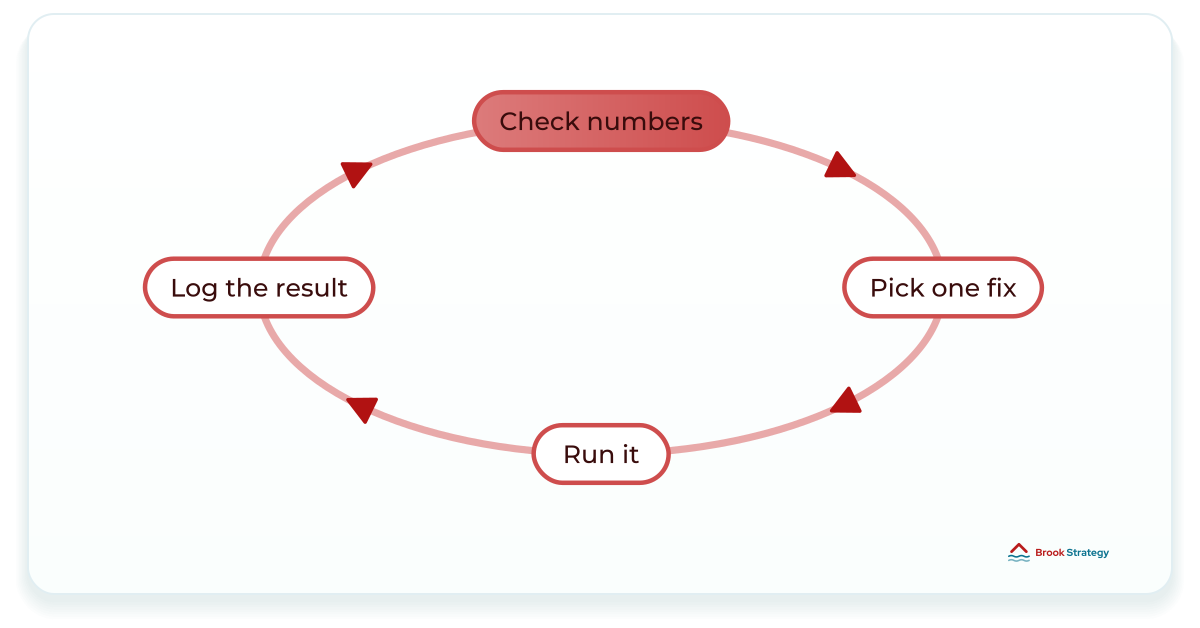
You do not need to rebuild all five layers at once. Diagnose first, then fix the highest layer that is weak.
- Pipeline is full but win rate is low: revisit the market and offer layers.
- Win rate is fine but pipeline is thin: look at the motion layer.
- Deals stall or forecasts miss: rework the process and measurement layers.
- Results differ wildly between reps: write down the process and handoffs first.
The tools that support each layer vary a lot by team size, so I keep a ranked list in best sales tools. Pick tools after the layers are written, not before.
Questions About the Sales Strategy Framework
What Is a Sales Strategy Framework?
A sales strategy framework is a fixed structure for the decisions that shape how you sell: who you target, what you offer, how you reach buyers, how deals move and how you measure results. It gives you one place to write those decisions down, so reps, managers and marketing work from the same plan instead of their own assumptions.
How Is a Sales Strategy Different from a Sales Plan?
The strategy sets the direction: your target customers, your offer and your route to market. The plan turns it into numbers, owners and dates for a quarter or a year. In my client work, teams that write a plan without the strategy underneath usually end up with a quota and no reason to believe it.
How Many Layers Should a Sales Strategy Framework Have?
Five is enough for most companies: market, offer, motion, process and measurement. More layers tend to produce documents nobody reads. If a layer does not change a decision someone makes this quarter, drop it or merge it into a neighbor.
How Long Does It Take to Build a Sales Strategy?
For a company with an existing sales team, I plan on four to six weeks. Roughly two weeks go to interviews and deal review, one to two weeks to draft the layers and the rest to test them with the people who will run them. A first draft in a week is possible, but it rests on opinions instead of evidence.
How Often Should I Update the Framework?
Review the metrics monthly and the strategy itself twice a year. Change the framework sooner when a clear signal shows up: win rates drop for a segment, a competitor changes pricing or a new channel starts producing most of your pipeline.
Who Should Own the Sales Strategy?
One person should own it, usually the head of sales or revenue, with marketing, finance and customer success reviewing it. Shared ownership sounds fair and tends to mean nobody updates the document. Name the owner on page one.
Can a Small Team Use the Same Framework as a Large One?
Yes, with fewer details. A five-person team can capture each layer in a page or two. The questions stay the same; only the depth changes. A short framework that people use beats a long one that sits in a shared drive.
Note: This article is general information, not legal, financial or tax advice. Figures and examples are estimates based on typical projects, so check current details with your providers and advisers before you decide.
Was this article helpful?
Thank you for letting us know.
Russell Tennant
Russell leads the Brook editorial team and works with our consultants to turn real client engagements into practical guides on roadmaps, go-to-market planning, growth and competitive strategy. Before joining Brook, he spent 11 years in strategy and product marketing roles at software and financial services companies. He has since edited more than 300 articles on strategy practice and drawn on roadmaps and growth plans from over 100 client projects. He is based in Denver, Colorado.