Key Takeaways
- The framework has six steps: arena, ideas, scoring, portfolio, staged testing and review.
- Score every idea with the same formula so decisions rest on evidence.
- Run three to five funded bets and release money stage by stage.
- Agree stop rules before each test starts and review the portfolio every quarter.
An innovation strategy framework is a way to choose between ideas. Most companies have more ideas than money and time, so the real work is deciding which ones to fund, in what order and with what proof. A framework puts that decision into steps you can repeat every quarter.
The model below has six steps and one scoring formula. I built it from client work in software and financial services and kept it short on purpose. If you want a partner to run it with your leadership team, innovation strategy consulting follows the same order.
The Six Steps at a Glance
The table shows what you do in each step and the decision it produces. Read it once, then use the sections below as a working guide.
| Step | What you do | Decision it produces |
|---|---|---|
| 1. Set the arena | Define where you will look for growth | Two or three search areas |
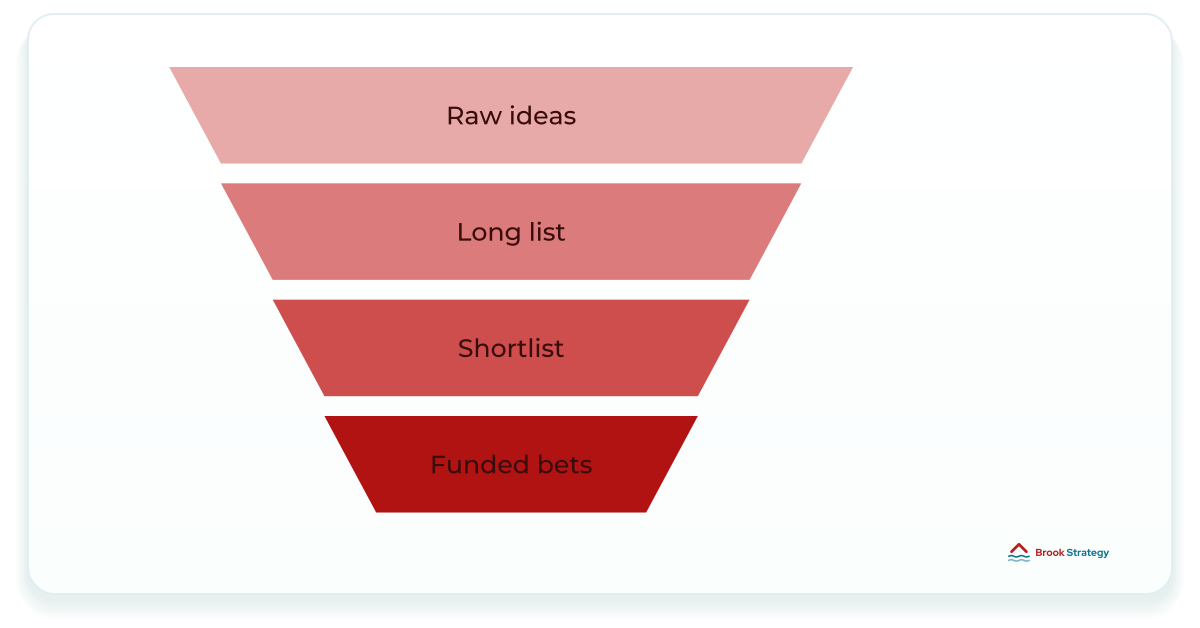
| 2. Collect ideas | Gather ideas from staff, customers and data | A single long list |
| 3. Score the ideas | Rank each idea with the same formula | A ranked shortlist |
| 4. Build the portfolio | Balance core, adjacent and new bets | A funded set of three to five bets |
| 5. Test in stages | Run cheap tests and release money by evidence | Go, change or stop at each gate |
| 6. Review and reset | Check the portfolio every quarter | New bets in, weak bets out |
Step 1: Set the Arena
Decide where you will look. An arena is a mix of customers, problems and technologies, such as “mid-sized finance teams and their reporting problems.” Two or three arenas are enough. More than that spreads your effort across too many markets.
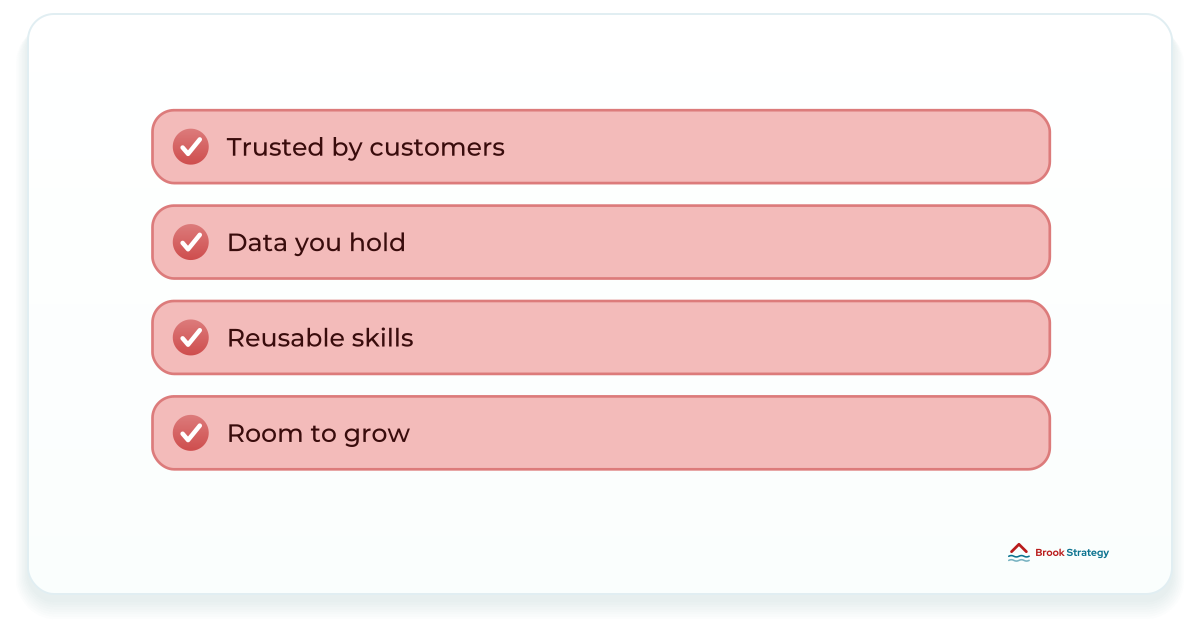
Base the choice on your strengths: customers who already trust you, data you hold or skills that are hard to copy. Also name arenas you will not enter. That list saves arguments later.
Step 2: Collect Ideas
Gather ideas from three places: your employees, your customers and your own data. Sales and support staff hear problems that product teams miss. Customer interviews show unmet needs. Data, such as usage patterns or complaints, shows where people struggle.
Put everything on one list in a standard format: the customer, the problem, the proposed solution and the evidence so far. A shared board or workspace helps here, and my ranking of innovation strategy tools compares the options.
Step 3: Score the Ideas
Score every idea with the same formula, so the discussion is about evidence and not about who argues loudest. This is the working formula I use. It is my own rule of thumb, not a published standard, so adapt the weights to your business:
Innovation score = (customer need × strategic fit × market size) ÷ cost to first evidence
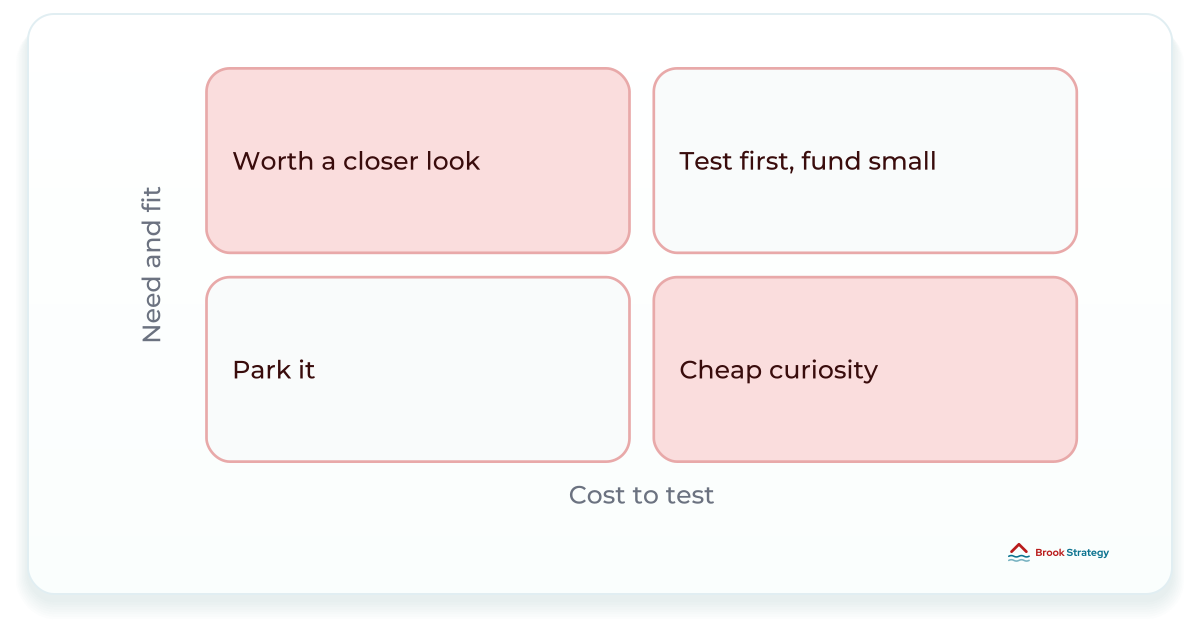
Score each of the first three factors from 1 to 5. Cost to first evidence is the money and time needed to learn whether the idea is wrong, also scored from 1 to 5, where 5 means expensive. An idea that solves a big customer problem, fits your strengths and can be tested cheaply rises to the top.
| Idea | Need | Fit | Market | Cost to test | Score |
|---|---|---|---|---|---|
| Reporting add-on for finance teams | 4 | 5 | 3 | 2 | 30 |
| New product for a different industry | 3 | 2 | 5 | 5 | 6 |
| Usage-based pricing option | 4 | 4 | 4 | 2 | 32 |
The scores in the table are invented for illustration. They show the pattern: the ambitious idea in a new industry scores low because it is costly to test and far from your strengths, which is a reason to delay it, not to reject it forever.
Step 4: Build the Portfolio
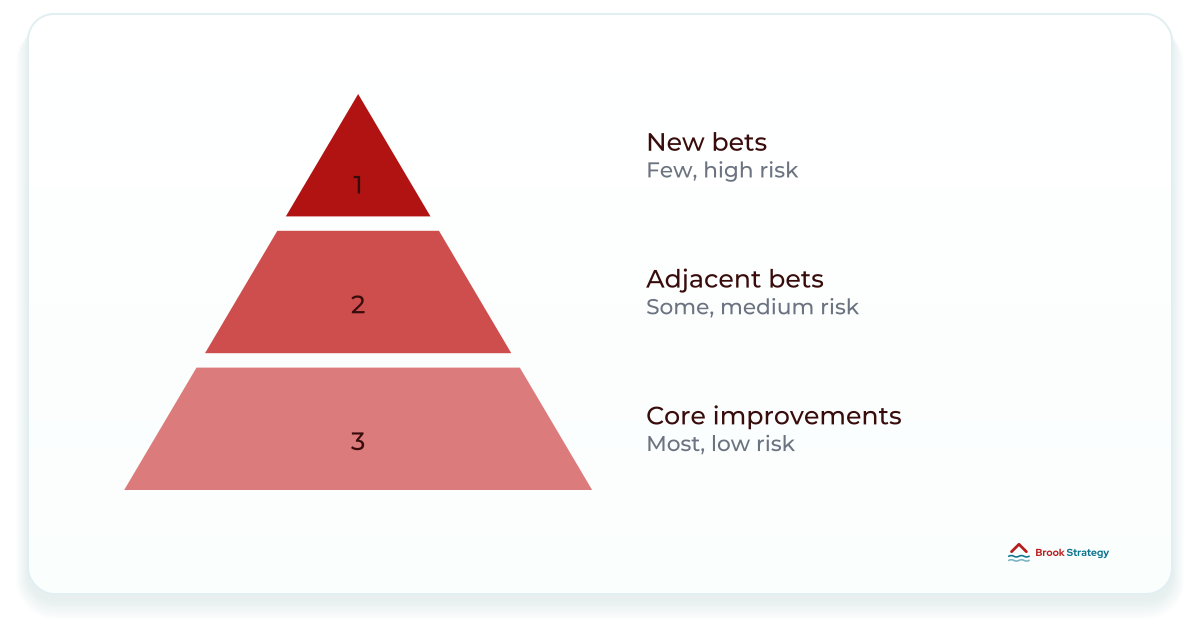
A portfolio balances three kinds of bets. Core bets improve what you already sell. Adjacent bets take your strengths into a nearby market or offer. New bets explore something far from today’s business. The three horizons model, popularised by McKinsey, describes the same idea, and Google’s often-quoted 70/20/10 rule of thumb for allocating effort follows a similar logic.
Pick a balance that matches your risk appetite and write it down. A young company may put most of its effort into adjacent bets, while a mature one may keep a protected share for new bets. Aim for three to five funded bets at any time. See how real companies mixed them in my innovation strategy examples.
Step 5: Test in Stages
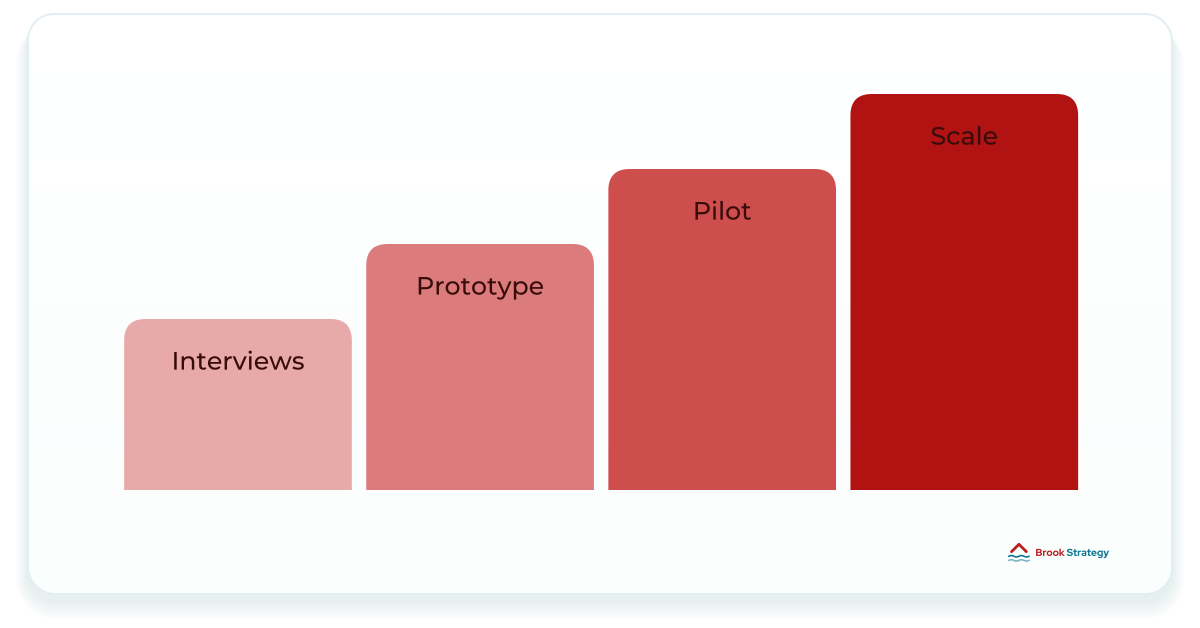
Each bet moves through stages, and each stage has a small budget and a clear question. Stage one asks whether the problem is real. Stage two asks whether customers want your solution. Stage three asks whether you can deliver it at a price that works.
Release money only when the evidence for a stage is in. At each gate, the team presents the result and the leader makes one of three decisions: go, change or stop. Write the criteria before the test starts, so nobody can adjust the bar after seeing the result.
Step 6: Review and Reset
Once a quarter, look at the whole portfolio. Which bets passed their gates? Which ones were stopped? What did you learn about the arenas? Then add new bets from the scored list to replace the ones that ended.
Keep a short scorecard: tests run, time from idea to first customer evidence, share of budget in new bets and revenue from new offers. Compare it with the targets in your innovation strategy roadmap, which sets the dates for these reviews over a year.
Who Does What in the Framework
A framework fails when nobody owns it. These are the roles I set up with clients. In small companies, one person may hold several of them.
| Role | Responsibility | Time needed |
|---|---|---|
| Executive sponsor | Protects the budget and makes final gate decisions | A few hours a month |
| Portfolio owner | Runs the scoring, the portfolio and the quarterly review | About a day a week |
| Bet owner | Runs the tests for one bet and reports results | Part of the week |
| Finance partner | Sets stage budgets and checks the numbers | A few hours a quarter |
A Worked Example: A Mid-Sized Software Company
Take a software company with 300 customers and slowing growth. In Step 1, it picks two arenas: finance teams in mid-sized companies, and partners who resell its product. In Step 2, it collects forty ideas from support, sales and customer calls. In Step 3, scoring cuts the list to six, and the usage-based pricing idea ranks first because it is cheap to test.
In Step 4, the portfolio holds four bets: the pricing option and a reporting add-on, both close to the core, one partner programme, which is adjacent, and one small exploration of a new customer type. Each gets a small first-stage budget. In Step 5, the pricing test runs with twenty customers for six weeks, and the gate asks for at least five who prefer the new option. Only two do, so the team changes the offer and tests again rather than scaling. The company runs the numbers in Step 6 at the end of the quarter.
The figures here are made up to show the sequence, but the pattern is realistic: small budgets, clear gate questions and one honest decision per bet. The slow part is rarely the testing. It is getting leaders to agree on the criteria in advance.
Questions Leaders Ask About Scoring
Two objections come up in almost every workshop. The first is that scoring is subjective. It is, and that is fine. The score does not replace judgment, it exposes it. When two leaders rate customer need differently, you can ask what evidence each one used, and the debate improves.
The second objection is that scoring kills bold ideas. A new-market idea will often score low on fit and cost, so keep a small protected share of the portfolio for such ideas and score them against each other, not against core improvements. That way you give them room without letting them drain the budget.
Where the Framework Usually Breaks
The first break is in Step 3. Teams skip the scoring, or they change the scores until their favourite idea wins. The second is in Step 5, where gates have no stop rule. The third is Step 6: the review is cancelled when the quarter gets busy, and the portfolio drifts.
Most of these come from a lack of sponsorship. Companies that treat innovation as a hobby of one enthusiastic manager lose the work when that person leaves. Name a sponsor with budget authority before you begin.
There is also a quieter failure: the framework works, but nobody tells the rest of the company. Share the scores, the portfolio and the stop decisions in a short note every quarter. Employees who see that ideas get a fair hearing, and that stopped bets are treated with respect, send better ideas the next time. If the process stays hidden, the idea list dries up within a year, and the whole framework loses its input.
How to Start With Your First Quarter
You can run a first version in about eight weeks. Here is the order I suggest:
- Weeks one and two: agree the arenas and the sponsor.
- Weeks three and four: collect ideas and write them in one format.
- Weeks five and six: score the ideas and pick the first portfolio.
- Weeks seven and eight: set the stage gates and start the first tests.
Keep the first version simple. A spreadsheet is enough for scoring, and you can add tools once the process is running.
Questions About the Innovation Strategy Framework
What Is an Innovation Strategy Framework?
It is a repeatable set of steps for deciding where to look for growth, which ideas to fund and how to test them. It gives teams one method for choosing between ideas and one rule for continuing or stopping.
How Many Steps Should an Innovation Framework Have?
I use six: arena, ideas, scoring, portfolio, staged testing and review. Frameworks with many more steps tend to produce documents instead of decisions.
Is the Scoring Formula an Industry Standard?
No. It is my own working formula, built from client projects. Use it as a starting point and change the factors or weights so they match your business. The value lies in using one method for every idea.
What Are the Three Horizons?
The three horizons model, popularised by McKinsey, splits work into improving the core, building adjacent businesses and exploring new options. It helps you check that you are not putting all your effort into one kind of bet.
How Many Bets Should a Company Run at Once?
Three to five funded bets is a good range for most mid-sized companies. Fewer may leave you too exposed to one outcome, and more usually spreads a small team too thin.
How Do I Stop a Bet Without Hurting the Team?
Agree the stop criteria before the test starts, review the result with the team and write down what was learned. People accept a stop decision more easily when the rule was set in advance and the learning is shared.
Can I Use This Framework Without Software?
Yes. A spreadsheet for scoring and a shared document for the portfolio are enough at first. Software helps once you collect ideas from many people or need portfolio reports for leaders.
Note: This article is general information, not legal, financial or tax advice. Figures and examples are estimates based on typical projects, so check current details with your providers and advisers before you decide.
Was this article helpful?
Thank you for letting us know.
Russell Tennant
Russell leads the Brook editorial team and works with our consultants to turn real client engagements into practical guides on roadmaps, go-to-market planning, growth and competitive strategy. Before joining Brook, he spent 11 years in strategy and product marketing roles at software and financial services companies. He has since edited more than 300 articles on strategy practice and drawn on roadmaps and growth plans from over 100 client projects. He is based in Denver, Colorado.