Key Takeaways
- The best innovation examples reuse a strength the company already has, such as infrastructure, data or customers.
- Each bet had a protected early phase, a sponsor and clear evidence rules.
- Several companies, such as Netflix and Adobe, changed the business model and not only the product.
- Plan for most of your own bets to stop early, and treat stop decisions as part of the process.
Innovation strategy is easy to describe and hard to see. The best way to understand it is to look at companies that made a clear choice about where to look for growth, funded it and kept going when the first results were slow. A good innovation strategy consulting engagement works the same way: choose a few bets, test them cheaply and stop the weak ones.
Below are twelve innovation strategy examples from software, retail, manufacturing, banking and consumer goods. I explain what each company did, why it worked and the steps you can adapt. The details come from public company history and my own reading of it, so I avoid precise financial claims.
What Counts as an Innovation Strategy
An innovation strategy answers three questions. Where will the company look for new growth? How much will it spend, and in what stages? And how will it decide to continue or stop? A product launch is not a strategy, and neither is a lab. Each example below shows at least one clear answer to those questions.
When I review a case, I look for a deliberate link to the core business. Companies that treat innovation as a side project tend to lose it at the first budget cut. The examples that last are the ones where new bets use the company’s strengths, customers or data.
The Twelve Examples at a Glance
The table lists the bet each company made and the lesson to take from it. Details follow in the numbered sections.
| Example | The bet | What you can learn |
|---|---|---|
| 1. Amazon Web Services | Sold internal infrastructure as a product | Look for strengths you already use internally |
| 2. Netflix | Moved from DVDs by mail to streaming | Cannibalise yourself before others do |
| 3. Adobe | Switched to subscriptions with Creative Cloud | Change the business model, not only the product |
| 4. Microsoft | Rebuilt around cloud services | Commit leadership attention to one bet |
| 5. LEGO | Opened product ideas to fans | Let customers propose, then apply strict rules |
| 6. 3M | Gave staff time for their own projects | Protect time and tolerate dead ends |
| 7. Intuit | Trained employees to run experiments | Teach a method, not only a mandate |
| 8. John Deere | Added precision agriculture technology | Add intelligence to a physical product |
| 9. Nike | Built digital services around its products | Connect products with ongoing engagement |
| 10. Google X | Created a unit for long-shot projects | Separate moonshots from the core budget |
| 11. DBS Bank | Rebuilt a bank as a digital company | Make a core-business change visible |
| 12. Shopify | Offered funding to merchants using their sales data | Use your own data to create a new service |
Amazon Web Services
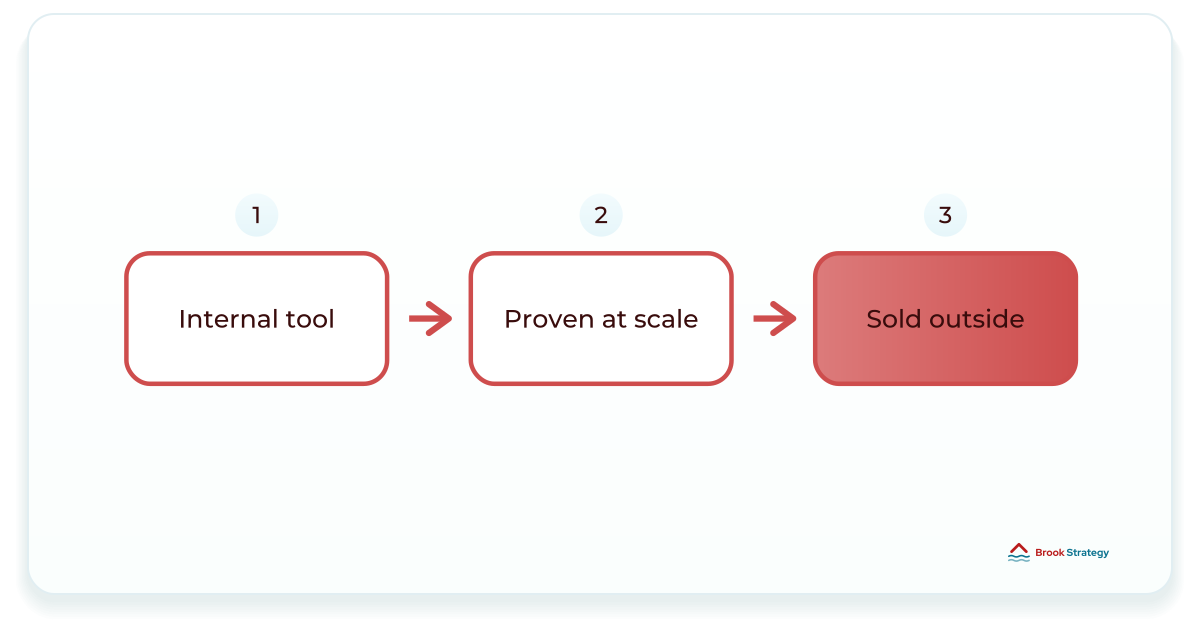
Amazon built large computing infrastructure to run its own store, and in 2006 it began selling that capacity to outside developers as Amazon Web Services. The company turned a cost centre into a product by noticing that its internal strength was a service others would pay for.
What worked was a clear link to the core. AWS reused skills, tools and data centre knowledge that Amazon already had, and it started with a small set of services. Many companies have a similar hidden strength, such as logistics, pricing know-how or a data set, that could become a separate offer.
How you can apply it
- List the internal capabilities your teams use every day.
- Ask which of them an outside customer would pay for.
- Interview five potential customers about the problem it solves.
- Launch a narrow version with a small team and separate metrics.
- Decide after two quarters whether to scale or stop.
Tools for this
A simple opportunity scorecard in a spreadsheet is enough to rank capabilities. A whiteboard tool helps run the customer interview synthesis.
Netflix
Netflix started by renting DVDs by mail and introduced streaming in 2007, while the mail business was still its main income. It accepted that streaming would eventually replace its own core service and chose to lead the change instead of defend the old model.
The lesson is timing. Netflix ran both models for years, and it moved investment gradually as customer behaviour changed. If you wait until the old business shrinks, you will have no money to fund the next one. Look for a small but real group of customers who already prefer the new way.
Steps to borrow
- Identify the customer behaviour that could replace your core offer.
- Find the small group that already behaves that way.
- Build a minimal version for them under a separate budget.
- Track adoption and revenue next to the old business.
- Shift investment as the numbers cross agreed thresholds.
Tools for this
Cohort analysis in your analytics tool shows which customers switch early. A portfolio tracker keeps the old and new bets side by side.
Adobe
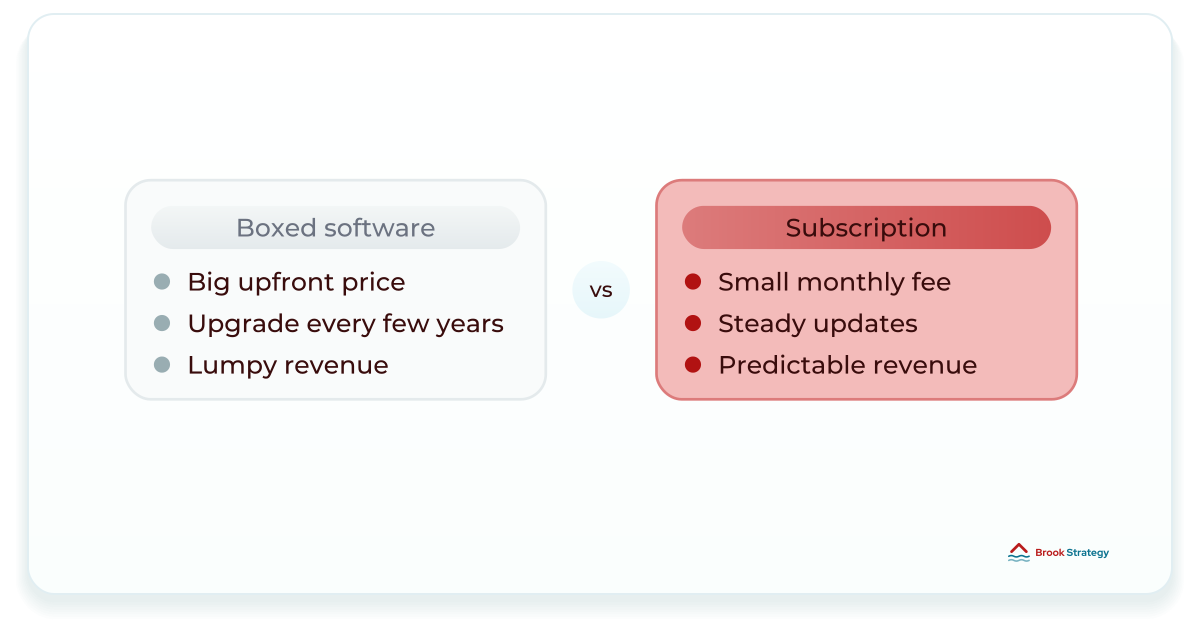
Adobe moved its Creative Suite software from one-time licences to the Creative Cloud subscription, which launched in 2013. Revenue fell at first, because customers paid monthly instead of up front, and the change needed investors and staff to accept a dip.
I use this example when a client’s innovation is really a business model change. The product barely changed, but pricing, delivery and the customer relationship did. It worked because Adobe now learned from usage data and could release updates continuously. Plan for the dip before you announce a change like this.
How it plays out
- Model the cash flow of the new pricing before you decide.
- Segment customers by how they will react.
- Pilot with new customers or one product line first.
- Prepare investors and your sales team for the transition period.
- Use the usage data to improve the product every quarter.
Tools for this
A financial model with a monthly cash view is the key tool. Billing software that supports subscriptions comes second.
Microsoft
After Satya Nadella became chief executive in 2014, Microsoft made cloud services, with Azure at the centre, the company’s main direction. Azure had launched in 2010, but the later choice to concentrate leadership time and budget on it changed the company’s trajectory.
The takeaway is about focus from the top. A bet that has no executive sponsor competes poorly with the core business for money and people. Microsoft also changed its attitude to open-source and partner tools, which removed friction that had slowed the cloud business before.
What you can take from it
- Name one bet as the company’s main direction.
- Give an executive a clear owner role and time to run it.
- Remove internal rules that slow the new bet, such as pricing conflicts.
- Report progress on the bet at every leadership meeting.
- Stop competing initiatives that dilute attention.
Tools for this
A one-page strategy map and a quarterly review calendar are enough. A shared dashboard keeps the bet visible to the leadership team.
LEGO
LEGO Ideas, which began as a Japanese site called Cuusoo and is now a platform on LEGO’s own site, lets fans submit set designs. A design that gathers 10,000 supporters goes to a review, and some become official products. The company also had a financial turnaround in the early 2000s, when it cut complexity and refocused on its core bricks.
Open submissions only work with strict rules. LEGO sets a vote threshold, a clear review and an agreed share for the creator. Without those, an open platform produces noise. The platform also gives LEGO market evidence before it commits to making a set.
A way to copy it
- Decide what kind of ideas you want and which you will not accept.
- Set a support threshold that triggers formal review.
- Publish the review criteria and the timeline.
- Tell every contributor what happened to their idea.
- Track how many accepted ideas reach the market.
Tools for this
Idea management software such as IdeaScale or Brightidea runs campaigns with voting and scoring. For a smaller group, a form and a shared tracker are enough.
3M
3M is known for letting technical staff spend a share of their time, often described as 15 percent, on projects of their own choosing. The Post-it note is often cited as a product that came out of that kind of freedom, and the practice still shapes how the company describes its culture.
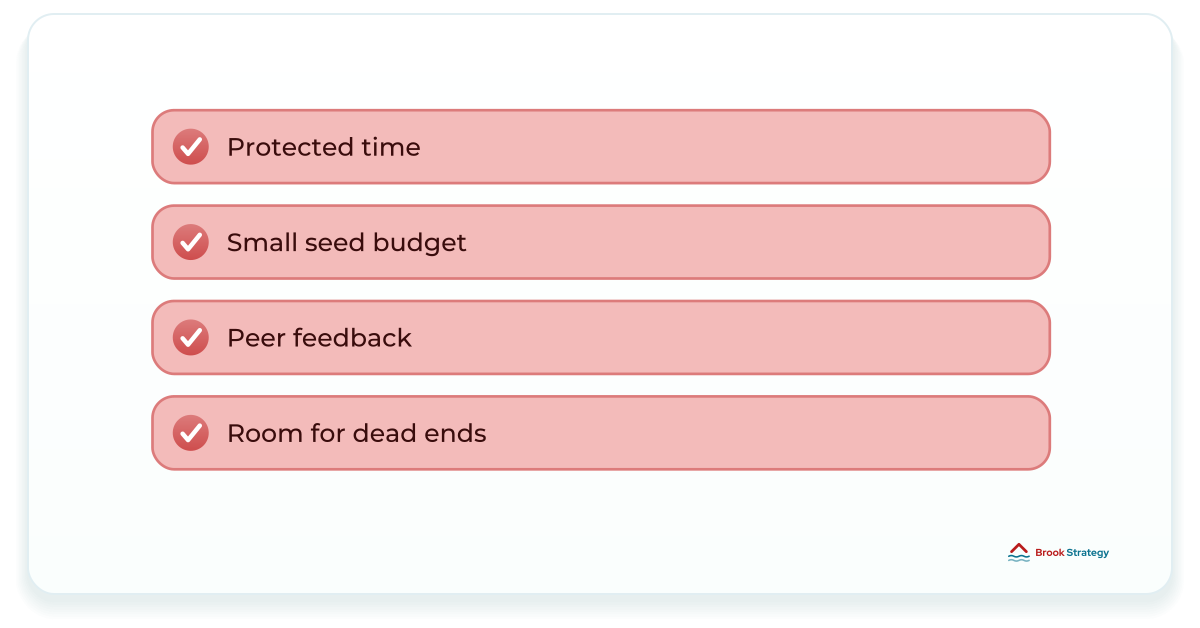
What I take from this is the protection of time. Free time without a path to funding only produces hobby projects, so 3M pairs it with ways to present ideas and get small grants. If you copy the idea, also copy the next step: a clear route from idea to a funded test.
How to try it
- Set a modest share of time and protect it in calendars.
- Ask people to write a one-page pitch for what they explore.
- Offer small seed grants through a short review.
- Share finished experiments, including those that failed.
- Review the programme yearly and stop it if nothing comes through.
Tools for this
A shared wiki or workspace such as Notion keeps pitches visible. A simple spreadsheet tracks time, grants and results.
Intuit
Intuit taught employees to run small experiments using a method it calls Design for Delight, based on customer empathy, wide idea generation and quick tests. The company has described how teams ran many experiments and used the evidence to decide what to build.
The method is the point. Many companies tell teams to innovate but give no way to do it. Intuit gave a common language, training and permission to test before building. That makes results comparable across teams, which helps portfolio decisions.
Steps you can follow
- Choose a short method and train a first group of teams.
- Require every project to state its riskiest assumption.
- Fund the cheapest test that could prove the assumption wrong.
- Review test results in a shared meeting each month.
- Promote the method by sharing results across teams.
Tools for this
An online whiteboard supports assumption mapping and test design. A tracker stores the experiments and results.
John Deere
John Deere added sensors, GPS and software to its machines, and in 2017 it bought Blue River Technology, a company working on computer vision for farming. The aim was precision agriculture, where machines apply seed, spray and fertiliser only where needed.
This is a good example for a company in a physical industry. The innovation extends a product customers already trust, and it creates a data and software layer on top. The company also had to build software skills, which it did partly through acquisition.
How you can apply it
- Look at what data your products could collect.
- Ask customers which decisions the data could improve.
- Pick one decision and build a simple service around it.
- Decide whether to build, partner or acquire the skills.
- Price the service separately from the hardware.
Tools for this
A product roadmap tool such as Aha! or Productboard helps manage the software side. Customer interviews show which decisions are worth supporting.
Nike
Nike built digital services around its products, starting with Nike+ in 2006, a running sensor made with Apple that tracked workouts. Later apps and memberships continued the idea: the product is a way into an ongoing relationship with the customer.
The strategic shift is from selling a shoe once to being part of a customer’s routine. That gives Nike data and a reason for customers to return. A company that sells a physical product can look for a similar service that keeps customers engaged between purchases.
A way to copy it
- Map how customers use your product after the purchase.
- Find a moment where a service would help them.
- Test a basic version, such as a guide or a tracker.
- Measure repeat use, not only downloads.
- Link the service to your next product sale.
Tools for this
Product analytics shows repeat use. A feedback tool collects what customers want next.
Google X
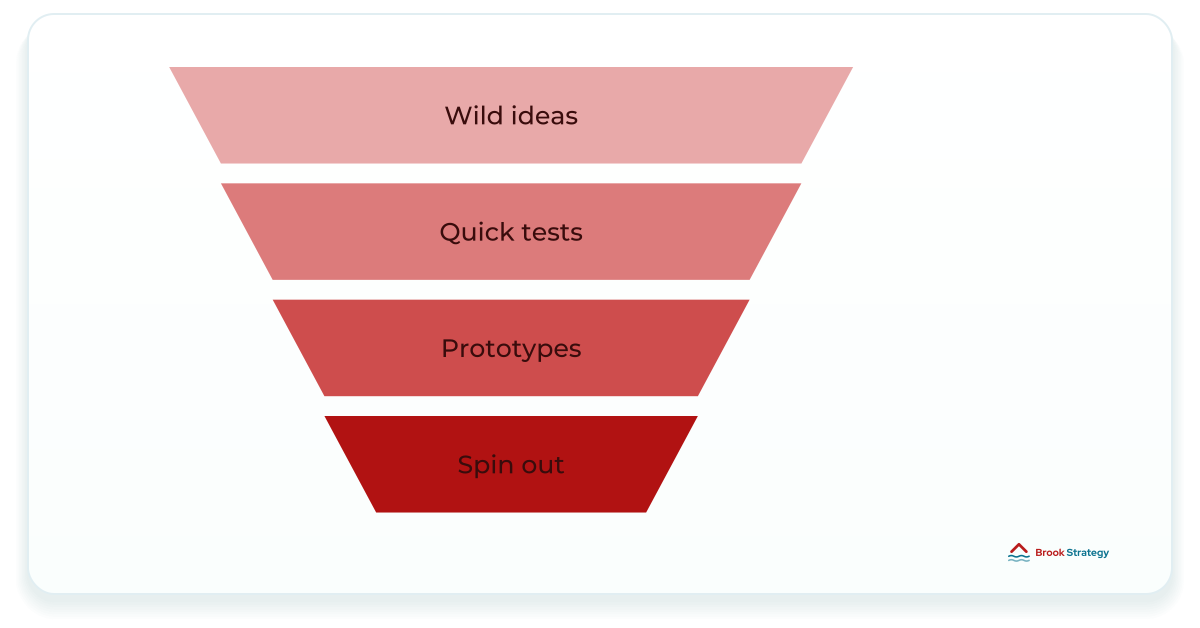
Google created X in 2010 as a unit for long-shot projects, away from the main business. Projects have an explicit process for being killed, and one of them, the self-driving car effort, became Waymo, a separate company under Alphabet in 2016.
The lesson is about separation and discipline. Moonshots live in their own unit with their own budget, so the core business does not have to carry the risk. It also makes stopping projects a normal part of the process. Most companies lack the funds for a unit like this, but the principle of a separate budget and clear kill rules still applies.
What a smaller version looks like
- Set aside a small, fixed budget for long-shot bets.
- Keep it separate from the budget of the core business.
- Define the evidence needed at each stage.
- Agree kill criteria before the project starts.
- Review the portfolio twice a year.
Tools for this
A portfolio tracker in Notion or a similar workspace is enough for a small set of bets. Larger programmes may add a dedicated innovation management platform.
DBS Bank
DBS, the Singapore bank, set out to operate like a technology company under chief executive Piyush Gupta, who took the role in 2009. It invested in engineering, redesigned customer journeys and launched digital banking brands such as digibank in India in 2016.
A bank is a hard place to innovate because of regulation and risk rules. DBS made the change visible by tying it to journeys customers noticed, such as opening an account without a branch visit. If you work in financial services, this shows how to build new bets inside a regulated business.
Steps you can follow
- Choose a journey customers find slow or painful.
- Bring risk and compliance into the design from the start.
- Build a digital version and test it with a small segment.
- Measure completion and time to finish.
- Expand to more segments once the process is stable.
Tools for this
Journey mapping on a whiteboard and funnel analytics show where customers drop out. A roadmap tool keeps regulatory checks on the plan.
Shopify
Shopify offered funding to merchants through Shopify Capital, which launched in 2016. It uses merchants’ sales history on its platform to decide who to offer money, and this is a service that competitors without that data cannot easily copy.
The strategic idea is to use data you already hold to create a new service. Shopify did not need a new customer base. It extended its relationship with the merchants it already served. Ask what your own data tells you about customers that they would value acting on.
How to try it
- List the data your platform collects about customers.
- Identify a problem that data could help solve for them.
- Check legal and regulatory limits early.
- Test the offer with a small group of customers.
- Track take-up and customer outcomes.
Tools for this
A data warehouse or analytics tool holds the data. A roadmap tool and a feedback system help refine the offer.
Patterns Across the Twelve Examples
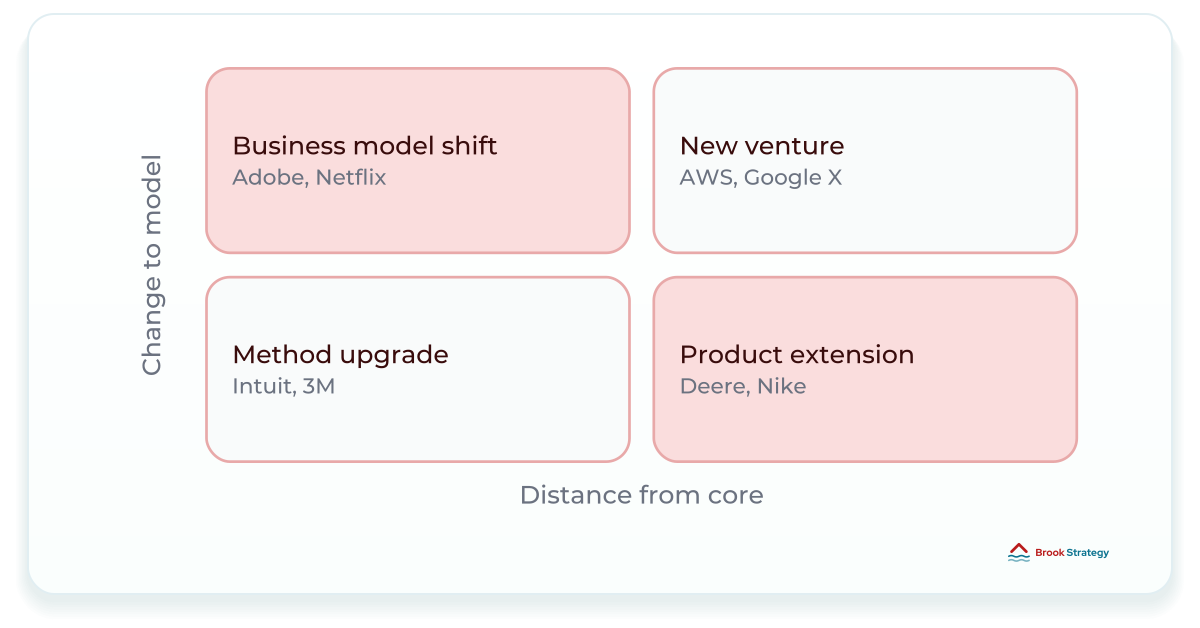
Three patterns show up in most of them. First, the bet used something the company already had: infrastructure, customers, data or engineering skill. Second, someone with authority protected the bet in its early, small phase. Third, the company set stages and evidence rules, so money followed proof.
The failures I see in my own client work are the mirror image. The idea has no link to the core, the sponsor leaves, or funding is all released at once. For a structured way to avoid those problems, my innovation strategy framework covers the steps in order, and the innovation strategy roadmap shows how to schedule them over a year.
How to Choose Which Example to Learn From
Match the example to your situation, not to the company you admire. Use these pointers:
- If you have a hidden strength, study Amazon Web Services and Shopify.
- If your core model is under threat, study Netflix and Adobe.
- If you want more ideas from your people, study 3M, Intuit and LEGO.
- If you work in a regulated or physical industry, study DBS and John Deere.
Whichever you choose, start with the tools that support your process. My ranking of innovation strategy tools compares nine options, with free and paid choices.
Questions About Innovation Strategy Examples
What Is an Innovation Strategy?
It is a plan that says where your company will look for new growth, how much it will spend at each stage and how it will decide to continue or stop. It connects new bets to the strengths of the core business.
What Is a Good Example of an Innovation Strategy?
Amazon Web Services is a clear one: Amazon turned internal infrastructure into a product for outside customers. Netflix moving from DVDs to streaming and Adobe moving to subscriptions are also strong examples, because each made a deliberate choice about the business model.
How Is Innovation Strategy Different from R&D?
R&D is a function that does research and development work. Innovation strategy decides which kinds of work to fund, in which markets and with what rules. A company can have a large R&D department and still lack an innovation strategy.
Can a Small Company Learn from These Examples?
Yes. The scale is different, but the logic carries over. A small company can pick two or three bets, run cheap tests, set a stop rule and review monthly. Small teams often move faster because fewer people need to agree.
Why Do Most Innovation Strategies Fail?
The common reasons are no link to the core business, no executive sponsor, too many bets at once and no rule for stopping. Funding everything equally and for too long is another frequent cause.
How Much Should a Company Spend on Innovation?
There is no single figure, and it varies by industry. A common practice is to set a fixed share of budget for new bets and release it in stages as evidence arrives. Decide the share with your finance lead and review it each year.
How Do I Measure Whether Innovation Is Working?
Track the number of tests run, the time from idea to first customer evidence, the share of budget in new bets and revenue from new offers after a fixed period. Review them every quarter and compare them against the targets you agreed.
Note: This article is general information, not legal, financial or tax advice. Figures and examples are estimates based on typical projects, so check current details with your providers and advisers before you decide.
Was this article helpful?
Thank you for letting us know.
Russell Tennant
Russell leads the Brook editorial team and works with our consultants to turn real client engagements into practical guides on roadmaps, go-to-market planning, growth and competitive strategy. Before joining Brook, he spent 11 years in strategy and product marketing roles at software and financial services companies. He has since edited more than 300 articles on strategy practice and drawn on roadmaps and growth plans from over 100 client projects. He is based in Denver, Colorado.