Key Takeaways
- A startup framework is a sequence of tests, not a three-year forecast.
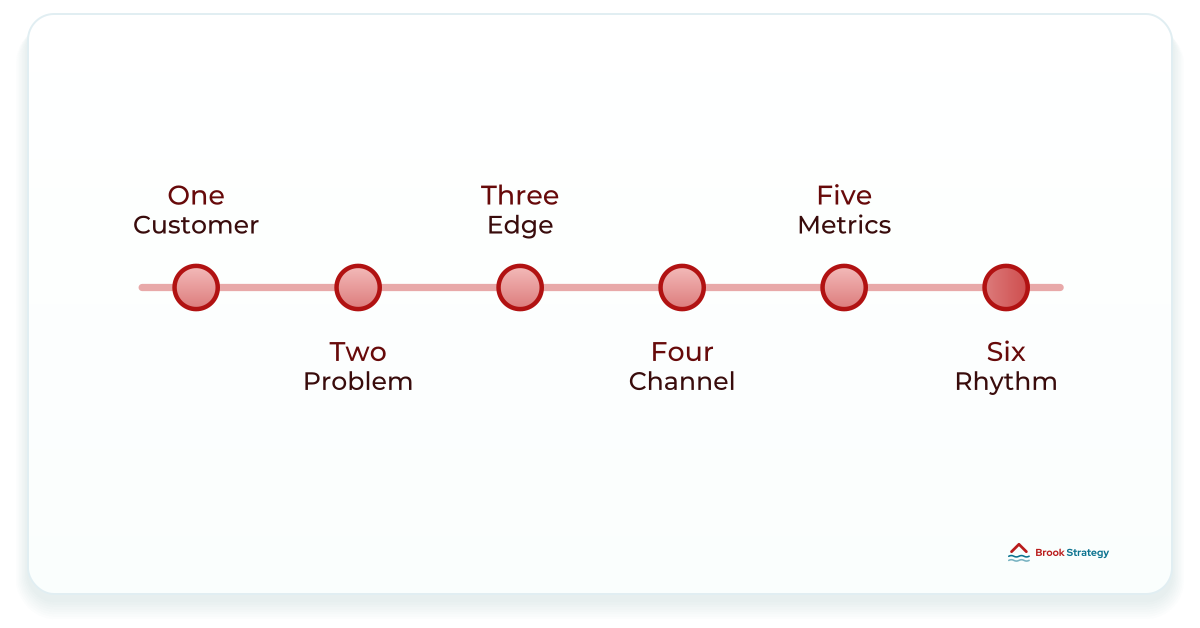
- Six phases cover customer, problem, edge, channel, metrics and rhythm, each with a stop rule.
- The result fits on one page, so founders, hires and investors read the same plan.
- Narrow the segment before you widen the offer, since a wide segment hides every pattern.
Most early-stage teams do not lack ideas. They lack an order in which to test them. After working on startup plans with many founders, I use the same six phases almost every time, because they force the cheap questions before the expensive ones. This is the same method behind startup strategy consulting work, written so you can run it yourself.
Below is the framework, a formula to keep it in your head, an overview of all six phases and the detail of each one, including the stop rule that tells you when to change course.
The Formula Behind the Framework
I summarize the whole thing in one line: Strategy equals a Sharp Customer, plus a Real Problem, plus an Edge, delivered through One Channel, tracked by a Few Metrics, reviewed on a Fixed Rhythm. Each term is a phase. If any of them is blank, the plan has a hole, and that hole is where your runway leaks.
The order matters. Founders often start with the channel, because ads and outbound feel like progress. But you cannot choose a good channel until you know who you are reaching and what they will pay to fix.
Six Phases in Brief
| Phase | Question it answers | Typical time | Stop rule |
|---|---|---|---|
| 1. Sharp Customer | Who pays first? | 1 week | No segment shows repeated pain after 15 interviews |
| 2. Real Problem | What do they pay to fix? | 1 to 2 weeks | Fewer than 3 in 10 would pay or pilot |
| 3. Edge | Why you and not the alternative? | 1 week | Buyers cannot name a difference |
| 4. One Channel | How do you reach them? | 4 to 8 weeks | Cost per customer above your set ceiling |
| 5. Few Metrics | How will you know it works? | 1 week | More than five measures on the page |
| 6. Fixed Rhythm | When do you decide again? | Ongoing | Reviews that change nothing |
Phase 1: Choose a Sharp Customer
Write down the customer in one sentence with a role, a company type and a trigger, for example: finance leads at fintechs with 50 to 200 staff who just failed an audit. A description like small businesses or enterprises is not a customer, it is a market. The sharper the sentence, the easier every later phase becomes.
Book fifteen to twenty interviews inside that segment. Ask what they did the last time the problem hit, what it cost and what they tried. I stay away from asking whether they would buy, since polite people say yes. If answers scatter in every direction, the segment is too wide, so narrow it and run another round.
Stop rule: if no segment shows the same pain across most interviews, do not move on. Pick another segment or rethink the idea, since every later phase builds on this one.
Phase 2: Confirm a Problem They Pay to Fix
Pain is not enough. Plenty of problems are real and still not worth money. You are looking for a problem that already has a budget, a workaround or a person who loses sleep over it. A workaround is the best signal: spreadsheets, manual steps and expensive agencies all show that people already pay in time or cash.
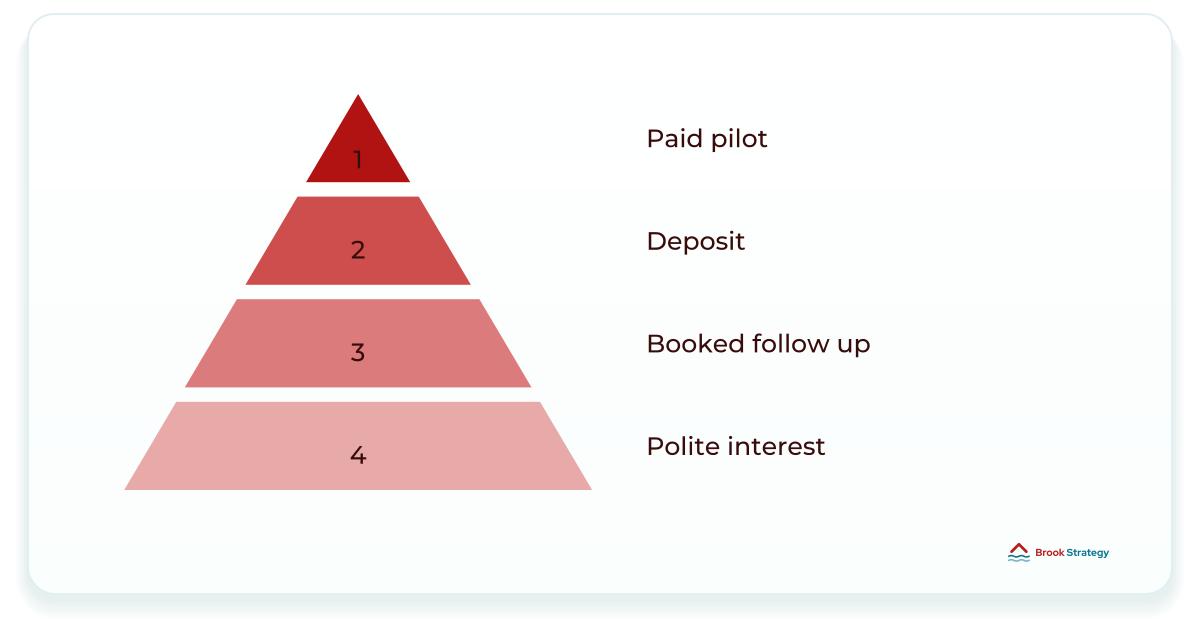
Test willingness to pay early. Offer a paid pilot, a deposit or a signed letter of intent to the people you interviewed. In my client work, a quarter of interviewees who said they loved the idea would not take any of these steps, and the ones who did became the first customers. If fewer than three in ten commit, the problem is not painful enough yet.
Phase 3: Define Your Edge Against the Real Alternative
Your competitor is rarely another startup. It is a spreadsheet, an agency or doing nothing. Ask each interviewee what they use today and what they dislike about it. Your edge is the one reason a buyer picks you over that alternative, written in their words, not yours.
I keep the edge to a single sentence and test it in five sales conversations. If buyers keep restating it differently, it is too vague. For a deeper look at where an edge shows up in practice, the stories in my startup strategy examples are a good reference.
Phase 4: Pick One Channel and Run It Properly
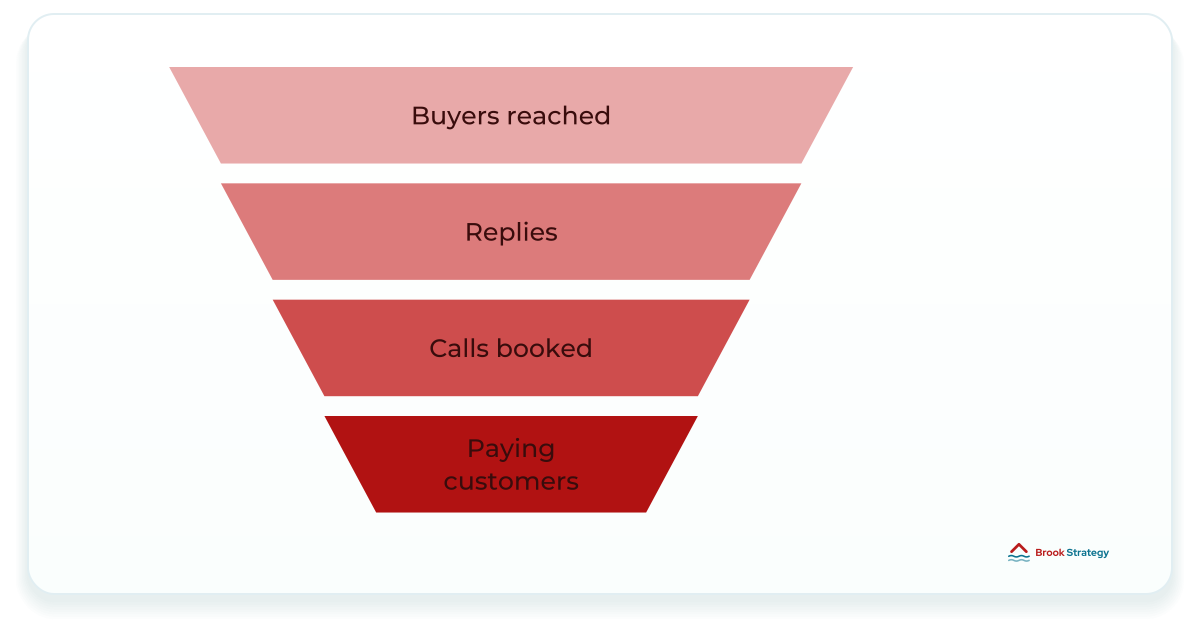
Most teams try four channels for a month each and learn nothing. Pick one that fits your buyer, such as outbound email for a narrow B2B list, partnerships for regulated buyers or content for a long research cycle. Give it a budget, a time limit and a cost ceiling per customer before you start.
Eight weeks is usually enough to see whether a channel can work. If cost per customer sits far above your ceiling, change the message first, then the channel. Do not add a second one until the first produces predictable results. The same one-channel rule appears in the lean setups I compare in my list of startup tools, where each tool supports one core motion.
Phase 5: Set a Few Metrics That Decide Things
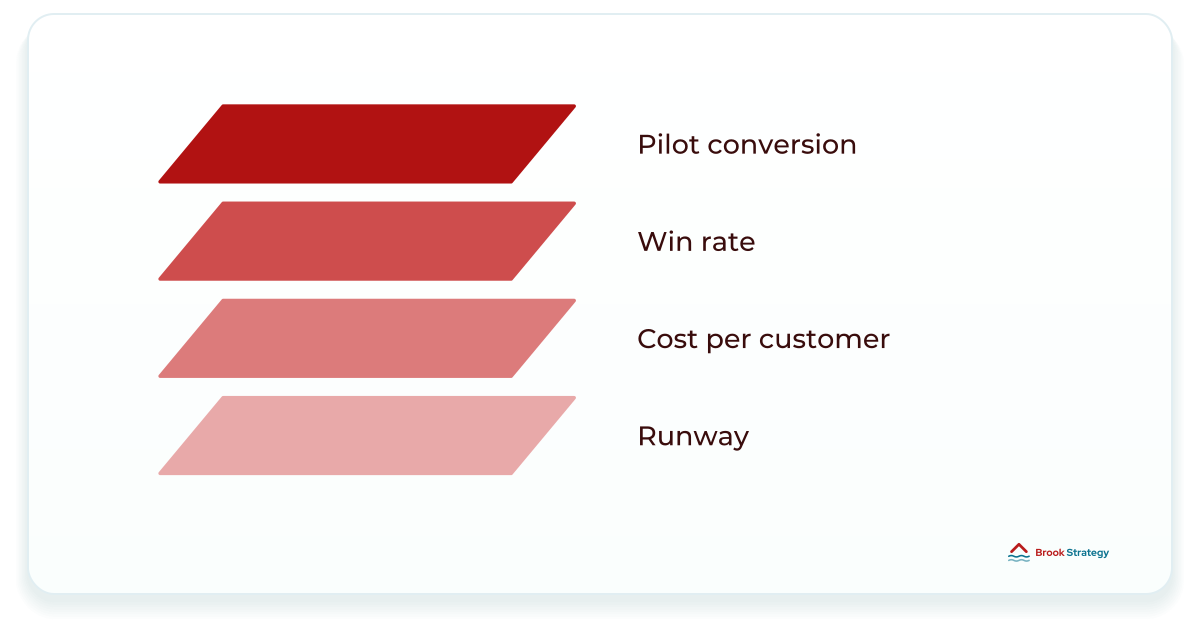
Pick one measure per phase and no more than five on the page. For customers, track interview patterns. For the problem, track pilot conversion. For the edge, track win rate. For the channel, track cost per customer. For the business as a whole, track months of runway. Write the number that would change your plan beside each one.
Founders often add vanity numbers such as followers and sign-ups. Keep them off the page unless they predict revenue. The page is a decision tool, so a measure that never changes a decision does not belong on it.
Phase 6: Fix a Rhythm for Decisions
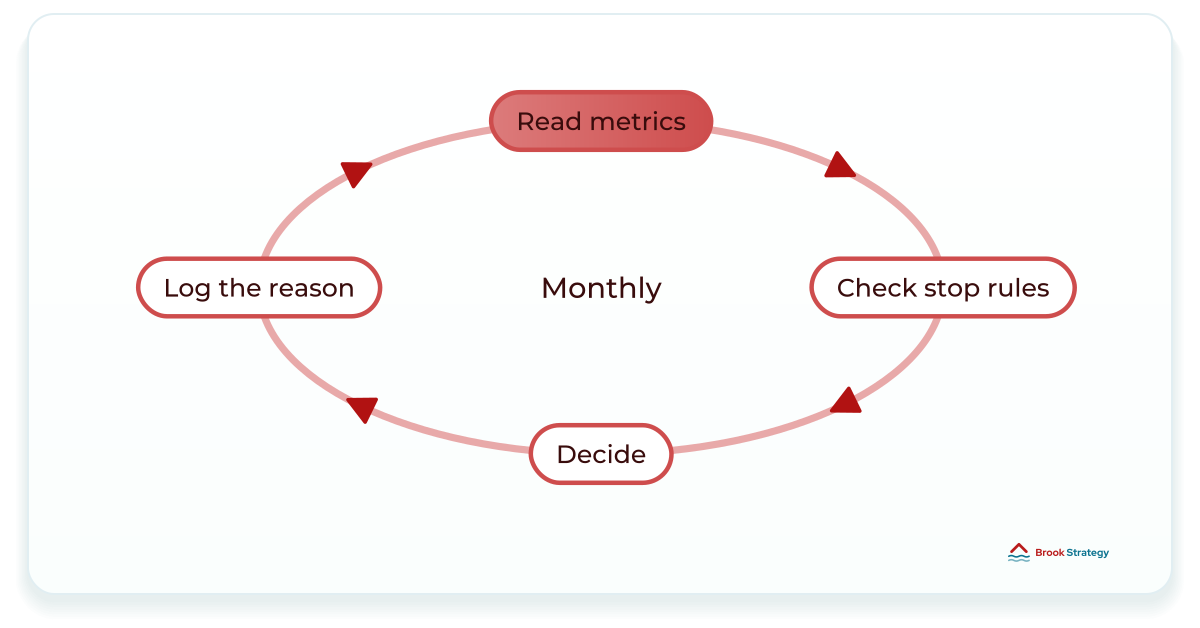
Strategy dies without a calendar. I suggest a 45-minute monthly review and a half-day reset each quarter. In the monthly meeting, look at the five metrics, and ask whether any stop rule has fired. In the quarterly reset, re-read the customer sentence and the edge, and decide whether the evidence still supports them.
Write down every change and its reason. After a year, the log shows you how your thinking improved, and it is the first thing investors and new hires ask to see.
The One-Page Output
When the six phases are done, put the results on one page. Each line is a sentence or a number, and the page should be readable in two minutes.
| Line | Example for a B2B fintech tool |
|---|---|
| Customer | Finance leads at fintechs with 50 to 200 staff |
| Problem | Audit evidence collected by hand every quarter |
| Edge | Evidence gathered automatically from existing systems |
| Channel | Outbound to a list of 300 named accounts |
| Metrics | Pilot conversion, win rate, cost per customer, runway |
| Rhythm | Monthly review, quarterly reset |
A Worked Pass Through the Six Phases
A compliance software startup came to me with a product for every regulated company. Phase 1 cut that to compliance leads at payment firms, after 17 interviews showed that audit preparation hurt them most and the other groups barely cared. Phase 2 found a workaround: a quarterly spreadsheet sprint that took a team of three about two weeks. Five of the ten interviewees agreed to a paid pilot.
In phase 3, buyers described the alternative as a consultant plus a spreadsheet, so the edge became finishing in days instead of weeks. Phase 4 picked outbound to 300 named accounts with a cost ceiling per meeting. Phase 5 limited the page to four numbers. Phase 6 set a monthly review. The whole pass took five weeks, and the founders dropped two planned features along the way, which saved more than the project cost.
Where Teams Break the Framework
The same errors come back often. Skipping interviews because the founder already knows the market is the most common, followed by treating interest as demand. Teams also keep a stop rule on paper and then ignore it when it fires, usually because the product took a year to build.
A quieter failure is running the framework once and filing it away. Markets and customers change, and the plan has to follow. Put the quarterly reset in the calendar now, before the plan feels finished, and ask someone outside the team to hold you to it.
One more habit helps: when a stop rule fires, hold a short meeting with a single question, which is what you now believe that you did not believe last month. Write the answer in the log, then decide whether to change the customer, the problem or the edge. The earlier the phase you change, the more of the later work has to be redone, so pay attention to where the evidence points before choosing the fix.
Deciding Where to Begin
If you already have paying customers, begin with phase 3 and write down your edge in their words. If you have none, start at phase 1. Check yourself against these points:
- You can name ten real companies that fit your customer sentence.
- At least three of them have committed money or time to a pilot.
- You know which alternative they use today.
- You have a budget and a time limit for one channel.
If you can answer yes to fewer than two, the first two phases come before anything else, even if the product is built.
Questions About the Startup Strategy Framework
What Is a Startup Strategy Framework?
It is a repeatable way to decide who you serve, what problem you solve, why you win and how you reach customers, with measures that show whether you are right. Mine has six phases and a one-page output, so a small team can finish it in a few weeks.
How Is a Startup Framework Different from a Business Plan?
A business plan tries to predict the next three years. A startup framework assumes you are guessing and builds tests into every phase. You update it every quarter as evidence comes in, instead of defending a document you wrote at the start.
How Long Should the Framework Take to Complete?
Three to six weeks for most teams, depending on how many customer interviews you can book. The first draft of the one-page plan should be ready by the end of week two. After that, you are testing and adjusting, not writing.
How Many Customers Should I Interview?
Fifteen to twenty interviews inside one segment usually show clear patterns. If answers keep surprising you after twenty, your segment is too broad. Narrow it and run another round.
When Does a Startup Need More than One Strategy?
Rarely before product-market fit. Until you have a repeatable way to win one segment, extra strategies split your attention. Add a second segment or product line only when the first one runs without the founders pushing every deal.
Which Metrics Belong on the One-Page Plan?
One metric per phase: interview findings for the customer, activation or pilot conversion for the problem, win rate for positioning, cost to acquire a customer for the channel and months of runway for the budget. More than five and the page stops being read.
Can I Run This Framework Without a Consultant?
Yes, many founders do. An outside partner helps most with interviews, because customers talk more freely to a neutral person, and with the stop rules that founders tend to soften. Start on your own and call for help where you get stuck.
Note: This article is general information, not legal, financial or tax advice. Figures and examples are estimates based on typical projects, so check current details with your providers and advisers before you decide.
Was this article helpful?
Thank you for letting us know.
Russell Tennant
Russell leads the Brook editorial team and works with our consultants to turn real client engagements into practical guides on roadmaps, go-to-market planning, growth and competitive strategy. Before joining Brook, he spent 11 years in strategy and product marketing roles at software and financial services companies. He has since edited more than 300 articles on strategy practice and drawn on roadmaps and growth plans from over 100 client projects. He is based in Denver, Colorado.