Key Takeaways
- The strongest startup strategies are small tests with a number, a date and a stop rule.
- Narrowing to one segment beats serving three at once.
- A paid pilot proves demand faster than a finished product.
- Set a cost ceiling and a time limit before you start any channel test.
Founders often ask me for a startup strategy and expect a grand document. What works is smaller: a handful of moves that swap guesses for evidence. Each of the seven examples below comes from early-stage SaaS and fintech work, and the details are anonymized. They are the habits I reach for first in startup strategy consulting.
For every example, you see what the team did, what changed, and the steps to copy it. Results come from my own client work, so treat them as ranges, not promises.
The Seven Examples at a Glance
| Example | Question it answers | Time to run |
|---|---|---|
| 1. Narrow to One Vertical Before Scaling | Who should we sell to? | 2 to 4 weeks |
| 2. Customer Interviews Before the Roadmap | What do customers need? | 2 to 3 weeks |
| 3. Pricing Test With Three Tiers | What should we charge? | 4 to 6 weeks |
| 4. One Channel With a Cost Ceiling | How do we reach buyers? | 8 weeks |
| 5. Paid Pilot Before Building | Will they pay? | 6 to 8 weeks |
| 6. Runway Milestones With Stop Gates | Are we on track? | Quarterly |
| 7. Founder-Led Sales Playbook | Can we hire for sales? | 3 to 4 weeks |
Seven Startup Strategy Moves in Detail
Narrow to One Vertical Before Scaling
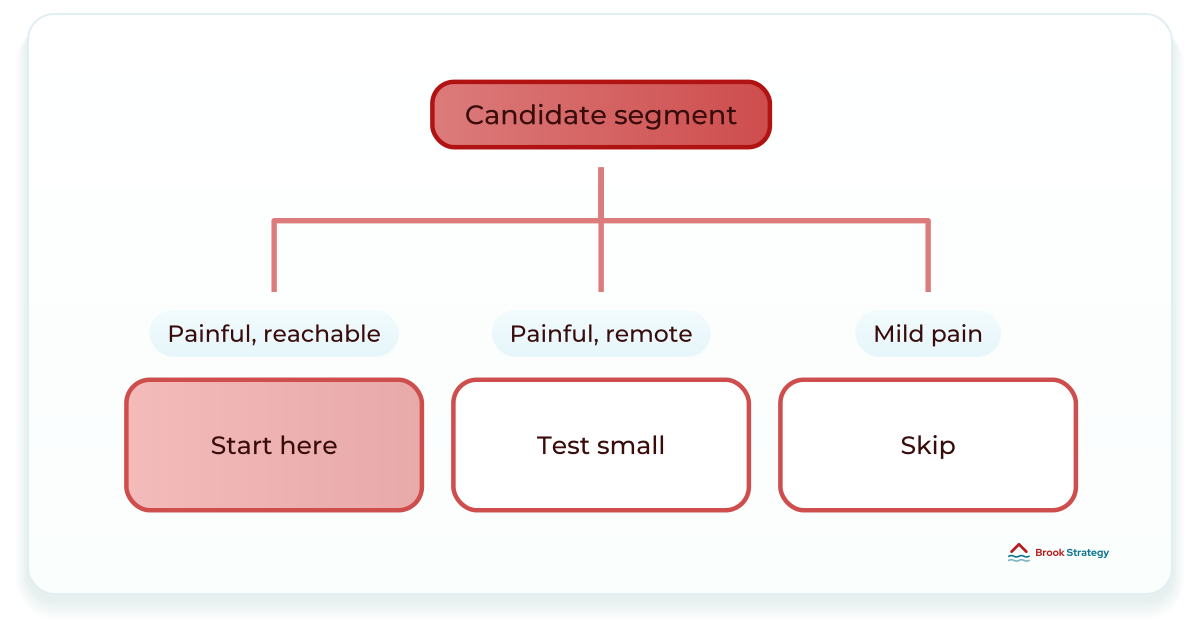
A workflow software startup sold to law firms, banks and agencies, and closed deals in none of them quickly. The founders looked at 22 closed and lost deals and found that mid-sized insurers had the shortest sales cycle and the highest renewal intent. They dropped the other two segments from the website, the outbound lists and the roadmap. Within two quarters, their sales cycle in the chosen segment was roughly half as long as before.
The hard part was saying no to a warm lead from a bank. They sent it to a partner instead. That single refusal told the team the focus was real, and it freed the product lead to build for one buyer.
How to Run the Same Focus Test
- Export your last 20 to 30 deals, won and lost.
- Tag each by industry, company size and buyer role.
- Compare cycle length, price and renewal intent per tag.
- Pick the one segment that wins fastest.
- Remove the others from site copy and outbound lists for a quarter.
What You Will Need
A spreadsheet and your CRM export are enough. Add a short call with five lost buyers to check your reading of the data.
Customer Interviews Before the Roadmap
A B2B startup had a roadmap of 40 features, all requested by someone. The founder ran 18 interviews in three weeks and asked only about the last time the problem hit. Three problems came up in most calls. The roadmap shrank to three themes, and the team stopped building a feature that only one loud customer wanted.
I like this example because it costs almost nothing. The only requirement is that you listen to stories about the past instead of asking people what they would like in the future.
How the Interview Round Works
- Pick one segment and book 15 to 20 calls.
- Ask for the last time the problem happened.
- Record what they did, what it cost and what they tried.
- Tag each story by problem.
- Build only the themes that show up in most calls.
Tools for the Round
A call recorder and a shared notes document cover it. Write quotes down word for word, since your memory will smooth them out.
Pricing Test With Three Tiers
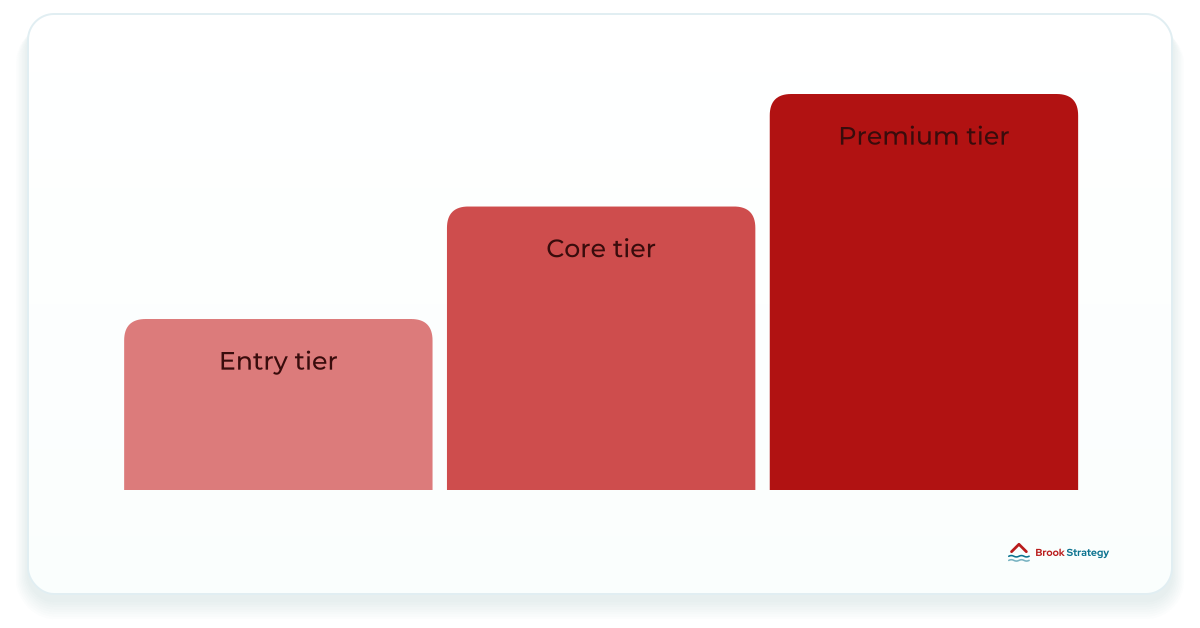
A developer tools startup charged one flat price and lost many small teams. They tested three tiers over six weeks, showing each new visitor one of two price pages. The middle tier took the largest share, and revenue per account rose noticeably without hurting conversion. They kept the test small and ended it when the data was clear.
The surprise was that the cheapest tier was rarely chosen. It still did its job, since it made the middle tier look reasonable. Do not judge a tier by how many people buy it alone.
How to Run a Simple Price Test
- Define two or three tiers with clear limits.
- Split new visitors across two price pages.
- Run for at least four weeks or 200 visitors per page.
- Compare conversion and revenue per visitor.
- Keep the winner and note why it won.
What the Test Needs
A landing page tool that supports split tests, or two URLs and manual tracking. Payments run through your normal provider.
One Channel With a Cost Ceiling
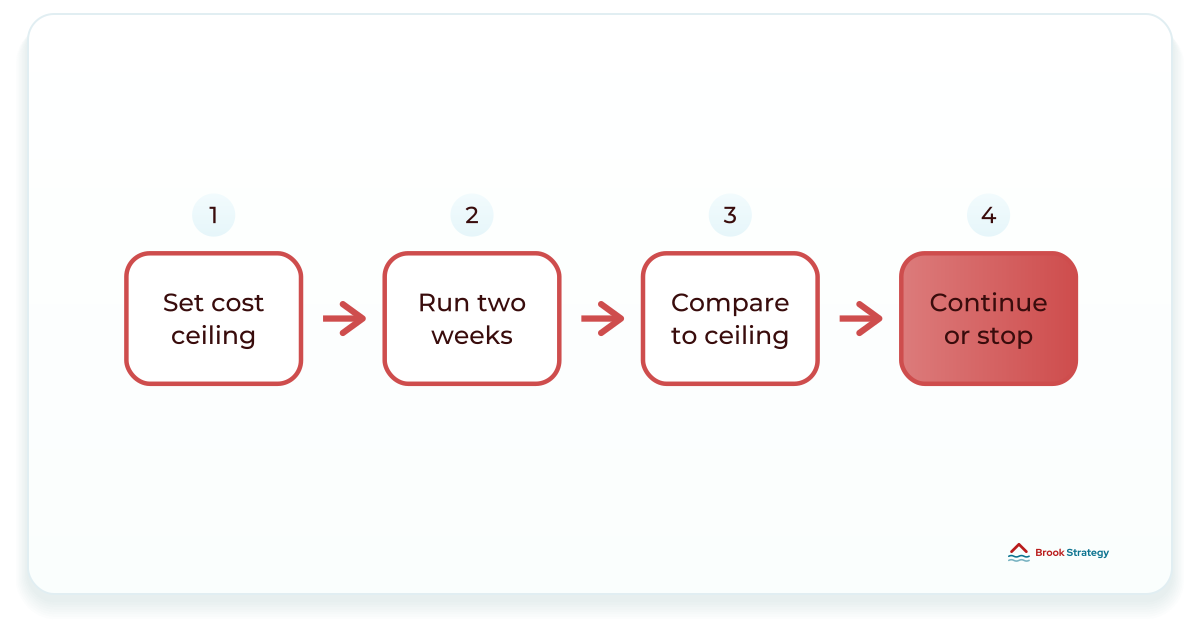
A fintech startup tried ads, events and cold email in the same quarter and could not tell which worked. They picked outbound email to a list of 300 named accounts and set a ceiling for cost per booked meeting before they started. In eight weeks the channel booked meetings at a fraction of the ceiling, so they kept it and ended the others.
The ceiling mattered more than the list. When the first two weeks ran far above it, the team rewrote the message, not the channel. That change cut cost per meeting by about half.
How to Set the Test
- Choose the channel that best matches how your buyers research.
- Set a budget, a time limit and a cost ceiling.
- Run it for eight weeks with one message at a time.
- Change the message before the channel.
- Stop or scale on the date you set.
Stack for One Channel
A prospecting list, an email tool and a CRM is enough for outbound. My list of startup tools compares options for each part.
Paid Pilot Before Building
A health-finance startup wanted to build a full platform. Instead, it offered ten prospects a paid pilot at a reduced price, delivered mostly by hand. Six signed. The founders learned which steps customers valued, and they automated those first. The pilot revenue also covered three months of runway.
Doing the work manually felt wrong to the engineers. It gave the team evidence that would have taken a year to collect with software.
How to Set Up a Paid Pilot
- Define a narrow outcome the pilot will deliver.
- Price it below the planned list price, but above zero.
- Deliver it by hand where you can.
- Note which steps customers use most.
- Automate only those steps.
What You Will Need
A simple contract, an invoice tool and a shared tracker. Keep the scope to six or eight weeks.
Runway Milestones With Stop Gates
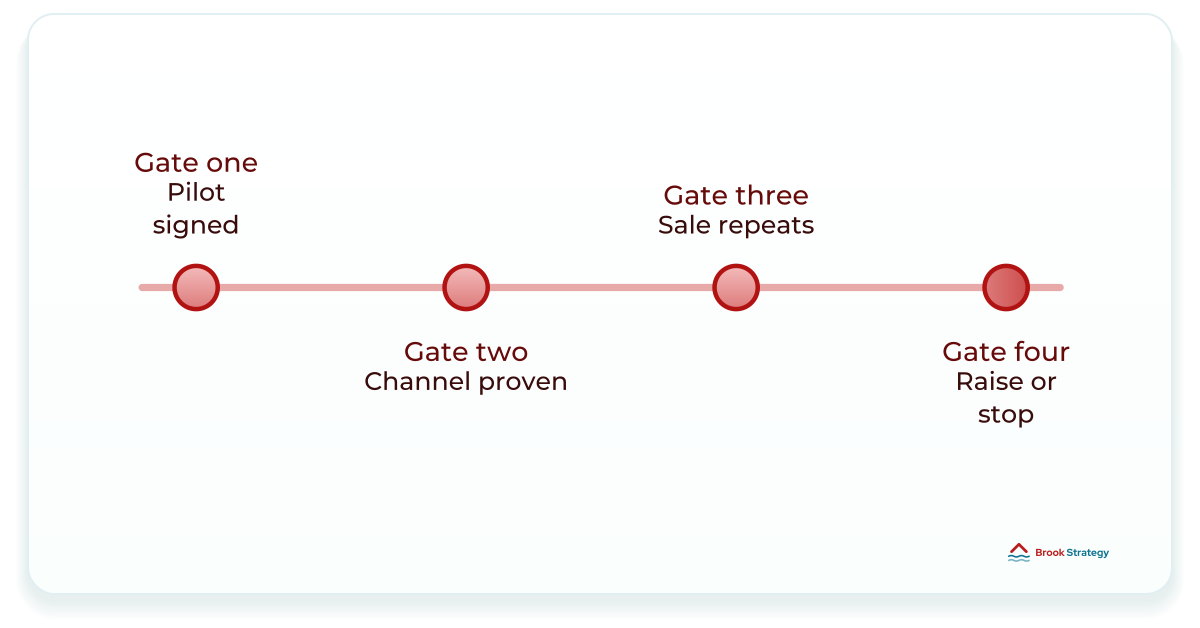
A seed-stage SaaS company with 14 months of cash split its plan into three milestones, each with a number and a date. At the first gate, it had hit only half of its target. The team stopped a second product line and moved two engineers back to the core product. By the second gate, the core numbers were on track.
The stop gate gave the founders permission to make an unpopular call. Without it, the second product would have run another half year.
How to Set Milestone Gates
- Divide your runway into three or four periods.
- Set one number and one date for each.
- Define what you will stop if you miss it.
- Review at each gate with your board or advisers.
- Record the decision and the reason.
Tools for Tracking
A runway model in a spreadsheet and a monthly one-page update. Share the page with your investors, so gates are public commitments.
Founder-Led Sales Playbook
A startup with three sales conversations a week wanted to hire a salesperson. First, the founder wrote down how the best deals went: who the buyer was, which questions mattered and what closed the deal. That playbook became the hire's training guide. The new rep reached the first deals about a month sooner than the team expected.
You cannot hire your way out of an unclear sale. If the founder cannot explain how deals close, a new rep will rediscover it slowly and expensively.
How to Write the Playbook
- List your last 10 won deals.
- Note buyer role, trigger and objection for each.
- Write the five questions that opened each deal.
- Capture the pricing and next-step pattern.
- Test the playbook on your next five calls.
What You Will Need
A call recording tool and a shared document. If you want a full structure around this, the six steps in my startup strategy framework show where the playbook fits.
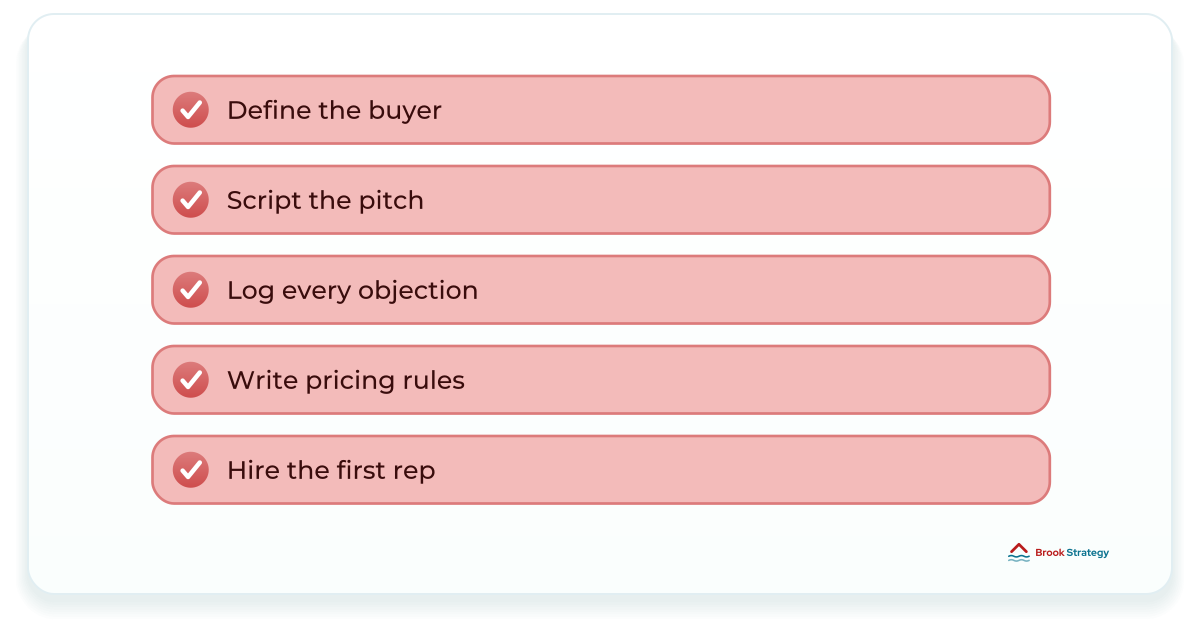
What the Seven Examples Have in Common
Every example starts with a question a founder could not answer from the desk, and ends with a decision. Teams that apply this kind of method keep the cost of being wrong small. Notice also that none of the seven needs a large budget. They need a person who owns the test and a date on which the decision gets made.
I also see the same mistake in all of them when they go wrong: the test runs but nobody commits to what would change the plan. Write the decision rule before you collect any data. If a result would not change what you do, you are measuring the wrong thing.
How to Choose Your First Move
Pick the move that attacks your most expensive uncertainty. If you cannot name your buyer, start with the segment test or interviews. If you know the buyer but not the price, run the price test. Check your pick against these points:
- It answers a question your next big decision depends on.
- You can finish it within a quarter.
- One person owns it and the result has a number.
- You decided in advance what result would change your plan.
If you want to see how these moves fit into one structure, the phases in my startup strategy framework put them in order.
Questions About Startup Strategy Examples
What Is a Good Example of a Startup Strategy?
Narrowing to one customer segment with a clear problem and a paid pilot is the example I see work most often. It is simple, cheap to test and gives you evidence for every later choice.
How Do I Pick Which Example to Copy First?
Pick the one that fixes your most expensive uncertainty. If you don't know who buys, start with interviews or a segment test. If you know the buyer but not the price, run the pricing test.
How Long Do These Tests Take?
Interviews take two to three weeks, a price test four to six, a channel test about eight and a paid pilot six to eight. You can run one or two at a time without overloading a small team.
Do These Examples Work Before Product-Market Fit?
Yes. Most of them are designed for that stage, since they swap guesses for evidence without needing a finished product.
How Much Money Do I Need to Test a Strategy?
Many tests cost your time and a small budget for tools or ads. The expensive mistake is building a product before running any of them.
What If a Test Fails?
A failed test is a result. Write down what you learned, change one variable and run it again, or drop the idea. The stop rules in my plans exist to make that decision quick.
When Should I Ask for Outside Help?
When your tests give mixed results and the team disagrees on what they mean. An outside strategist can run neutral interviews and help you set stop rules you will keep.
Note: This article is general information, not legal, financial or tax advice. Figures and examples are estimates based on typical projects, so check current details with your providers and advisers before you decide.
Was this article helpful?
Thank you for letting us know.
Russell Tennant
Russell leads the Brook editorial team and works with our consultants to turn real client engagements into practical guides on roadmaps, go-to-market planning, growth and competitive strategy. Before joining Brook, he spent 11 years in strategy and product marketing roles at software and financial services companies. He has since edited more than 300 articles on strategy practice and drawn on roadmaps and growth plans from over 100 client projects. He is based in Denver, Colorado.