Key Takeaways
- An SEO strategy framework has six blocks: goals, technical base, topic research, page plan, authority and measurement.
- A priority score, based on demand, buyer intent, win chance and effort, ranks topics so you start with the best return.
- Fix the technical base before you scale content, or new pages inherit old problems.
- Measure leads and revenue next to rankings, since traffic alone does not tell you whether the strategy works.
Most SEO plans start with a keyword export and end with a content calendar nobody can explain. A framework fixes that by giving you a fixed order of questions. If you want help applying it, SEO strategy consulting follows the same logic.
Below are the six blocks I use, the formula I use to rank topics and a worked example with numbers. At the end, you get a short way to check whether your current plan has all six blocks.
What an SEO Strategy Framework Is
A framework is the decision logic behind your plan. It answers which topics to target, which pages to build, which fixes to make first and how you will judge the result. It is different from a tool, which supplies data, and different from a schedule, which supplies dates.
The benefit is consistency. When a new competitor appears or traffic dips, you do not rewrite the plan from scratch. You return to the block that changed, update it and let the rest follow. Teams with a framework also argue less, because disagreements point to a specific block and a number.
| Block | Question it answers | Output |
|---|---|---|
| 1. Goals and Audience | What should search deliver, and for whom? | Target outcomes and buyer profiles |
| 2. Technical Base | Can search engines crawl and index the site well? | A ranked list of fixes |
| 3. Topic Research | What do buyers search, and where can you win? | A scored topic list |
| 4. Page Plan | Which pages, in which format? | Page types, briefs, internal link map |
| 5. Authority | Why would search engines trust you? | A link and mention plan |
| 6. Measurement | How do you know it works? | Dashboard and review rhythm |
Block 1: Goals and Audience
Start with the business result, not the ranking. Pick one primary outcome such as qualified leads, trial sign-ups or revenue from organic visitors, and a secondary one such as brand reach. Then describe the buyer in two or three lines: who they are, what they search and what they need to see before they get in touch.
This block sets the filter for everything that follows. A topic with huge volume that attracts students is a poor fit for a software vendor that sells to finance teams. Writing the goal down first lets you say no to those topics with a reason.
Block 2: Technical Base
Before you add pages, check that the site can be crawled, indexed and loaded quickly. Run a crawl, open the indexing report in Google Search Console and list the problems: blocked pages, duplicate versions, broken redirects, slow templates and missing structured data.
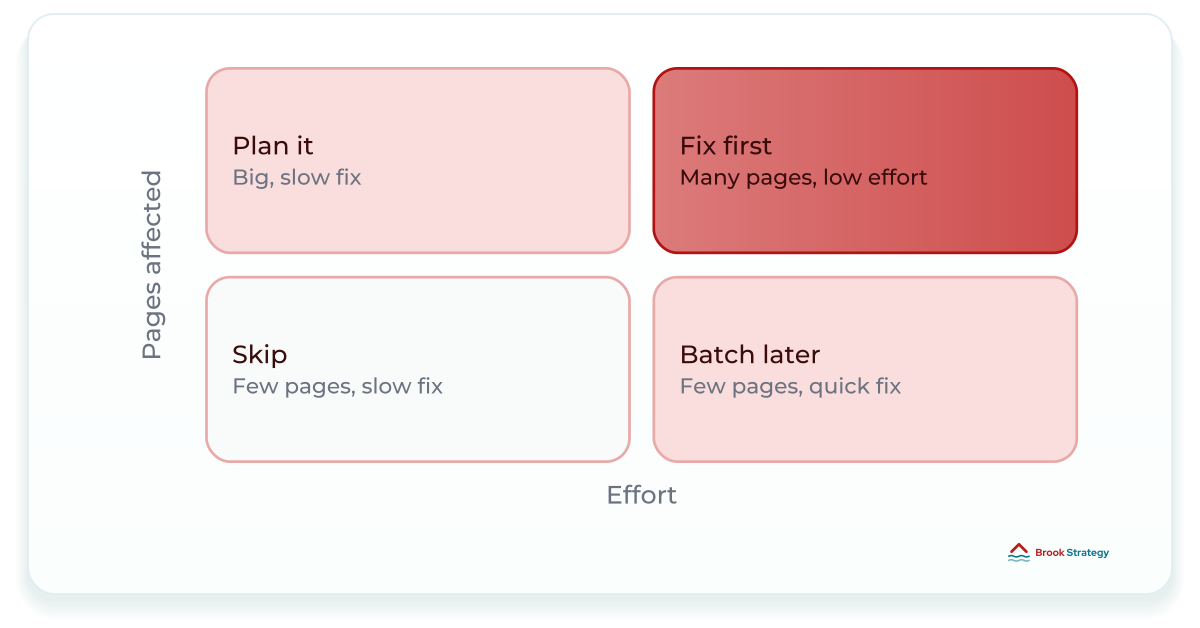
Rank the fixes by the number of pages affected and the effort. A single template change that touches five hundred pages beats ten isolated fixes. In one site review I ran, a redirect chain on the blog template held back an entire section for months, and the fix took a developer one afternoon. Tools for this step are covered in my ranking of SEO tools.
Block 3: Topic Research and the Priority Formula
Collect the topics your buyers search by using your own data, competitor rankings and keyword tools. Group them by intent: commercial topics where people compare or buy, and informational topics where they learn. Each group needs a different page type and a different goal.
Then score each topic so the order is not a matter of opinion. The formula I use is:
Priority score = (Monthly searches × Intent weight × Win chance) ÷ Effort
Monthly searches come from your tool, intent weight rates how close the searcher is to a purchase, win chance estimates how likely you are to rank given your authority and the strength of current results, and effort rates the work needed on a scale of one to five. Use the same scales every time.
| Factor | Scale | How to rate it |
|---|---|---|
| Monthly searches | Actual number | From your keyword tool, for the main phrase in your market |
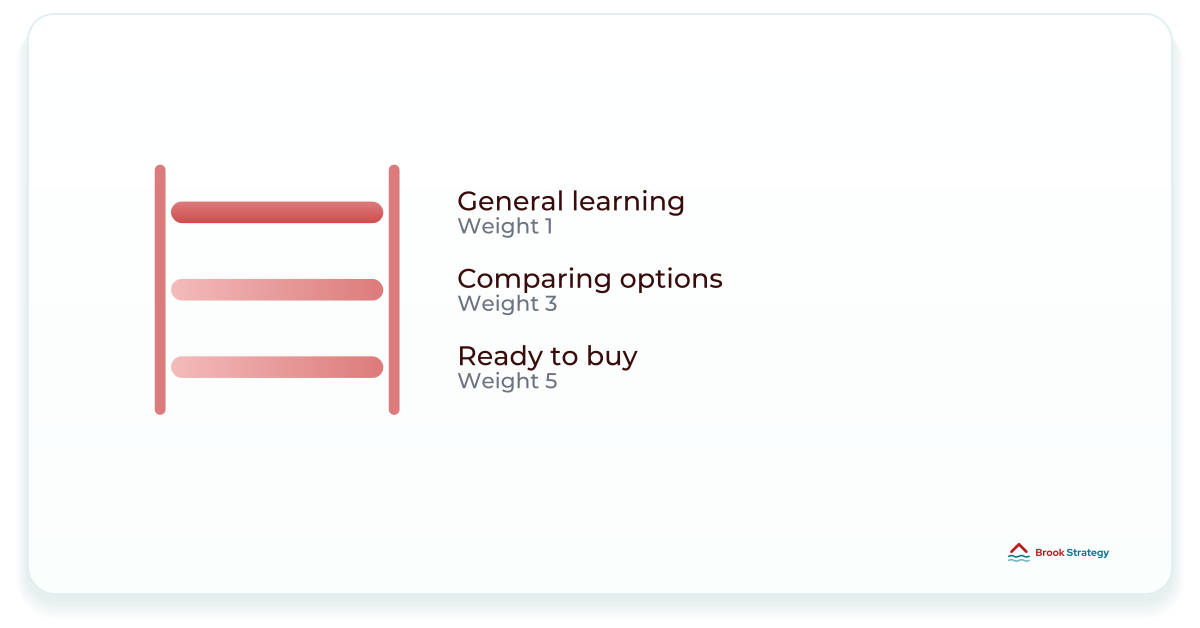
| Intent weight | 1 to 5 | 5 for people ready to buy or compare vendors, 1 for general learning |
| Win chance | 0.1 to 1 | High when current results are weak or you already rank on page two, low against strong brands |
| Effort | 1 to 5 | 1 for a quick update to an existing page, 5 for a new in-depth page with research or design |
Here is a worked example for a company that sells project software to agencies. The numbers are illustrative, but the logic holds for your own data.
| Topic | Searches | Intent | Win chance | Effort | Score |
|---|---|---|---|---|---|
| agency project management software | 1,300 | 5 | 0.3 | 4 | 488 |
| agency resource planning template | 600 | 3 | 0.6 | 2 | 540 |
| how to run a project kickoff | 2,400 | 2 | 0.4 | 2 | 960 |
The kickoff topic scores highest on paper, but the score ignores fit. Check the result against Block 1. If the buyer is a decision-maker comparing tools, a kickoff guide may bring readers who never buy, so I would raise the commercial topic by hand and note the reason. The formula supports your judgment and does not replace it.
Block 4: Page Plan
Assign each high-scoring topic to a page type. Commercial topics get service or product pages, comparisons get listicles or comparison pages and learning topics get guides. One page per intent keeps your site clear, and several pages for the same query tend to compete with each other.
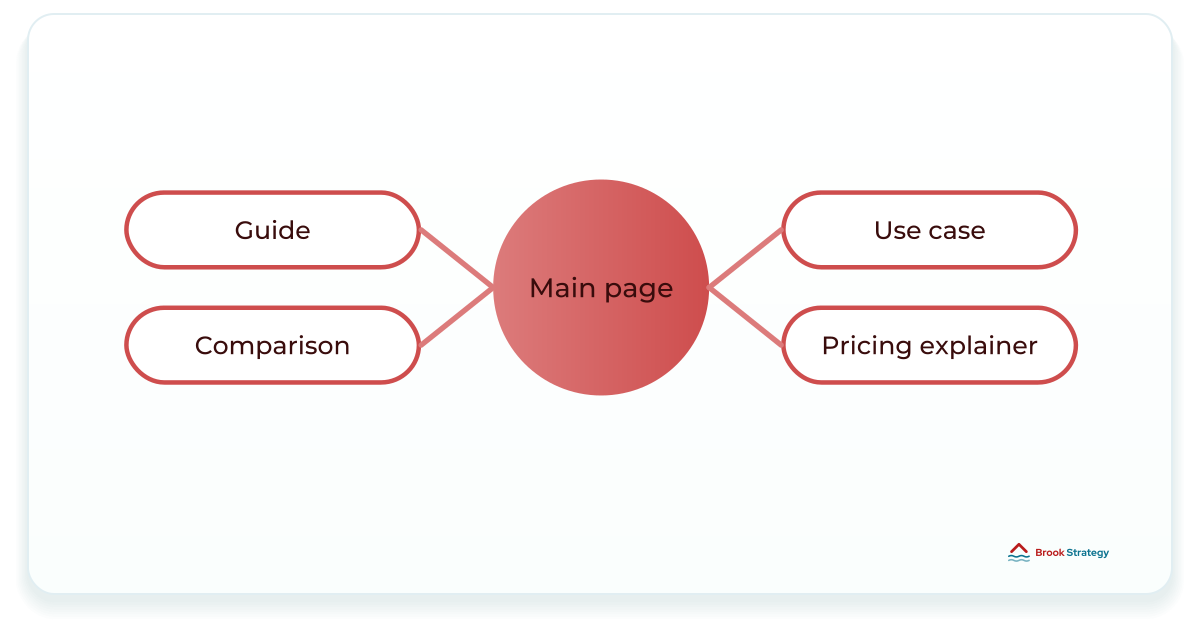
Write a short brief for each page: the main question, the proof you will use, the internal links in and out, and the call to action. Plan the link structure so that guides support the commercial pages they relate to. This is the block where a cluster of pages around one service gets designed.
Block 5: Authority
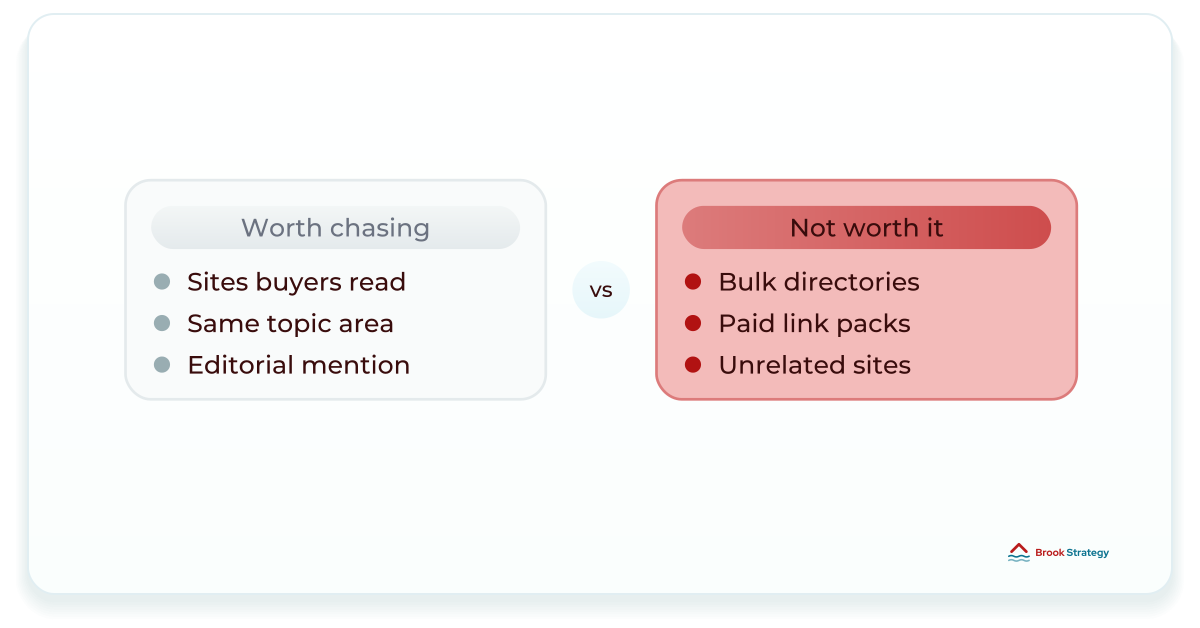
Search engines trust sites that others reference. Your plan should name how you will earn that: customer stories that partners link to, original data, contributions to industry publications, directory listings and relationships with sites your buyers read. Choose two or three tactics and give each an owner.
Be selective. A few relevant links from sites your buyers actually visit beat dozens of generic ones, and they cost less risk. Authority also depends on real expertise, so author pages, case material and accurate, sourced content belong in this block.
Block 6: Measurement
Track three layers. Visibility covers impressions, rankings and share of voice for your target topics. Traffic covers organic sessions by page type. Business results cover leads, sign-ups and revenue from organic visitors. Report all three together, since a rise in the first two without the third means the topics are wrong.
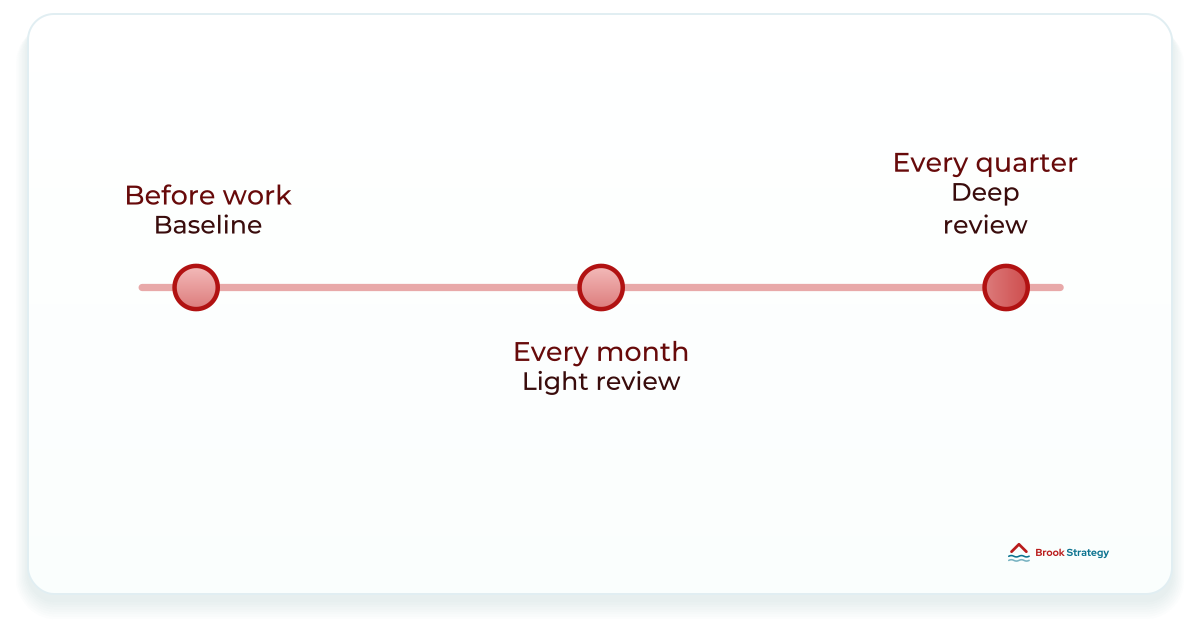
Set a baseline before any work, review monthly and hold a deeper quarterly review where you re-score the topic list. Use my SEO strategy roadmap to turn the framework's output into phases with dates.
Where Teams Misuse the Framework
The most common error is skipping block one. A team jumps to keyword research because it feels productive, then produces a list of topics with no link to revenue. Six months later, traffic is up and the sales team asks where the leads are. Spend a day on the goal and the buyer before you open a keyword tool.
The second error is trusting the score too much. The formula ranks topics by the numbers you give it, and rough inputs give rough outputs. Treat a close call, such as 488 against 540, as a tie and break it with business judgment. Treat a large gap as a real signal.
The third is treating the framework as a one-time workshop. Competitors publish, search results change and your product moves. Teams that re-score their topic list each quarter keep the plan honest, and the effort is small once the sheet exists. Keep the inputs in one shared spreadsheet with the date of each rating, so you can see which numbers have aged. Add a column for the page that will serve each topic, so gaps and overlaps show up as soon as you sort the sheet.
The last is mixing up the blocks. Authority work cannot rescue a site with crawling problems, and content cannot rescue a weak technical base. If results stall, go through the blocks in order and look for the first one that is not solid.
How to Check Your Own Plan Against the Framework
Hold your current SEO plan up to the six blocks. Wherever you have no clear answer, you have found your next piece of work. Ask yourself:
- Is there one written business goal for search, and a buyer profile behind it?
- Do you have a ranked list of technical fixes with owners?
- Are topics scored the same way, and grouped by intent?
- Does each topic have a page type, a brief and links to related pages?
- Is there a short list of authority tactics, and do reports show leads next to rankings?
If more than two of these are missing, the quickest fix is a structured review with an outside view. A short call is usually enough to see where the plan has gaps.
Questions About the SEO Strategy Framework
What Is an SEO Strategy Framework?
It is a repeatable structure for deciding what to do in search: your goals, the technical base, the topics you target, the pages you build, the authority you earn and the measures you track. A framework does not tell you the answers, but it makes sure you ask the same questions in the same order every time.
How Many Blocks Should an SEO Framework Have?
Six is enough for most businesses. Fewer, and something important gets skipped. More, and the framework becomes a project of its own. The six in this guide are goals, technical base, topic research, page plan, authority and measurement.
Can I Use the Priority Formula Without Paid Tools?
Yes. Google Search Console shows your own queries and positions for free, and Google's Keyword Planner gives rough volumes with an ads account. Paid tools give better difficulty and competitor data, but a rough score still beats choosing by instinct.
How Often Should I Revisit the Framework?
Review the scores and the plan every quarter. Rankings shift, competitors publish and your business goals change. A yearly reset of the goals block is also useful, since the other blocks depend on it.
Does the Framework Work for a New Website?
Yes, with a different weight. A new site has little authority, so favor topics with low difficulty and strong buyer intent first. The formula handles that through the win-chance factor, which will be low for competitive topics until your site earns trust.
How Is a Framework Different from a Roadmap?
The framework is the logic: how you decide. The roadmap is the schedule: what happens when. You need the framework first, so the roadmap contains work that is worth doing. My SEO roadmap guide shows how to turn the output of the framework into phases.
Should I Hire an SEO Consultant to Build the Framework?
It helps when you lack time or have competing opinions about priorities. A consultant brings market data and a neutral view. If you have a strong in-house lead, you can run the framework yourself and use a consultant for a one-off review.
Note: This article is general information, not legal, financial or tax advice. Figures and examples are estimates based on typical projects, so check current details with your providers and advisers before you decide.
Was this article helpful?
Thank you for letting us know.
Russell Tennant
Russell leads the Brook editorial team and works with our consultants to turn real client engagements into practical guides on roadmaps, go-to-market planning, growth and competitive strategy. Before joining Brook, he spent 11 years in strategy and product marketing roles at software and financial services companies. He has since edited more than 300 articles on strategy practice and drawn on roadmaps and growth plans from over 100 client projects. He is based in Denver, Colorado.