Key Takeaways
- Every strong operations strategy makes one clear choice and accepts the cost that comes with it.
- The best examples line up activities so rivals cannot copy a single piece.
- Copy the trade-off and not the tool: kanban cards without reliable suppliers bring risk and no gain.
- Test any model in one team, product or region before you change the whole business.
Operations strategy sounds abstract until you see what a company gave up to get it. The eight examples below show clear choices, what they cost and what you can reuse, whether your business ships software, financial products or physical goods. If you want help turning one of them into a plan, my operations strategy consulting team starts with exactly this kind of review.
I picked examples where the choice is easy to describe in a sentence. Each one includes the numbers I am confident about, a plain view of the trade-off and a short sequence of steps you can adapt. Where I give a result, I describe it in general terms, since exact figures change from year to year.
What Makes an Operations Strategy Example Worth Copying?
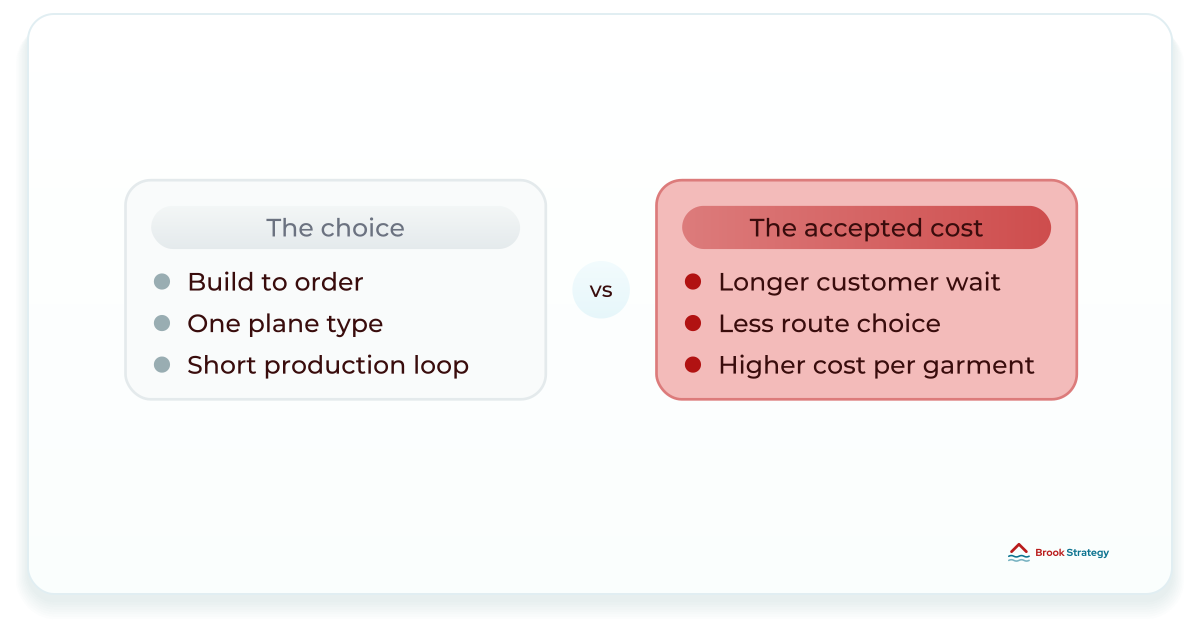
A good example has three parts: a choice about what the business will be good at, a set of activities that support the choice and a cost the company accepts. If one of the three is missing, the example is only a tactic. Zara accepts higher unit costs for speed. Toyota accepts the risk of low stock for quality. Both are easy to explain, and both took years to build.
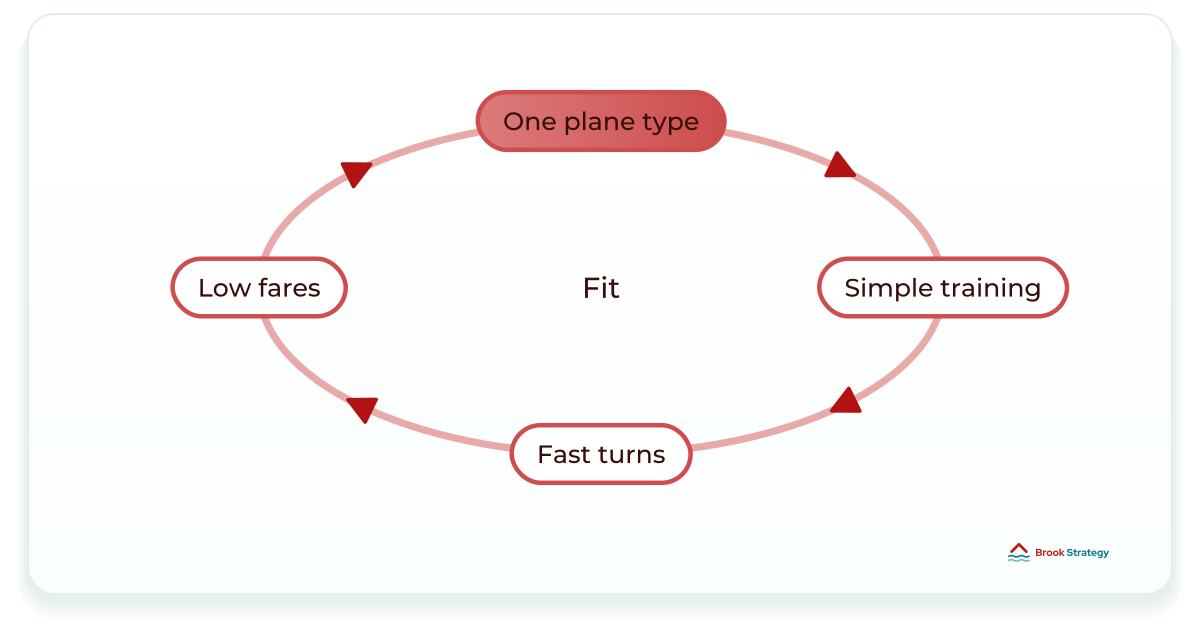
Southwest is a quick test case: one aircraft type feeds training, turn times and fares, and each of those supports the others.
8 Operations Strategy Examples You Can Learn From
Each example below gives you the choice, the trade-off and a short list of steps. The overview table comes first, so you can jump to the one closest to your situation.
| Example | Strategic choice | What you can borrow |
|---|---|---|
| 1. Toyota's Just-in-Time Production | Make only what is needed, stop the line on defects | Pull-based planning and a clear stop rule |
| 2. Southwest Airlines and One Aircraft Type | One plane type, fast turns, point-to-point routes | Standardize to cut complexity cost |
| 3. Zara's Short Production Loop | Small batches made close to the market | Speed over unit cost where demand is uncertain |
| 4. Amazon's Fulfillment Network Built Ahead of Demand | Invest in capacity before the volume arrives | Treat capacity as a growth decision |
| 5. Dell's Build-to-Order Model | Assemble after the customer orders | Cut inventory by linking supply to real orders |
| 6. Atlassian's Low-Touch Go-to-Market | Self-serve first, sales only where it pays | Design the operating model around cost to acquire |
| 7. Ally Bank's Branchless Operating Model | Run a bank without branches | Move cost from buildings to service quality |
| 8. IKEA's Flat-Pack Design | Design for transport and self-assembly | Let operations shape the product |
Toyota's Just-in-Time Production
Toyota built its operations strategy around two ideas that still define the company: make only what is needed, when it is needed, and stop work the moment something goes wrong. Toyota describes these as just-in-time and jidoka, the two pillars of the Toyota Production System. The result is a plant that carries little stock and finds defects at the source instead of at the end of the line.
What makes this a strategy and not a set of tools is the trade-off. Low inventory only works if quality is very high and suppliers are reliable, so Toyota organized hiring, supplier contracts and layout around that promise. If you copy the kanban cards but keep long supplier lead times, you take on the risk without the benefit. I check that trade-off first in every operations strategy framework session.
How the Pull Logic Runs
- Customer demand sets the production signal.
- Each step requests parts only from the step before it.
- Any worker can stop the line when a defect appears.
- The team fixes the cause before work restarts.
- Suppliers deliver in small, frequent batches that match the pull signal.
What to Borrow
Borrow the stop rule first: any team member can halt work when quality slips. Add pull-based planning only where your lead times are short enough to support it.
Southwest Airlines and One Aircraft Type
Southwest flew a single aircraft family, the Boeing 737, for most of its history. That choice looks boring until you follow its effects: pilots and mechanics can move between planes, spare parts are shared and schedules are simpler to repair after a delay. Each of these removes a small cost, and together they let the airline keep planes in the air longer each day.
Michael Porter used this kind of fit in his well-known What Is Strategy? article: activities reinforce each other, so a rival cannot copy one piece and get the benefit. The lesson for a SaaS or financial services firm is to look for the one standardizing choice, such as a single billing model or one onboarding path, that makes many other activities cheaper at once.
Steps to Find Your Standardizing Choice
- List the activities that make your service different.
- Mark where variety adds cost, such as plans, contracts or workflows.
- Pick the variation customers value least.
- Remove it and track the effect on cost and delivery time.
- Repeat with the next-largest source of variety.
Where to Start
A simple activity map on one page is enough, with lines between activities that reinforce each other. Ask your team which exceptions they handle most often, since exceptions point to the variety worth removing.
Zara's Short Production Loop
Zara, part of Inditex, chose speed over the lowest possible unit cost. It keeps much of its fast-moving production close to its home market and makes small batches, so new designs can reach stores within weeks and weak sellers are not made again. It accepts a higher cost per garment to avoid unsold stock and markdowns.
The operating logic is the same for any business where demand is hard to predict. If a forecast is often wrong, shorten the loop between a signal and a response before you try to improve the forecast. In my client work, a software firm with unpredictable onboarding volume applied this by training a small flexible team instead of hiring ahead of every forecast.
How to Shorten Your Own Loop
- Measure the time from a demand signal to a delivered response.
- Mark the steps where work waits in a queue.
- Move the slowest approval closer to the team doing the work.
- Pilot small batches in one product or region.
- Compare cost per unit with the cost of waste and delay.
Tools That Help
A value stream map shows where time goes, and a weekly sales and capacity review keeps decisions short. Start with one product line before you change the whole network.
Amazon's Fulfillment Network Built Ahead of Demand
Amazon invested early in warehouses, transport and, after buying Kiva Systems in 2012, warehouse robots. Capacity came before the volume to fill it. That made delivery promises possible that smaller rivals could not match, and it turned operations into a reason customers chose the company.
Most firms cannot copy this scale, and they should not. What you can copy is the habit of asking which operating capability your growth plan depends on, and then building it one step ahead. For many software and financial services firms that capability is onboarding, support or compliance review, and the same question applies.
A Capacity-First Sequence
- Name the capability your growth plan depends on most.
- Estimate what it will need at twice today's volume.
- Find the step that will break first.
- Fund that step one quarter ahead of the need.
- Review utilization monthly and adjust.
What You Will Need
A simple capacity model with volume, handling time and staff hours is enough. Keep the assumptions visible so leaders can challenge them.
Dell's Build-to-Order Model
In the 1990s Dell sold directly to customers and assembled each computer after the order arrived. Components were bought close to when they were needed, so inventory stayed low and prices of parts that fell quickly did not leave Dell holding old stock. The model rewarded tight coordination with suppliers more than it rewarded scale.
It also had limits. Build-to-order is hard to keep when supply is tight or when customers want next-day delivery from a shelf. I use Dell as a reminder that an operating model fits a period and a customer need. Check every few years whether the assumptions behind yours still hold.
Testing a Build-to-Order Idea
- Find products where customers accept a short wait.
- Map the suppliers who must respond within days.
- Agree data sharing and delivery windows with them.
- Run a pilot on one product family.
- Compare stock levels and lead time before and after.
Where It Fits
It fits configurable products and services with predictable components. It fits poorly where customers expect immediate availability.
Atlassian's Low-Touch Go-to-Market
For many years Atlassian sold its software with very little field sales. Customers could try and buy online, and the product and documentation did the work a sales team would do elsewhere. That choice shaped the whole company: support, billing and onboarding all had to work without hand-holding.
If you run a SaaS company, the question is where a person adds more value than they cost. Self-serve for small accounts and a sales team for large ones is common, but the operations behind it need to match. A billing system built only for credit cards will slow down your first enterprise deal.
Setting the Self-Serve Line
- Split customers by contract size and complexity.
- Find the size where a person starts to pay back.
- Design onboarding so small accounts finish alone.
- Give larger accounts a named contact and a longer path.
- Review the line every quarter.
What to Prepare
You need product analytics that show where self-serve users get stuck. You also need billing and support routines that handle both groups.
Ally Bank's Branchless Operating Model
Ally Bank operates without physical branches. The money saved on property supports higher deposit rates and a strong digital service. In exchange, it must answer phones and chat well, because there is no counter to solve a problem.
For a financial services firm, the useful lesson is that removing a channel moves the burden somewhere else. Make sure the service team, the controls and the product are ready to carry it before you remove the channel.
Before You Remove a Channel
- List what customers use the channel for.
- Move each task to a digital or phone alternative.
- Test with a group of customers first.
- Staff the replacement channel for peak load.
- Track complaints and cost per contact.
Controls to Keep
Keep identity checks and complaint handling documented as the channel changes. Your compliance team should review the new flow before launch.
IKEA's Flat-Pack Design
IKEA designs furniture so it ships flat and customers assemble it. This changes truck loads, warehouse space and store layout, and it lets the company keep prices low. Operations is involved before the product exists, which is rare and valuable.
You can use the same habit in any business. Before a new product or service is approved, ask the delivery team what it will cost to run. In my experience, that one question removes a large share of expensive launches.
Bringing Operations into Design
- Invite the delivery team to the first product review.
- Estimate the cost to serve of each option.
- Rank options by customer value and cost to run.
- Change the design where the cost is high.
- Record the cost assumption for the later review.
A Simple Template
A one-page cost-to-serve estimate attached to each proposal is enough. Require it before any launch is approved.
The Patterns Behind These Eight Operating Models
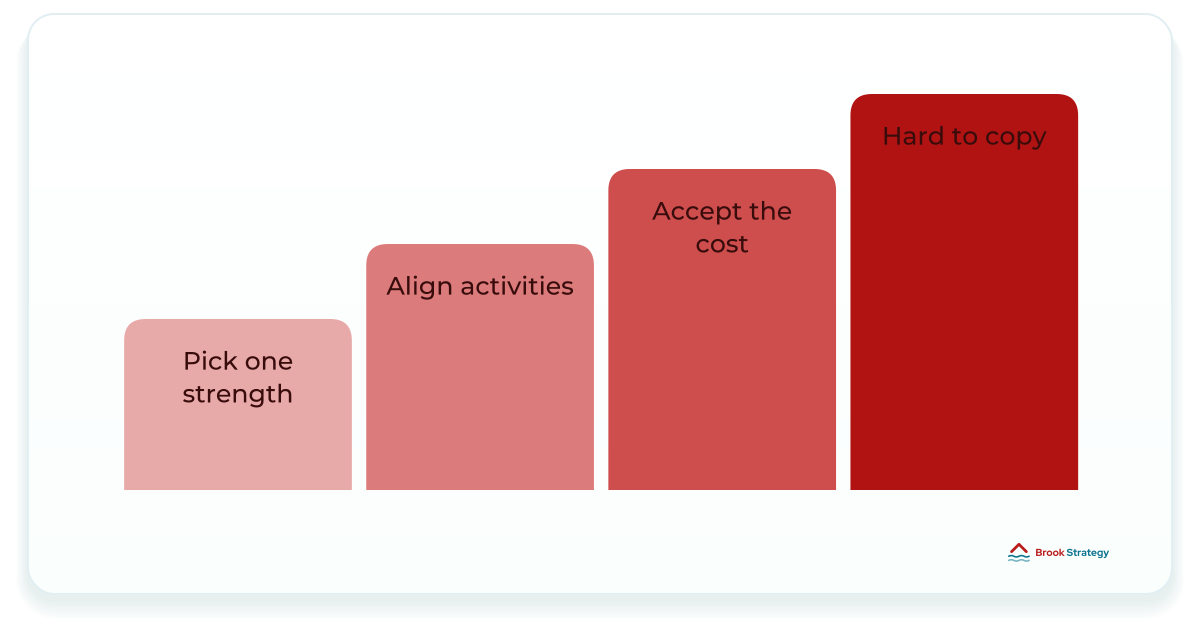
Read side by side, the examples share four habits. Each company picked one dimension to be best at, such as quality, speed, cost or service, and accepted weakness elsewhere. Each also built activities that reinforce each other, so rivals could not copy a single piece. A third habit is a visible cost, like Dell's dependence on suppliers. The last is regular review, since models that worked in one decade need new checks in the next.
| Company | Primary strength | Accepted cost |
|---|---|---|
| Toyota | Quality and low stock | Dependence on reliable suppliers |
| Southwest | Low cost and quick turns | Less choice of aircraft and routes |
| Zara | Speed to market | Higher cost per garment |
| Amazon | Delivery promise | Heavy capital before demand |
| Dell | Low inventory | Longer wait for customers |
| Atlassian | Low cost to acquire customers | Weaker personal contact |
| Ally Bank | Lower fixed cost | No branch counter |
| IKEA | Low price through design | Customers do the assembly |
Put differently, each strength in this table is paid for by the cost beside it.
How to Choose the Example That Fits Your Business
You do not need to copy any model whole. Check your shortlist against four questions before you commit effort:
- Does the choice support the position you want in your market?
- Can your teams run the supporting activities with the people you have?
- Do you accept the cost the model carries?
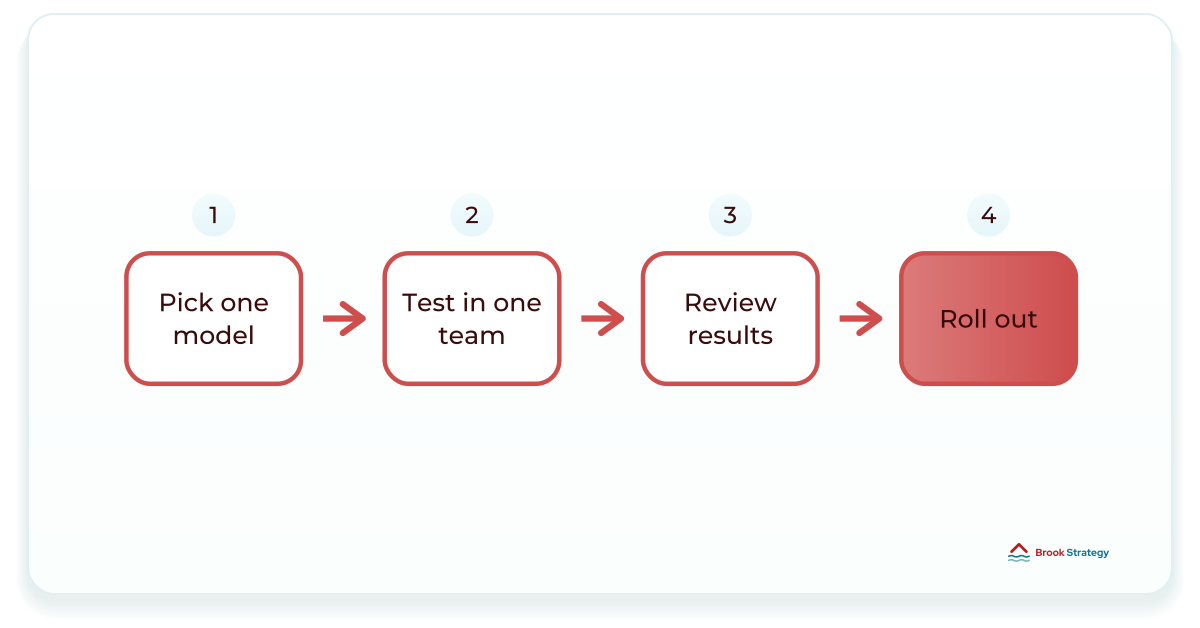
- Can you test it in one product, region or team first?
If the answer to the last question is yes, start there. The step-by-step method in my operations strategy framework shows how to score options and agree an order with your leadership team. If you want a second opinion, a short call usually clears up which example fits.
Questions About Operations Strategy Examples
What Is an Example of an Operations Strategy?
Toyota's just-in-time system is the classic example. It chose to make only what is needed and to stop the line on a defect, then organized suppliers, staffing and layout around that choice. Your own strategy can be smaller, such as deciding to run onboarding without a sales call, as long as the choice is clear and the activities support it.
How Is Operations Strategy Different from Business Strategy?
Business strategy decides where you compete and how you win. Operations strategy decides what the business has to be good at, and how good, for that to work. It turns the plan into capabilities, capacity and priorities for the teams that deliver.
Can a Small Company Use These Examples?
Yes, in a lighter form. Southwest's single aircraft type translates into a single plan or a single onboarding path. You do not need the scale of Toyota to use the idea of removing a source of variety.
Do These Examples Work for SaaS and Financial Services?
The principles do. Atlassian and Ally Bank are service examples, and the pull idea behind Toyota applies to support queues and review work. Check cost, risk and regulatory limits before you copy any model.
How Long Does It Take to See Results from an Operations Strategy?
A focused change in one area, such as onboarding, often shows results within a quarter. Network or structural changes take longer. Set review dates for each initiative so you can tell early whether it works.
What Is the Most Common Mistake When Copying a Famous Operating Model?
Copying the visible tools without the trade-offs behind them. Kanban cards without reliable suppliers, or self-serve without good onboarding, bring the cost and not the benefit. Always write down what the model gives up.
When Should I Get Outside Help with Operations Strategy?
When leaders disagree on priorities, when growth is straining teams, or when a plan keeps slipping for reasons nobody can name. An outside team can run interviews and present facts without taking sides.
Sources
- Toyota Motor Corporation, Toyota Production System
- Michael E. Porter, What Is Strategy? Harvard Business Review
Note: This article is general information, not legal, financial or tax advice. Figures and examples are estimates based on typical projects, so check current details with your providers and advisers before you decide.
Was this article helpful?
Thank you for letting us know.
Russell Tennant
Russell leads the Brook editorial team and works with our consultants to turn real client engagements into practical guides on roadmaps, go-to-market planning, growth and competitive strategy. Before joining Brook, he spent 11 years in strategy and product marketing roles at software and financial services companies. He has since edited more than 300 articles on strategy practice and drawn on roadmaps and growth plans from over 100 client projects. He is based in Denver, Colorado.