Key Takeaways
- A working framework moves from the growth plan to operating priorities, to a diagnosis, to design choices and then to a ranked list of initiatives.
- Score every initiative with one formula: strategic impact times confidence, divided by effort.
- Name one owner per initiative and review the list monthly, or the framework stays on paper.
- Six to twelve weeks is enough for a first pass if you start with interviews and limit the scope.
Most operations strategies fail in the same place: the plan is clear, the daily work is clear, and nobody has written down what must change between the two. Working with teams on operations strategy consulting projects, I use the same six phases each time, because they force the questions that matter in the right order.
The model below is practical, and it is short on purpose. You can run it with your leadership team in one quarter. For each phase you get the question it answers, the output and the usual way it goes wrong. If you prefer to start from stories, my collection of operations strategy examples shows the same logic in real companies.
Six Phases in Brief
| Phase | Question it answers | Output | Typical time |
|---|---|---|---|
| 1. Anchor in the plan | What does the growth plan demand from operations? | Three to five operating requirements | 1 week |
| 2. Diagnose today | Where does work stall and what does it cost? | Fact base from interviews and data | 2 to 4 weeks |
| 3. Set operating priorities | What must the business be best at, and what can be average? | Ranked capabilities with target levels | 1 week |
| 4. Design the operating model | How do teams, processes, tools and partners fit? | Model with options and trade-offs | 2 weeks |
| 5. Score and sequence | Which initiatives go first? | Ranked roadmap with owners and dates | 1 to 2 weeks |
| 6. Set the review rhythm | How will you know it works? | Baselines, targets, monthly review | 1 week |
Phase 1: Anchor the Strategy in the Growth Plan
Start with what the business wants to do in the next two to three years: new products, new regions, higher volumes, lower cost. Translate each goal into a requirement for operations. A goal to double the number of enterprise customers, for example, requires faster security reviews, a larger onboarding team and contract terms that finance can bill.
Write three to five requirements, each in one sentence and with a number where possible. Fewer is better. The usual mistake is to list everything operations does, which produces a catalog and no direction.
One micro-story shows the value. A software client wanted to move upmarket and listed eleven operating requirements. After two rounds of cutting, three remained: faster security reviews, a named onboarding lead for each large account and contracts finance could bill without manual work. Every later decision was easier, because each one could be checked against those three lines.
Phase 2: Diagnose How Work Flows Today
Interview people at every level in the functions the plan touches. I aim for ten to fifteen conversations, and I ask the same four questions each time: what takes longest, where does work wait, what do you do twice and what would break first if volume doubled. Combine the answers with data on capacity, cost to serve and service levels.
The result is a fact base your leaders recognize. People often disagree about causes, but they rarely disagree about numbers once the numbers are on one page.
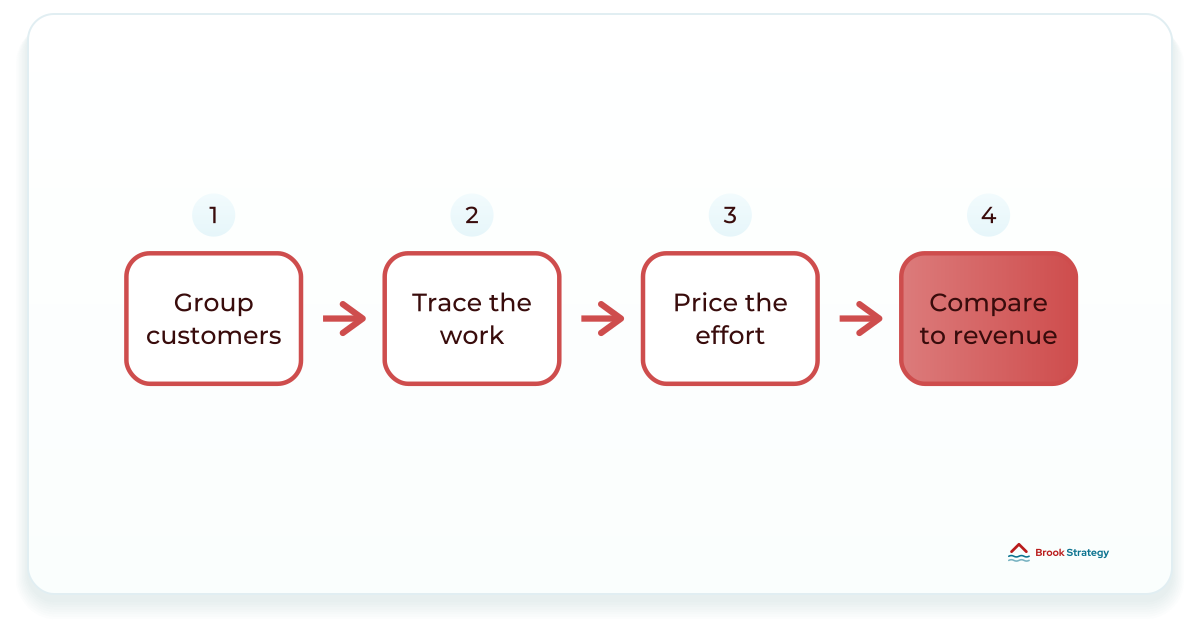
Cost to serve deserves its own view. Split customers into three or four types and estimate what each costs to onboard, support and bill. Teams are often surprised that their smallest accounts take as much effort as the mid-sized ones, and that a few special contracts cause most of the exceptions. That finding alone often shapes the operating model.
Phase 3: Set Operating Priorities
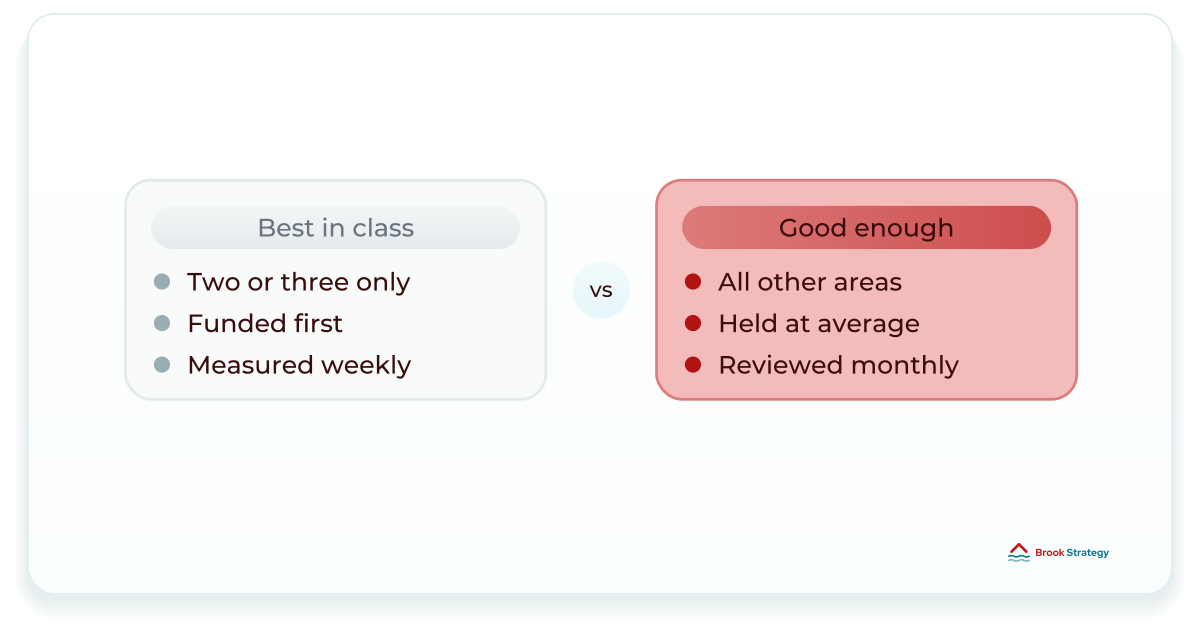
Rank the capabilities the plan depends on, and decide how good each one must be. A capability can be market-leading, solid or simply adequate. A SaaS company chasing enterprise deals might need market-leading security review and merely adequate invoicing.
This is where trade-offs are chosen. If every capability is a priority, none is. Write the ones you will let stay average, and get your leaders to agree in writing. That list will save you months of argument later.
Be specific about the target level. "Fast onboarding" can mean two days or two weeks, and each needs a different team. Write the level as a number and a date, such as security reviews closed within five working days by the end of next year. That gives phases four and five something to test options against.
Phase 4: Design the Operating Model
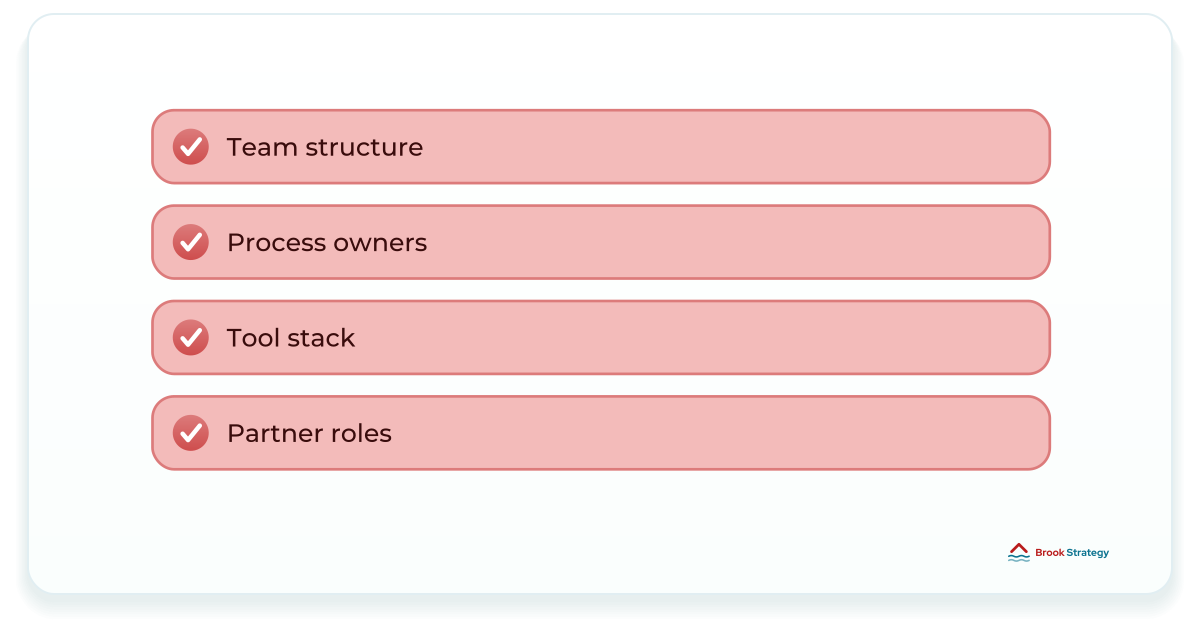
For each priority capability, compare the options for people, process, tools and partners. You can build it in-house, buy a platform, outsource part of the work or simplify the offer so less work is needed. The consulting team I work with usually brings three options per capability, and each carries a rough cost, a risk and a time to value.
Keep the options honest by listing what each one gives up. Outsourcing support lowers cost and reduces control. A platform shortens time to value and creates a dependency. When leaders see the trade-off in one table, the decision is faster.
| Option | Gains | Gives up | Fits when |
|---|---|---|---|
| Build in-house | Control and fit | Time and hiring effort | The capability is a differentiator |
| Buy a platform | Speed | Flexibility and some lock-in | The process is common across firms |
| Partner or outsource | Flexible capacity | Direct control | Volume swings and quality is easy to check |
| Simplify the offer | Lower cost to serve | Some customer choice | Variety is rarely used |
Phase 5: Score and Sequence the Initiatives
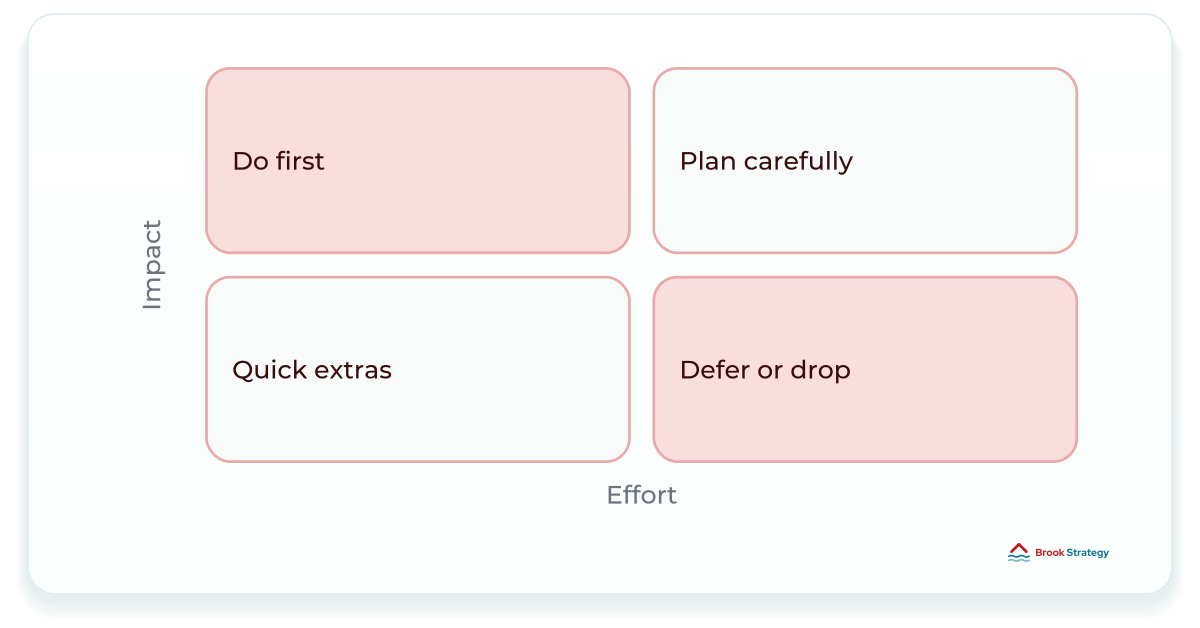
Now turn the chosen options into initiatives and rank them with one formula. The formula is simple on purpose, so every leader can check the math.
A worked example shows how it behaves. A faster security review rates 5 for impact, 0.8 for confidence and 2 for effort, which scores 2.0. A new billing platform rates 4 for impact, 0.6 for confidence and 5 for effort, which scores 0.48. The billing project is useful but not first.
| Initiative | Impact | Confidence | Effort | Score |
|---|---|---|---|---|
| Faster security review | 5 | 0.8 | 2 | 2.00 |
| Onboarding team in a second time zone | 4 | 0.7 | 3 | 0.93 |
| New billing platform | 4 | 0.6 | 5 | 0.48 |
Use the score to start the discussion, not to end it. If two initiatives depend on each other, move the one that unblocks the other forward, even when its score is lower. Then check the total effort against the capacity of your teams. A roadmap that needs more people than you have is a wish list.
Plan for delays in the roadmap itself. In my experience the first wave takes longer than the plan says, mostly because a key person is busy with the daily work. Leave about a fifth of each team's time unassigned in the first quarter, and name a deputy for every owner.
Phase 6: Set the Review Rhythm
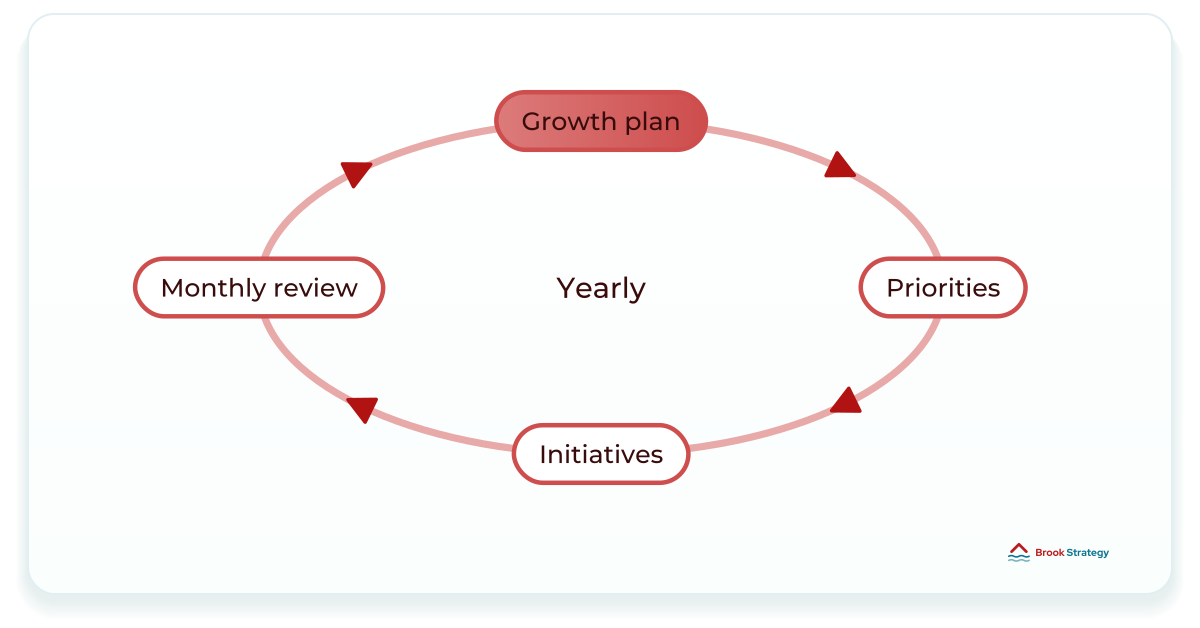
Give each initiative a baseline, a target and a review date before work starts. Typical measures are cycle time, cost to serve, error rate and capacity used. Review progress in a monthly meeting of 45 minutes, with owners reporting numbers in a standard format.
Once a year, return to phase one. The growth plan will have changed, and so will the requirements. A strategy that is never revisited turns into the thing teams work around.
Applying the Model in SaaS and Financial Services
In a SaaS company, the pressure point is usually the handoff between sales, onboarding and support. The framework tends to surface the same pattern: deals are signed with promises operations has not seen, and onboarding teams absorb the gap. The fix is often a rule that large contracts get an operations review before signature, plus a standard onboarding path for the rest.
In financial services, controls and audit trails set the limits. Operating choices have to pass risk and compliance review, so involve those teams in phase four and not at the end. A model that looks cheaper on paper but needs three extra approvals per case will not save what the spreadsheet says. Check current rules with your compliance advisers, since requirements differ by product and region.
| Setting | Common bottleneck | Typical first initiative |
|---|---|---|
| SaaS | Handoff from sales to onboarding | Operations review for large contracts |
| Financial services | Manual review and approvals | Risk-tiered review paths |
| Professional services | Utilization and scoping | Standard scoping templates |
Where the Framework Breaks Down in Practice
Three failure modes appear again and again. The first is skipping phase two because everyone feels they already know the problems. The numbers then surprise leaders at the workshop, and the meeting turns into a debate about data. The second is a roadmap with eight initiatives in the first wave. Teams cannot carry that, and all eight finish late. Keep the first wave to three.
The third is a missing owner. If an initiative has a committee, it has no owner. Name one person, give that person decision rights over the budget and the timeline, and expect them to report at every monthly review. Everything else in the framework gets easier when ownership is clear.
Deciding Where to Begin With the Framework
You do not need to run every phase at full depth. Pick the entry point that matches your situation:
- If leaders disagree on priorities, begin with phases one and three.
- If a plan keeps slipping, begin with the diagnosis in phase two.
- If options are known but stuck, jump to the scoring in phase five.
- If results fade after launch, fix the review rhythm in phase six.
A short call is often enough to tell which entry point fits. I find that most teams start in the wrong place, usually design, because it feels like progress.
Questions About the Operations Strategy Framework
What Is an Operations Strategy Framework?
It is a structured way to decide what your business must be good at, how good, and in what order to build those capabilities. A framework gives your leaders a shared method, so the discussion moves from opinions to criteria such as impact, confidence and effort.
How Many Phases Should an Operations Strategy Framework Have?
Six or seven is enough for most companies. Fewer phases tend to skip the diagnosis, and more phases usually mean extra paperwork. The model in this article has six phases and one review loop, which fits a project of six to twelve weeks.
How Long Does It Take to Build an Operations Strategy?
A focused project takes six to twelve weeks. Interviews and data collection take the first half, and the choices, sequencing and workshop take the second. Larger groups with many locations take longer, mostly because of the data work.
Who Should Own the Operations Strategy?
A senior leader with authority over several teams, usually the chief operating officer or the head of the largest delivery function. The strategy needs one owner who can settle trade-offs between teams, plus one named owner for every initiative.
How Do I Choose Between Two Good Initiatives?
Use the priority score from phase five: strategic impact times confidence, divided by effort. If the scores are close, pick the one that unblocks other work, or the one that you can test in a single team within a quarter.
How Often Should I Update the Strategy?
Review progress monthly and revisit the choices once a year, or sooner when the plan changes, a major customer is lost or a new market opens. A yearly refresh keeps the strategy tied to the growth plan.
Can I Use This Framework in a Small Company?
Yes. Use fewer inputs: five or six stakeholder conversations, a one-page capacity view and a short list of three initiatives. The logic stays the same, and the workshop can fit into half a day.
Note: This article is general information, not legal, financial or tax advice. Figures and examples are estimates based on typical projects, so check current details with your providers and advisers before you decide.
Was this article helpful?
Thank you for letting us know.
Russell Tennant
Russell leads the Brook editorial team and works with our consultants to turn real client engagements into practical guides on roadmaps, go-to-market planning, growth and competitive strategy. Before joining Brook, he spent 11 years in strategy and product marketing roles at software and financial services companies. He has since edited more than 300 articles on strategy practice and drawn on roadmaps and growth plans from over 100 client projects. He is based in Denver, Colorado.