Key Takeaways
- A complete content strategy covers twelve points across four stages: foundation, research, plan and operations.
- Each point needs a proof, such as a written goal, an interview summary or a named owner.
- The gaps I see most often are a missing baseline, no buyer interviews and no review rhythm.
- Re-run the production and measurement points every quarter and the rest once a year.
A content strategy can look finished and still have holes. There might be a calendar but no goal, a topic list but no research, or a dashboard no one opens. The fastest way to find the holes is to walk through a checklist and ask for proof at every point.
This list comes from the plans I review in content strategy consulting work. Each point includes what to check and what a finished version looks like, so you can mark it done honestly.
The 12 Points at a Glance
| Stage | Point | Proof it is done |
|---|---|---|
| Foundation | 1. Business goals | Written goals with numbers and dates |
| Foundation | 2. Baseline metrics | Current traffic, rankings and leads recorded |
| Foundation | 3. Ownership | One named owner and a sponsor |
| Research | 4. Buyer profiles | Interview notes and one-page profiles |
| Research | 5. Content audit | Scored inventory with decisions |
| Research | 6. Competitor gaps | List of topics rivals cover poorly |
| Plan | 7. Topic clusters | Ranked clusters with a target page each |
| Plan | 8. Formats and channels | Format chosen per topic, channels listed |
| Plan | 9. Voice and standards | Style guide and brief template |
| Operations | 10. Calendar and workflow | Dates, owners and review times |
| Operations | 11. Measurement | Dashboard with agreed KPIs |
| Operations | 12. Review rhythm | Monthly and quarterly meetings on the calendar |
Stage 1: Foundation
1. Business Goals
Check that content has goals tied to the business, with a number and a date. Done looks like two or three sentences a sales leader would recognize, such as a target for demo requests from organic search.
Avoid goals that describe activity, like “publish four posts a month”. Activity is a plan, and the goal is what the plan should produce.
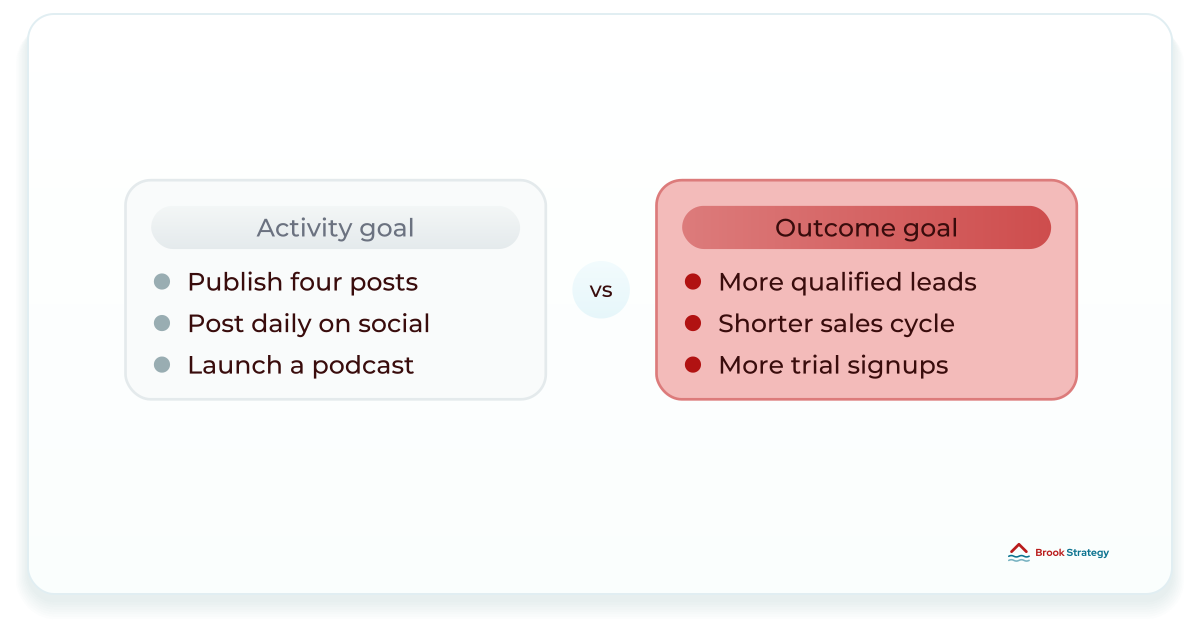
A useful test is to ask your sales lead what content has to do for them this year. If their answer matches your written goal, the goal is real. If it doesn’t, you have found the first conversation to schedule, and it is cheaper to have it now than after six months of publishing.
2. Baseline Metrics
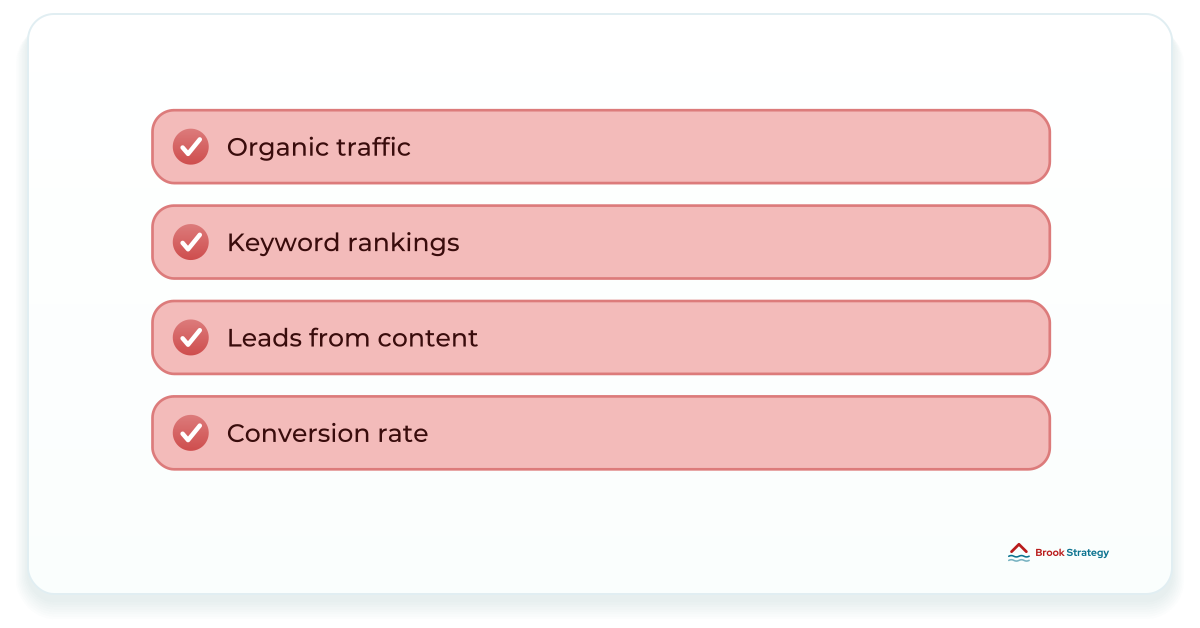
Record where you stand before you change anything: organic sessions, leads from content, rankings for core terms and the number of live pages. Export them to a dated sheet, so the numbers can’t drift later.
Capture the numbers from at least the last six months, not only today’s snapshot, so seasonality doesn’t fool you later. If tracking is broken, for example forms that don’t record the landing page, fix that first, because you can’t measure what you never captured.
3. Ownership
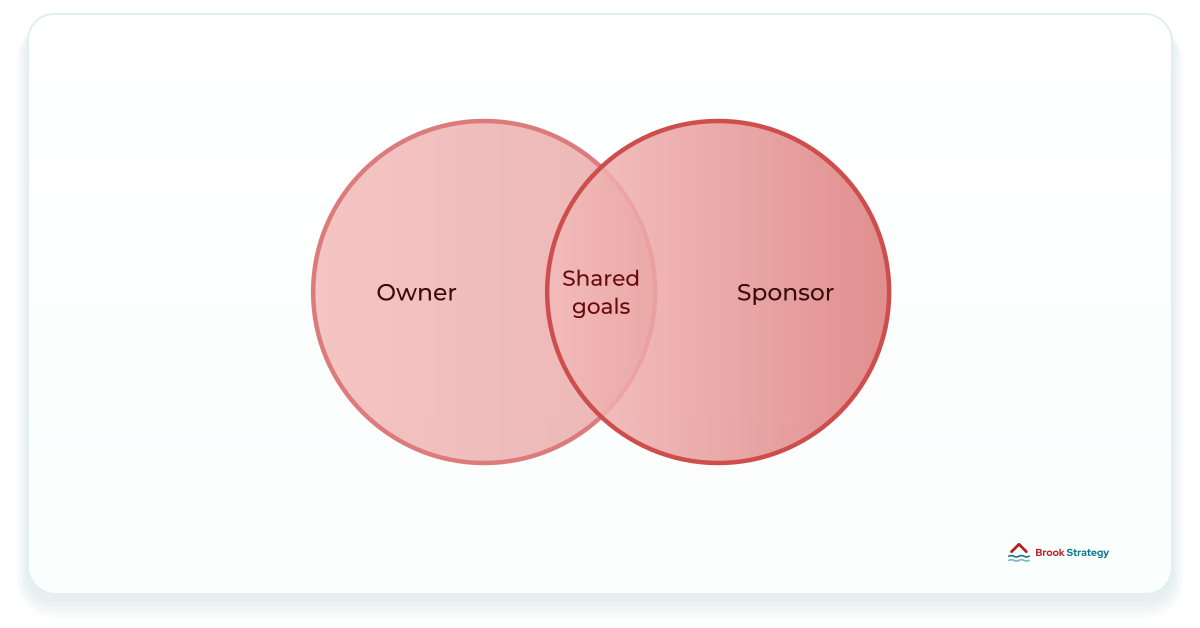
Check that one person owns the strategy and one executive sponsors it. When ownership is shared, deadlines slip and nobody settles disputes about priorities.
The sponsor matters as much as the owner. Someone senior must be willing to protect the budget when results take a few quarters to show, and to settle disputes between marketing, product and sales about what gets covered.
Stage 2: Research
4. Buyer Profiles
Done means you have talked to real buyers, five to eight of them for a first pass, and wrote down their questions in their own words. A profile with a job title and an age range but no quotes is a guess.
Include the objections you hear on sales calls. They make the best topics, because a buyer who has the objection is already searching for the answer. Record three to five of them per profile, and note which stage of buying each belongs to.
5. Content Audit
Score every existing page for traffic, conversions, relevance and quality, then choose keep, refresh, merge or remove. On sites I audit, the decision to merge near-duplicate pages often lifts results faster than new articles.
Include conversions in the score, not only traffic. A page with modest visits that brings steady demo requests deserves protection, while a high-traffic page that brings nobody may be attracting the wrong readers. Keep the audit sheet, since you will reuse it at every review.
6. Competitor Gaps
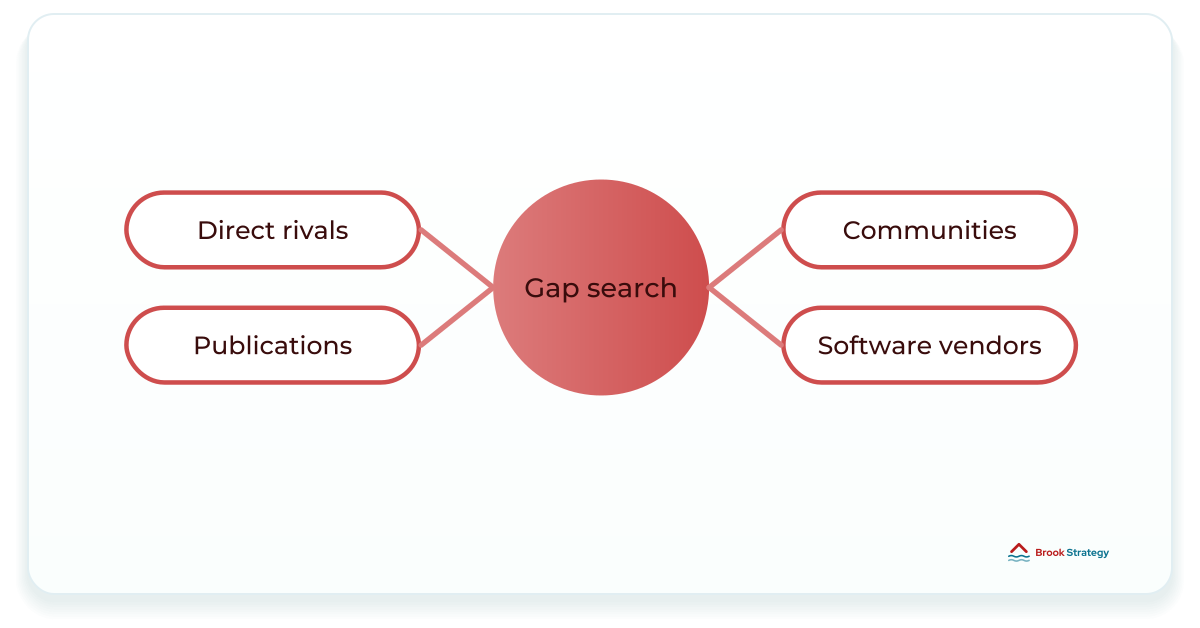
Look at the top results for your target topics and find where the answers are thin, outdated or aimed at the wrong reader. Those gaps are where a new page can win, so record them with a link to each weak result.
Look beyond direct rivals. Publications, communities and software vendors often win the search results for your topics, and they set the standard your page must beat. Note what format they use, how recent it is and which question they fail to answer.
Stage 3: Plan
7. Topic Clusters
Check that topics are grouped into clusters, each with one main page and supporting pieces, and ranked by demand, difficulty and closeness to purchase. A flat list of keywords is not a plan, because it hides how pages support each other. A roadmap for putting clusters in order is in my content strategy roadmap.
Check that each cluster has a main page that deserves to rank and supporting pages that link to it. A cluster with no clear main page spreads authority thinly, and readers get lost between similar articles that compete with each other.
8. Formats and Channels
Match each topic to a format your buyer wants, such as a comparison, a checklist or a guide, and note where it will be promoted. If every piece uses the same template, buyers at different stages are poorly served.
Make sure the format fits what the reader wants to do. People comparing options want a table and a verdict, people ready to act want steps, and early-stage readers want a plain explanation. Also list where each piece will be promoted, since publishing alone rarely brings readers.
9. Voice and Standards
Write a short style guide and a brief template, so every writer starts from the same place. Done means a new freelancer could produce an on-brand draft after reading two pages.
Add examples of good and bad paragraphs. Rules such as “plain and direct” mean little until a writer sees a sample, and one page of examples will do more than a long list of principles. Include a rule for sources and facts as well.
Stage 4: Operations
10. Calendar and Workflow
The calendar should show a writer, an editor and a date for each piece, along with a time limit for each review step. Tools help, and my overview of content strategy tools compares planners and research platforms.
Look at the realistic capacity of the team before you fill the calendar. If your editor can review six pieces a month, a calendar of twelve creates a queue and delays everything, so match the plan to the slowest step in the workflow.
11. Measurement
Agree the KPIs before launch and build a dashboard that shows them in one view. Pick a few that reflect goals, and avoid a wall of charts. For the metrics I suggest and how to calculate them, see my guide to content strategy KPIs.
Check that every KPI has a formula and an owner, and that the dashboard shows baselines beside current values. A chart without a target can’t tell you whether a result is good, and a metric nobody owns will quietly stop being updated.
12. Review Rhythm
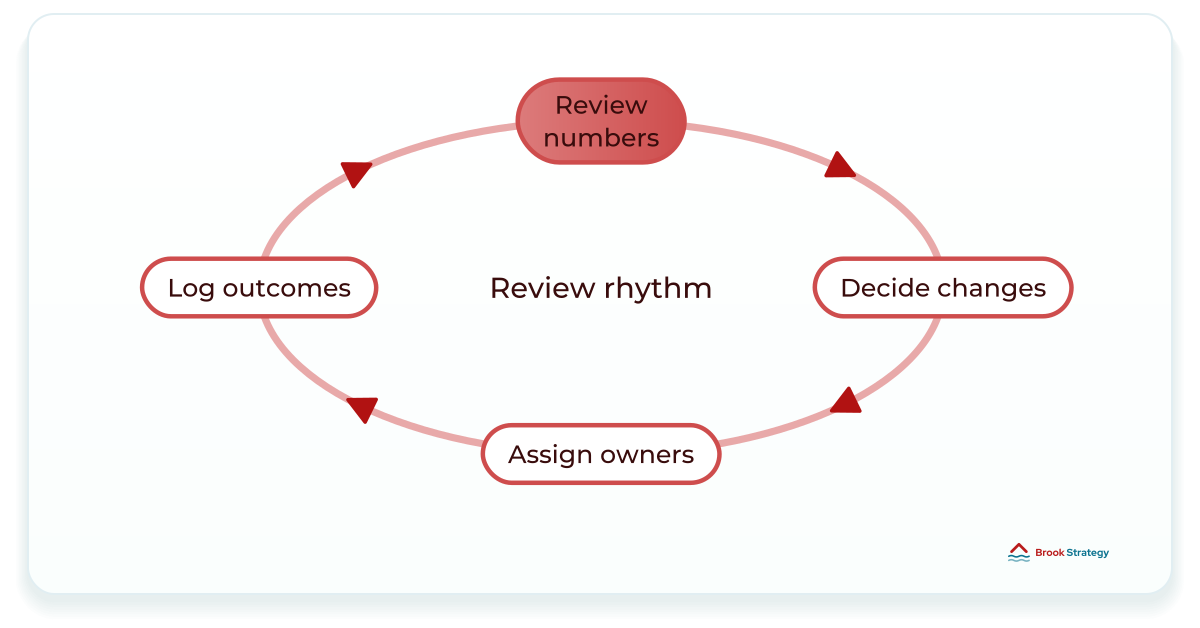
Put a monthly production check and a quarterly strategy review in the calendar now. A review that is not scheduled will not happen, and the plan will gradually drift away from what the data shows.
Decide in advance what a review can change. Good reviews end with decisions: topics to add, pages to refresh and experiments to stop. If a review only produces a report, people stop attending after two quarters.
How to Score Your Own Strategy
Give each point one of three marks: done with proof, partly done or missing. Be strict, because a point without proof is partly done at best. Then read the pattern.
| Result | What it usually means | Next step |
|---|---|---|
| 10 to 12 done | The strategy is sound and mostly needs upkeep | Schedule quarterly reviews |
| 6 to 9 done | You have a plan with gaps, often in research or measurement | Close the gaps before you add volume |
| Fewer than 6 | You have a calendar, not a strategy | Start again from goals and baseline |
Pay attention to which points are missing, not only how many. Missing research with a finished calendar means you are likely producing content nobody searches for. Missing measurement with a strong plan means you can’t prove it is working.
One more habit helps: attach the proof to each point as a link or file in a shared folder. When a stakeholder asks whether the audience research was really done, you can open the interview notes in seconds. It also makes handovers painless, since a new owner can see what exists and what is still open without a long meeting.
What to Do With the Gaps You Find
Resist fixing everything at once. Sort the open points by how much they block the rest: goals, baseline and ownership first, because every later point depends on them. Research and planning come next, and operations last, since a calendar built on weak research only produces content faster than you can learn from it.
Give each open point an owner and a date, and put the list in the same place as your calendar. In reviews I run, teams that close two or three points a month reach a complete strategy within a quarter, while teams that try all twelve in a week usually leave half of them half done.
Questions About the Content Strategy Checklist
How Often Should I Run Through a Content Strategy Checklist?
Run the full list when you build or rebuild a strategy, then review the measurement and production items every quarter. The goals and audience items only need a yearly check, unless your product, pricing or target market changes in between.
Which Checklist Item Do Teams Skip Most Often?
The baseline. Teams start publishing before they record current traffic, rankings and leads, so they can’t show progress later. It takes an afternoon to capture and it makes every later report credible.
Do I Need All Twelve Points for a Small Site?
Yes, but each one can be light. A small site might handle the audit in an hour and keep the calendar to one page. Skipping a point entirely usually creates a gap that shows up a few months later.
How Long Does It Take to Complete the Checklist?
Most teams need four to six weeks to work through it the first time, mainly because of the interviews and the audit. After that, a quarterly review takes a few hours.
Who Should Sign Off on the Finished Checklist?
The person who owns the content budget, plus whoever leads sales. Marketing alone can’t confirm that the topics match real buyer questions, and sales can. Their sign-off also makes it easier to keep priorities stable.
What Is the Difference Between a Checklist and a Roadmap?
A checklist confirms that every element of a strategy exists and is sound. A roadmap places the work in time, with phases, owners and dates. I use the checklist to test the plan and the roadmap to carry it out.
Can I Use This Checklist for a Single Campaign?
Partly. Goals, audience, topics, production and measurement apply to a campaign, while the audit and governance points usually don’t. Drop what doesn’t fit and keep the order of the rest.
Note: This article is general information, not legal, financial or tax advice. Figures and examples are estimates based on typical projects, so check current details with your providers and advisers before you decide.
Was this article helpful?
Thank you for letting us know.
Russell Tennant
Russell leads the Brook editorial team and works with our consultants to turn real client engagements into practical guides on roadmaps, go-to-market planning, growth and competitive strategy. Before joining Brook, he spent 11 years in strategy and product marketing roles at software and financial services companies. He has since edited more than 300 articles on strategy practice and drawn on roadmaps and growth plans from over 100 client projects. He is based in Denver, Colorado.