Key Takeaways
- A workable B2B marketing strategy framework has six phases: accounts, buying group, positioning, channel mix, sales alignment and measurement.
- Gartner reports that B2B buyers spend only about 17% of their buying time meeting potential suppliers, so most of your influence happens when no salesperson is in the room.
- Only around 5% of B2B buyers are in the market at any time, which is why a plan built only on lead capture misses most of your future customers.
- Each phase should end with one written output, such as an account list or a one-page message, so the framework turns into decisions and not slides.
A B2B marketing strategy framework is a fixed order of decisions: whom you sell to, what you tell them, where they hear it and how you know it worked. Teams that skip the order usually start with channels, such as LinkedIn ads or a webinar series, and discover six months later that nobody can say why those channels were chosen. When I run a B2B marketing strategy consulting engagement, the first week is spent undoing exactly that.
Below is the six-phase model I use as a starting point. It is built for companies that sell to other companies with a sales cycle of weeks or months and more than one person involved in the decision. If you have a small team and a small budget, my guide to B2B marketing strategy for small business shows which phases to shrink.
Six Phases in Brief
Read this table first. It shows the whole path on one screen, and the sections after it go through each phase in the same order.
| Phase | Question it answers | Output to have before moving on | Typical time |
|---|---|---|---|
| 1. Accounts | Which companies should we win? | Tiered target account list and a one-page ideal customer profile | 1 week |
| 2. Buying group | Who decides, and what does each person need? | Role map with the top concern of each role | 1 to 2 weeks |
| 3. Positioning | Why should they pick you? | One-page message: problem, outcome, proof, alternatives | 1 week |
| 4. Channel mix | Where do these buyers already pay attention? | Channel list with a budget share and an owner each | 1 week |
| 5. Sales alignment | What happens when a buyer raises a hand? | Agreed definition of a qualified account and a handoff rule | 1 week |
| 6. Measurement | How will we know it is working? | Dashboard of five numbers and a monthly review date | Ongoing |
Phase 1: Choose the Accounts Before the Channels
Start with the companies you want to win. Pull your 20 best customers and write down what they share: industry, headcount, the system they replaced, the event that triggered the purchase and how long the deal took. Then do the same for 20 deals you lost. The traits that appear in the wins and not in the losses become your ideal customer profile.
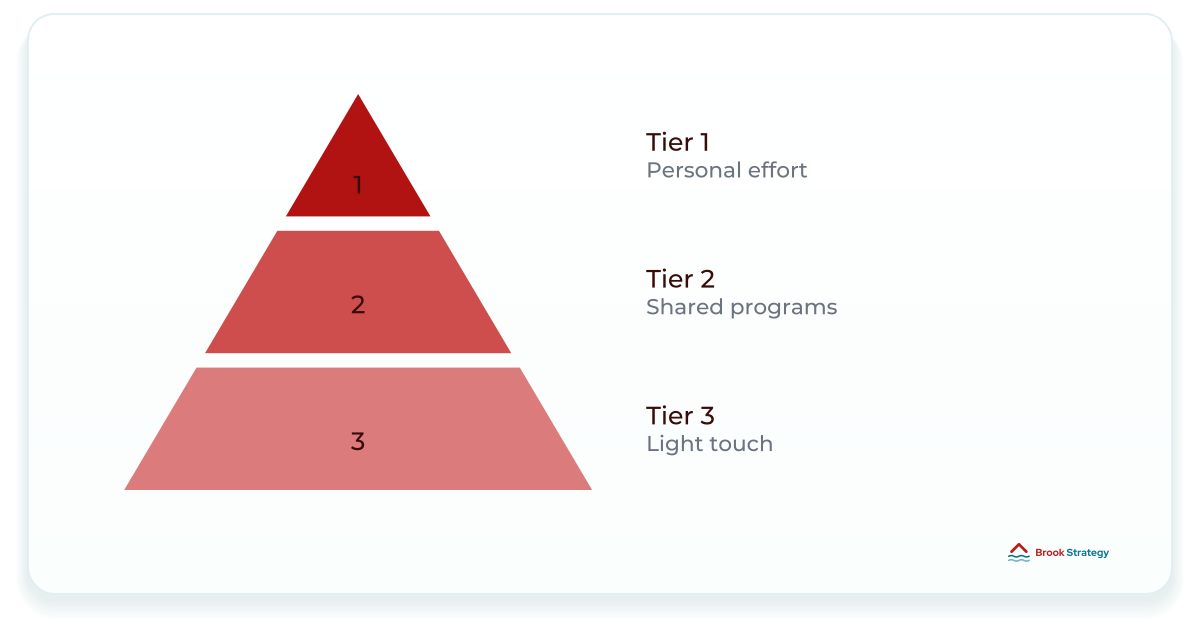
I split the resulting list into three tiers. Tier 1 is a short list of accounts that deserve personal attention from sales and marketing together. Tier 2 is a larger group that gets targeted campaigns. Tier 3 is everyone else who fits the profile and gets standard programs. The point is to decide in advance where the expensive effort goes.
Phase 2: Map the People Who Sign Off
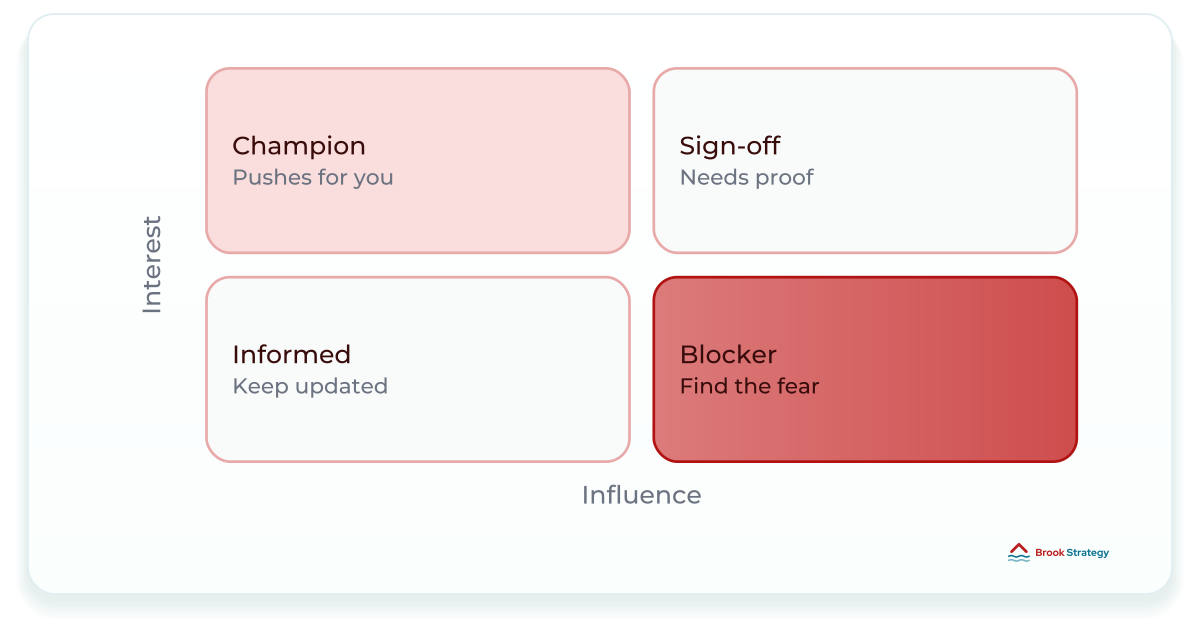
Gartner describes a typical buying group for a complex B2B purchase as six to 10 decision makers. Each one arrives with a different worry. The finance lead asks about payback, the operations lead asks about disruption, and the person who will use the product daily asks about workload. If your marketing speaks to only one of them, the others will quietly stall the deal.
Write one line per role: who they are, what they fear and what proof they need. Then check your current website and sales deck against that list. In most audits I run, three of the five roles have nothing written for them at all.
Gartner also finds that buyers spend about 17% of their purchase time meeting potential suppliers, and when they compare several vendors, time with any single sales rep can fall to 5% or 6%. The rest of the work happens in documents, peer conversations and search. That is the space your marketing has to cover.
Phase 3: Write the One-Page Message
Positioning is the page that your whole company can read in two minutes and repeat in the same words. I keep it to four parts: the problem your accounts have, the outcome they get, the proof you can show and the alternatives they would otherwise choose, including doing nothing.
The alternatives line is the one teams skip, and it is the most useful. A buyer rarely compares you with the vendor you consider your rival. They compare you with a spreadsheet, an internal build, or leaving things as they are. If your message does not answer that, it will not move anyone.
| Message part | Weak version | Stronger version |
|---|---|---|
| Problem | Teams struggle with reporting | Finance teams close the month nine days late because data sits in four systems |
| Outcome | Better visibility | Month-end close in five working days |
| Proof | Trusted by leading brands | Three named customers with their before and after numbers |
| Alternative | Other vendors | Spreadsheets plus a part-time analyst |
The examples in the table are illustrations of the level of detail to aim for. Fill yours in with numbers from your own customers.
Phase 4: Pick Channels by Where Buyers Already Look
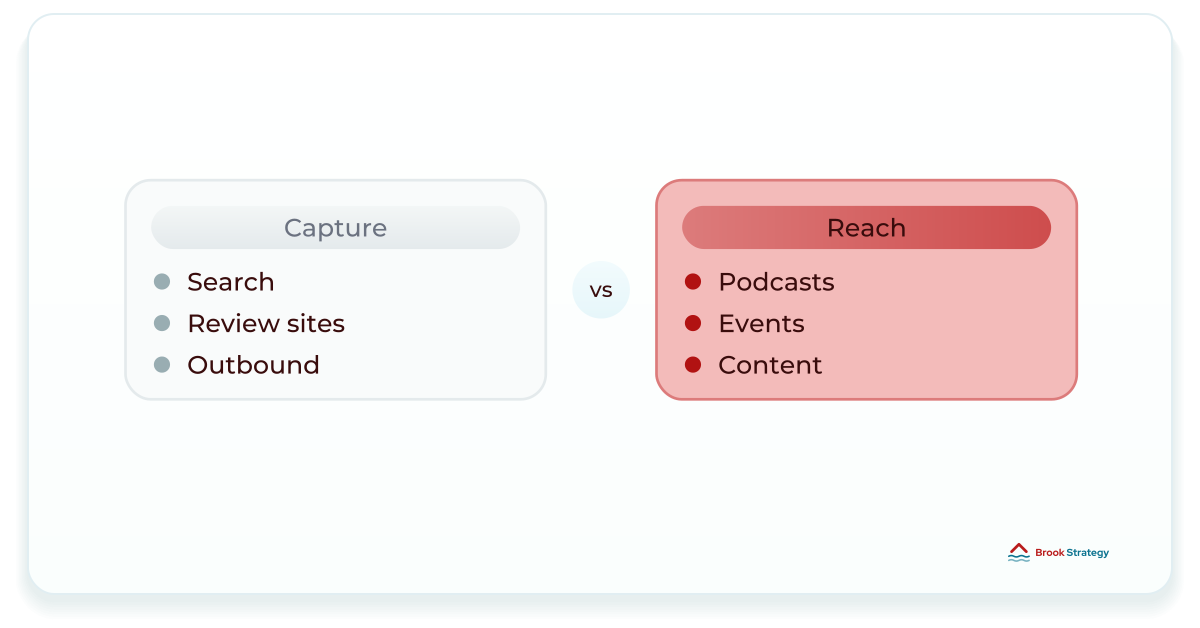
Research from the LinkedIn B2B Institute and the Ehrenberg-Bass Institute, summarized as the 95:5 rule, says only about 5% of B2B buyers are in the market at any given time. The other 95% may not buy for months or years, and when they do, they tend to choose from the brands they already remember. A channel plan therefore needs two jobs: capture demand from the few who are ready and stay visible to the many who are not.
For capture, think search, comparison sites, review platforms and outbound to Tier 1 accounts. For reach, think content that people in your accounts read repeatedly, such as a newsletter, a podcast or a LinkedIn presence from your own experts. I give each channel a budget share, an owner and a review date. If a channel has no owner, it does not make the list.
Resist the urge to pick six channels. In my experience a team of three people runs two channels well and four channels badly.
Phase 5: Agree on the Handoff With Sales
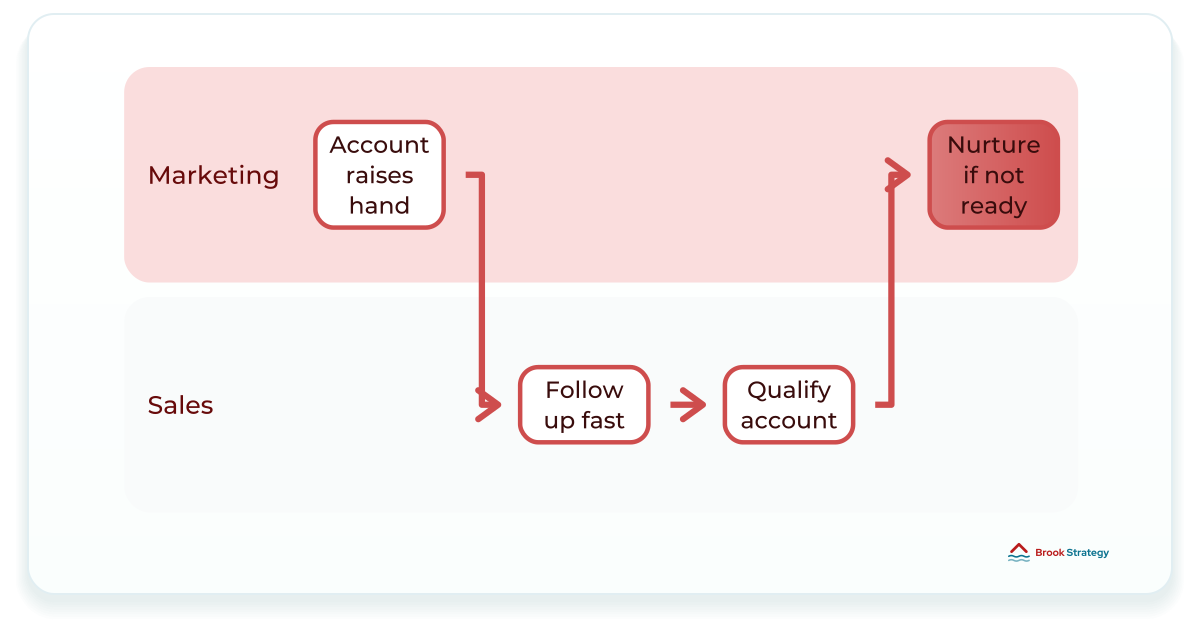
Most B2B marketing strategies break at the handoff. Marketing counts a lead when a form is filled. Sales counts it when a budget exists. Both are right by their own rules, and the pipeline report satisfies nobody. One session with both teams fixes most of this. Agree on what makes an account qualified, how fast sales will follow up and what happens to accounts that are not ready.
Put the rules in a single page. I include a service level for follow-up, such as same-day contact for Tier 1 accounts, and a rule for recycling accounts that are not ready back into nurture content instead of dropping them. If you also need a stack for account-based programs, intent data and email, my ranking of B2B marketing tools weighs up the main options.
Phase 6: Measure Five Numbers Every Month
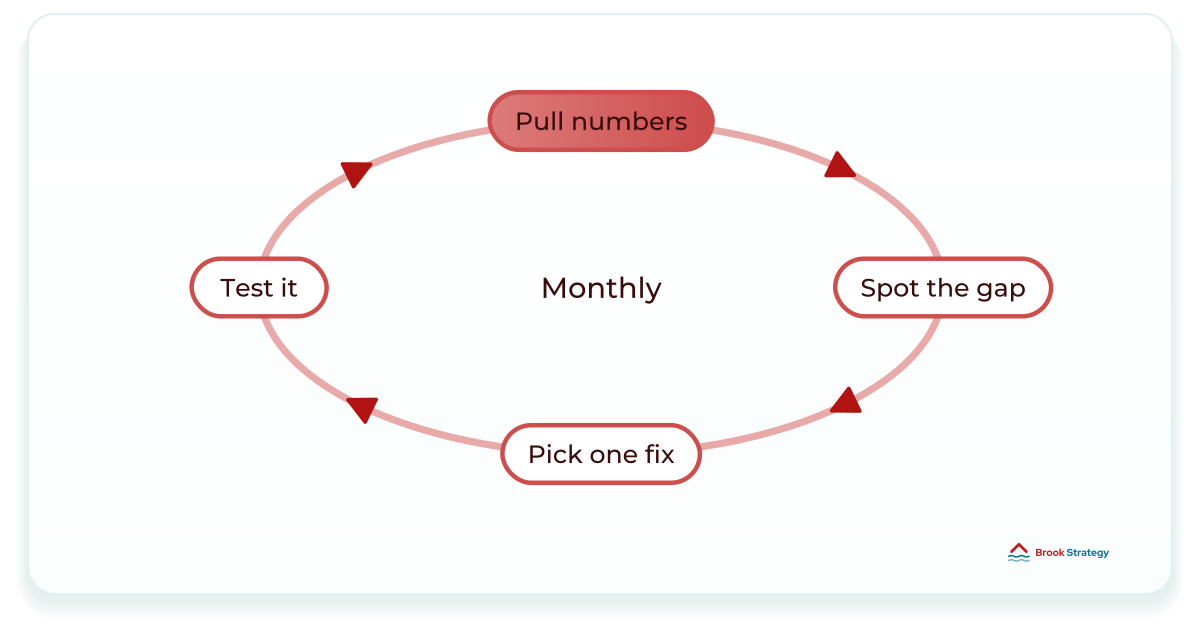
Pick five numbers and review them on a fixed date each month. I use share of Tier 1 accounts engaged, qualified opportunities created, cost per qualified opportunity, win rate by segment and sales cycle length. These cover reach, pipeline and revenue, so one weak area cannot hide behind a strong one.
Leads, clicks and impressions are useful when you diagnose a problem, but they should not lead the report. A rise in leads with flat opportunities is a warning that your targeting has drifted. Because B2B cycles are long, give a change at least one full cycle before judging it.
How This Compares With Other Models
You will meet other frameworks, and most are compatible with this one. The table shows where each fits.
| Model | What it is good at | Where it falls short |
|---|---|---|
| Account-based marketing | Focusing effort on a short list of high-value accounts | Needs a clear profile and sales cooperation first |
| Demand generation funnel | Tracking volume through stages | Treats buying as a straight line, which it rarely is |
| Jobs to be done | Explaining why customers switch | Does not choose channels or budgets |
| The six phases above | Putting decisions in order, from account to measurement | Needs your own data to fill in the details |
How to Know Your Framework Is Ready
Before you spend a budget, check that your draft passes four tests:
- Someone outside marketing can name your Tier 1 accounts after reading the document once.
- Each buying role has a written concern and a piece of proof.
- Every channel has an owner, a budget and a review date.
- Sales has signed the handoff rule.
If one answer is no, fix that before you add anything else. Plans rarely fail because they were too short.
Questions About the B2B Marketing Strategy Framework
How Many Steps Should a B2B Marketing Strategy Framework Have?
Six is enough for most companies. Fewer steps skip something that matters, such as the buying group or the handoff to sales. More steps tend to produce a long document nobody opens. If your team is small, you can merge phases 3 and 4 into one working session, as long as the message and the channel plan are both written down.
What Is the Difference Between a B2B Marketing Strategy and a Marketing Plan?
The strategy decides who you target, what you say and where you will not spend money. The plan turns that into campaigns, dates, owners and budgets. I write the strategy once or twice a year and the plan every quarter. Teams that start with the plan usually end up with a calendar full of activity and no clear reason for any of it.
How Do I Choose an Ideal Customer Profile?
Start with your best 20 customers, not your whole list. Look at what they have in common: size, industry, the problem that made them buy, the system they replaced and how long the deal took. Then check the same traits against your lost deals. A profile that fits your winners and your losers equally is too vague to be useful.
How Much of My Budget Should Go to Brand Building Versus Lead Capture?
There is no single correct split, and you should be suspicious of anyone who sells you one. The 95:5 research from the LinkedIn B2B Institute and the Ehrenberg-Bass Institute argues that most buyers are not in the market at any moment, so spending only on lead capture reaches a small slice. In my client work I usually start near 60% capture and 40% reach and adjust after two quarters of data.
Which Metrics Should a B2B Marketing Strategy Track?
Track a small set across three levels. For reach, look at share of target accounts engaged. For pipeline, track qualified opportunities created and the cost per opportunity. For revenue, track win rate and sales cycle length by segment. Leads and clicks are useful as diagnostics, but they should not be the headline numbers in a board report.
How Long Does It Take to Build the Framework?
A first version takes two to four weeks when you already have customer data and a few stakeholders to talk to. The slowest part is nearly always the customer interviews and the sales alignment session, since both depend on other people's calendars. Plan for the whole thing to be a draft that you revise after the first quarter of results.
When Should I Bring in a Strategy Consultant?
Bring one in when the team disagrees about who the customer is, when pipeline has stalled despite steady activity, or when you are entering a new segment and have no data yet. An outside view is also useful when the strategy keeps getting rewritten every quarter. If your direction is clear and you only need execution, hire a specialist for the channel instead.
Sources
Note: This article is general information, not legal, financial or tax advice. Figures and examples are estimates based on typical projects, so check current details with your providers and advisers before you decide.
Was this article helpful?
Thank you for letting us know.
Russell Tennant
Russell leads the Brook editorial team and works with our consultants to turn real client engagements into practical guides on roadmaps, go-to-market planning, growth and competitive strategy. Before joining Brook, he spent 11 years in strategy and product marketing roles at software and financial services companies. He has since edited more than 300 articles on strategy practice and drawn on roadmaps and growth plans from over 100 client projects. He is based in Denver, Colorado.