Key Takeaways
- A small business has less time and money than a large competitor, so the strategy is mostly about what you leave out.
- Pick one segment and two channels, and review them monthly before you add anything.
- A list of 30 to 50 named accounts gives a small team the focus that an account-based program gives a larger one.
- Plan around your weekly hours first, then your budget, since time is usually the tighter limit.
Most B2B marketing advice assumes a team, a stack of tools and a budget that covers all of it. If you are running marketing yourself, or with one part-time helper, that advice leaves you with a to-do list that cannot be finished. When I take on a B2B marketing strategy project for a small company, the first thing we do is shrink the plan until it fits the week.
This guide shows how to do that, in the order I work through it with clients. If you want the full six-phase model that this is a trimmed version of, read my B2B marketing strategy framework.
What Is Different When You Are Small
Small does not only mean fewer dollars. It changes which mistakes are expensive. A large company can run a campaign that fails and absorb the loss. You cannot. A large company has a brand that people recognize before the first email. You usually do not. That is why a small business needs a different order of work.
| Situation | Large company approach | Small business approach |
|---|---|---|
| Target market | Several segments served in parallel | One segment where you can be the obvious choice |
| Channels | Six or more, managed by specialists | Two, run by one person each |
| Account focus | Platform-driven account programs | A spreadsheet of 30 to 50 named accounts |
| Content | Large calendar across formats | One recurring piece with real expertise in it |
| Measurement | Full attribution model | Five numbers reviewed once a month |
| Brand | Reach campaigns to build recall | Consistent presence in the few places buyers look |
The right column is not a lesser version of the left one. It is a different plan that fits the facts you have.
Start With Your Hours
Before you choose a channel, write down how many hours a week you can protect for marketing. I mean protect, as in blocked in a calendar. Most small teams overestimate this by half. A founder who says ten hours usually has five once sales calls and customer problems take their share.
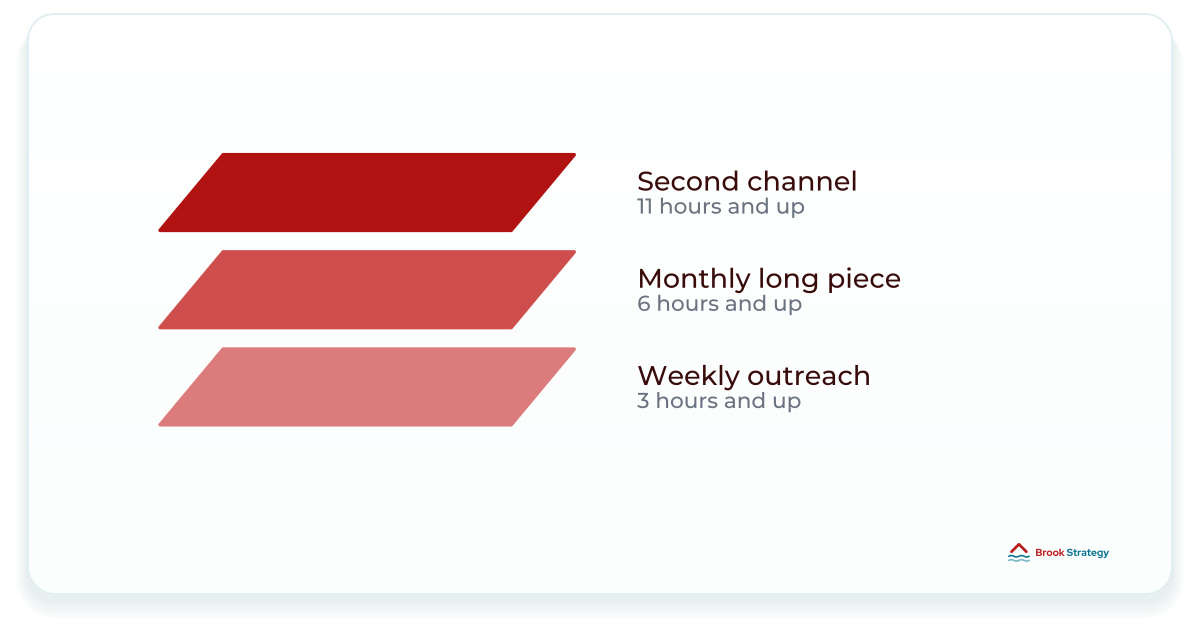
Then match the plan to the hours. The table shows the shape I use.
| Hours per week | What fits | What to skip |
|---|---|---|
| 3 to 5 | Outreach to a short account list and one helpful email or post a week | Webinars, podcasts, paid campaigns |
| 6 to 10 | Outreach plus one longer piece a month and a basic search page for your main service | Several social platforms, events |
| 11 to 20 | Two channels in depth, a small content library and light paid tests on your best-performing page | A third channel until the first two are steady |
Choose One Segment You Can Own
Large vendors have to speak to a whole market. That leaves a gap for anyone willing to speak to one corner of it with real detail. Look at your last ten customers and sort them by industry, size and the problem that made them call. If six of them came from one corner, that is your segment.
Describe it in one sentence a stranger could use to decide whether it fits them. For example, a consultancy might say it helps regional banks with fewer than 500 staff plan their digital channels. That sentence is easy to write onto a page, easy to search for and easy to repeat on a sales call. A sentence like "we help businesses grow" is none of those.
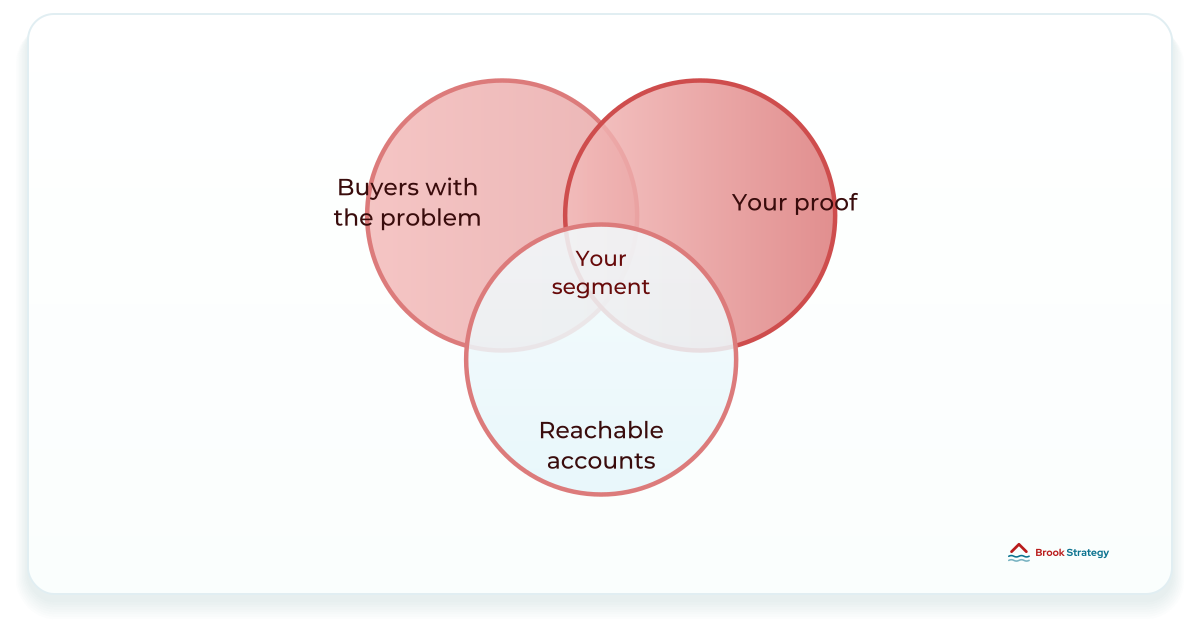
Gartner reports that a typical buying group for a complex B2B purchase involves six to 10 decision makers. That is another reason to narrow. When you know one segment well, you know who sits in that group and what each person worries about, and you can write for them without guessing.
Build a List of 30 to 50 Named Accounts
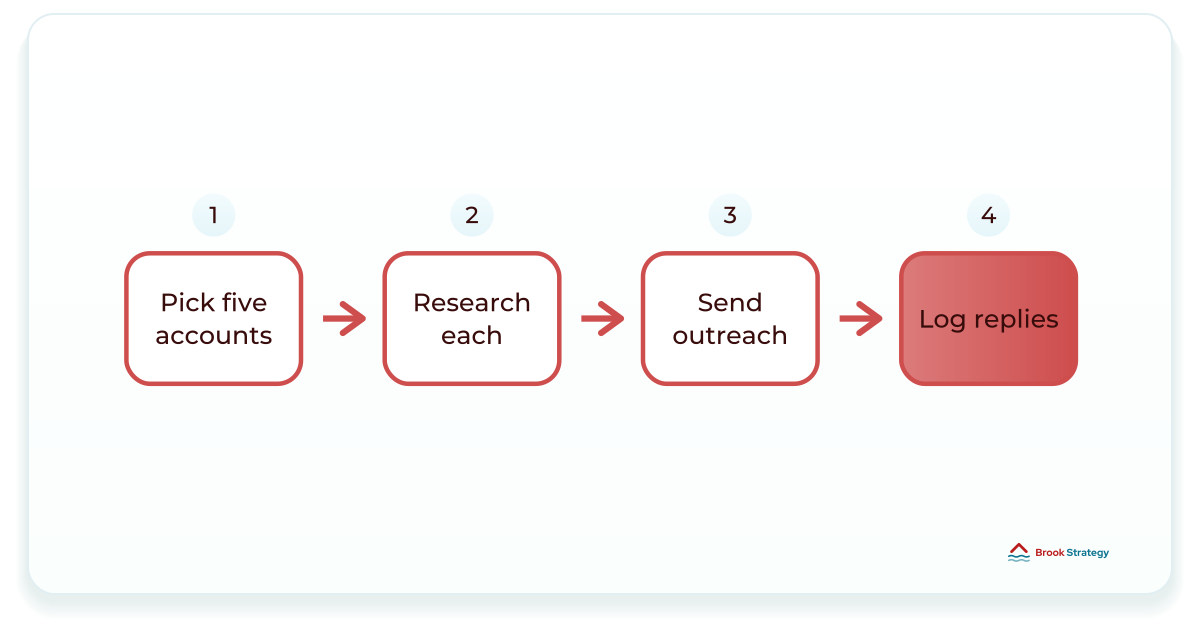
This is the cheapest account-based program that exists. Open a spreadsheet and list 30 to 50 companies that match your best customers. For each one, add the likely decision maker, one recent event such as a hire, a funding round or a product launch, and the date of your last contact.
Then use the list as the spine of your week. Each Monday pick five accounts and do something useful for each: send a relevant article, comment on a post, make an introduction or write a short personal note. Because the list is short, you can remember each company, and that memory is what large teams pay software to simulate.
The LinkedIn B2B Institute and the Ehrenberg-Bass Institute argue, in what became the 95:5 rule, that only about 5% of B2B buyers are in the market at any given time. A named list helps with the other 95%. You are not asking for a meeting. You are making sure that when one of those companies starts looking, your name is already familiar.
Pick Two Channels and Give Each a Job
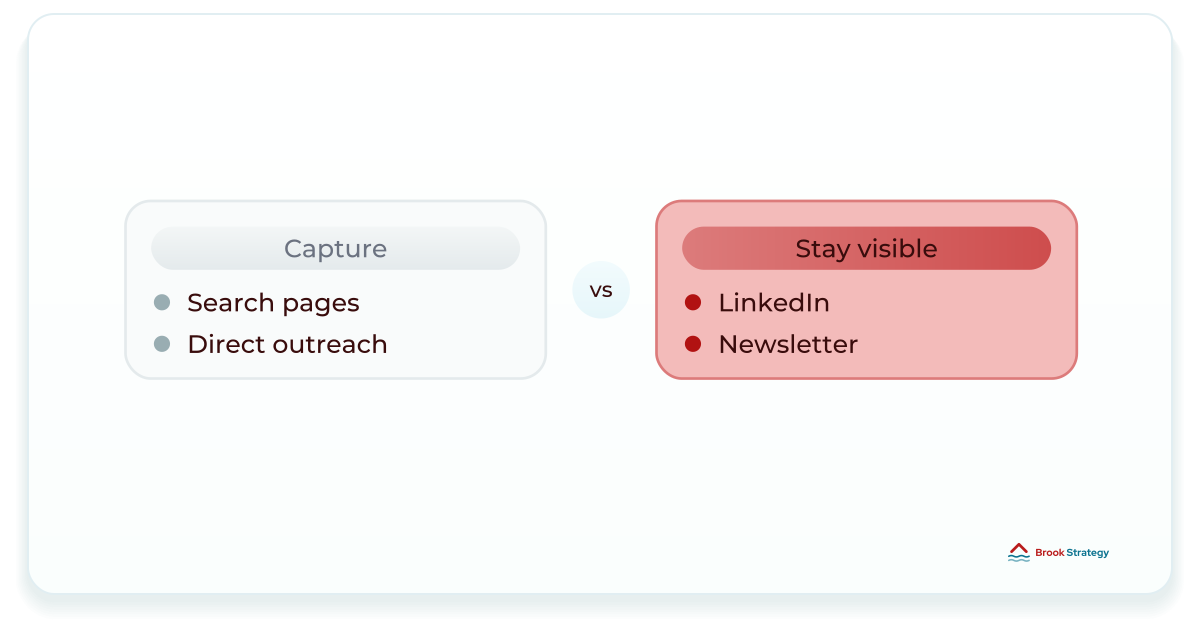
Give one channel the job of capturing demand from people who are already looking, and the other the job of keeping you visible to people who are not. A small business has to choose carefully, since both jobs are real and neither can be skipped for long.
| Channel | Job | Time to first signal | Fits you when |
|---|---|---|---|
| Search pages for your core service | Capture demand | 3 to 6 months | Buyers search for the problem by name |
| Direct outreach to your account list | Capture and open doors | 2 to 6 weeks | Your deal size justifies personal contact |
| LinkedIn presence from your experts | Stay visible | 2 to 4 months | Your buyers are senior and active there |
| A niche newsletter | Stay visible | 3 to 6 months | You have a real point of view to share each month |
| Review and comparison sites | Capture demand | 1 to 3 months | Buyers shortlist vendors on these sites |
| Paid search or paid social | Capture demand | Days, with cost from day one | You already know which page converts |
The time column is a rough guide from projects I have seen, and your market may differ. The point is the contrast. Outreach produces signals fast and costs hours. Search produces them slowly and costs less over time. A balanced pair for a small team is outreach plus either search or a newsletter.
If you want help choosing software for any of these, my overview of B2B marketing tools shows what is worth paying for and what a free plan covers.
Make One Piece of Content Do Several Jobs
A small team cannot run a content calendar, but it can write one good piece a month. Choose a question your buyers ask during sales calls, answer it fully with numbers and examples from your own work, and then reuse it. The same piece becomes a page on your site, an email to your account list, three short posts and the talking point for your next outreach round.
I ask clients to keep a running file of questions from prospects. After a quarter, that file is a better editorial plan than anything a tool will suggest. It also keeps the content honest, since every topic came from a real buyer.
A 90-Day Plan You Can Actually Finish
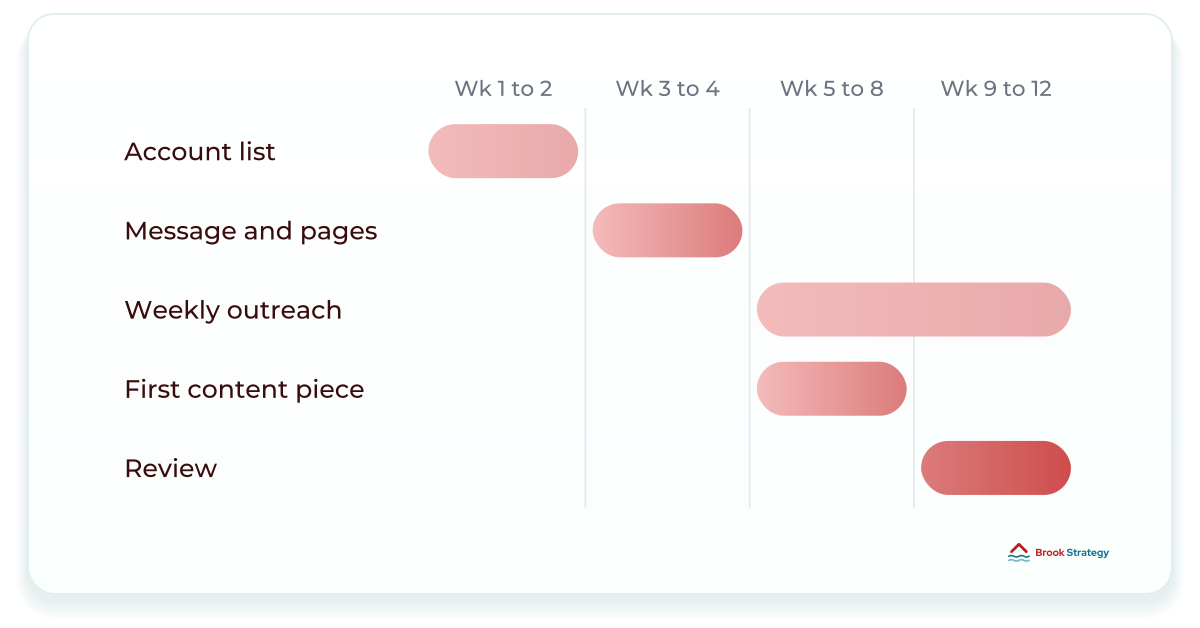
Here is the plan I hand to small teams. It assumes six to ten hours a week.
| Period | Focus | Done when |
|---|---|---|
| Weeks 1 and 2 | Pick the segment, write the one-sentence description and build the account list | You have 30 to 50 accounts with a named contact each |
| Weeks 3 and 4 | Write a one-page message and fix your homepage and main service page to match it | A stranger can tell who you serve within ten seconds |
| Weeks 5 to 8 | Start weekly outreach to five accounts and publish the first monthly piece | At least ten useful touches sent and one piece live |
| Weeks 9 to 12 | Review replies, meetings and page traffic, then keep, change or drop each channel | You can name what worked and what to stop |
The review in the last weeks matters most. Small teams tend to keep every channel alive out of hope. Be willing to stop one.
Measure Five Things Once a Month
You do not need an attribution model. Track how many accounts on your list replied or engaged, how many qualified meetings you booked, how many of those became proposals, your win rate and the length of your sales cycle. Write the numbers in one sheet and read them on the same day each month.
In my client work, small teams who review monthly fix problems about a quarter earlier than teams who only look when revenue dips. Because B2B cycles run long, allow one full cycle before you judge a change.
How to Know Your Small-Business Plan Is Realistic
Check the plan against four questions before you start:
- Do the hours in the plan fit the hours you can protect?
- Can you describe your segment in one sentence?
- Does every channel have one owner and one job?
- Is there a review date in your calendar?
If you answered no to any of them, trim the plan. A smaller plan that gets done is worth more than a complete one that stalls in week three.
Questions About B2B Marketing Strategy for Small Business
How Much Should a Small Business Spend on B2B Marketing?
There is no honest universal percentage, because it depends on margin, deal size and how fast you want to grow. A practical way to set it is to work backward from a target number of new customers, your average deal value and your current close rate, then fund the cheapest channel that can plausibly deliver that. In my client work, small teams get further by spending a modest budget on one channel for a year than by spreading it across five for a quarter each.
Can I Do B2B Marketing with No Dedicated Marketer?
Yes, if you limit the scope. A founder or sales lead can run a focused plan in five to eight hours a week: one target segment, one content habit, outreach to a short account list and a monthly review. The plan breaks when it grows past the time available, so cut channels before you cut quality.
Which Channel Works Best for a Small B2B Company?
The one where your buyers already look for the problem you solve and where you can show real expertise. For many small firms that is search, a niche newsletter or direct outreach to a named list. LinkedIn works well when your buyers are senior professionals who are active there. Test with a small budget and keep the channel that produces qualified conversations, not the one that produces the most clicks.
How Do I Compete with Bigger Competitors That Outspend Me?
Pick a narrower market and be the obvious choice in it. A large vendor has to speak to everyone, so it cannot be specific about an industry, a size of company or a problem. You can. Specific pages, specific case stories and a clear point of view beat a larger budget spread thin.
Should a Small Business Use Account-Based Marketing?
A light version fits very well. Build a list of 30 to 50 companies that match your best customers, learn who is in the buying group, and send relevant material and personal outreach to those accounts. You do not need an expensive platform for this. A spreadsheet and a calendar reminder are enough to start.
How Long Before B2B Marketing Produces Results for a Small Company?
Outreach to a named list can create conversations within weeks. Content and search usually need three to six months to build, and longer when your sales cycle is long. Set expectations with your team at the start, and judge the plan by leading signs such as replies and qualified meetings before closed revenue shows up.
When Is It Worth Hiring an Agency or Consultant?
Hire help when you have a clear target segment but no time to execute, or when you keep changing direction and need someone to hold the plan steady. For the strategy itself, a short engagement is often enough. For execution, a specialist freelancer in one channel is usually cheaper than a full agency retainer.
Sources
Note: This article is general information, not legal, financial or tax advice. Figures and examples are estimates based on typical projects, so check current details with your providers and advisers before you decide.
Was this article helpful?
Thank you for letting us know.
Russell Tennant
Russell leads the Brook editorial team and works with our consultants to turn real client engagements into practical guides on roadmaps, go-to-market planning, growth and competitive strategy. Before joining Brook, he spent 11 years in strategy and product marketing roles at software and financial services companies. He has since edited more than 300 articles on strategy practice and drawn on roadmaps and growth plans from over 100 client projects. He is based in Denver, Colorado.