Key Takeaways
- Fix what you already own first: pricing, retention and sales to current customers.
- Pick one acquisition channel and run it for a full quarter before you add another.
- Track five numbers on one page every month and review them on a fixed day.
- A small team needs one clear bet, a budget limit and a date to decide.
Large companies can afford to run ten growth experiments and learn from the nine that fail. A small business can't. With a handful of people, every hour has a price, so your growth strategy is mostly a list of what you will not do. If you'd like a second opinion on that list, growth strategy consulting can be scoped to a few weeks.
The order below is the one I give small clients. It starts with the cheapest moves, which are usually inside your current customer base, and moves outward only when those are done. Each step has a cost, a time to result and a way to tell if it worked.
Why Small Businesses Need a Different Playbook
Growth advice usually comes from companies with a marketing department, a data team and funding. Copying it with three employees leads to scattered effort. The numbers on survival explain why focus matters. According to the latest Bureau of Labor Statistics table on establishment survival, about 79% of new private-sector establishments reach their second year, and about 47% of the cohort that started five years ago is still open (BLS Business Employment Dynamics). Many exits come from running out of cash before growth arrives.
So the aim is not the biggest growth rate. It is steady growth that your cash can fund. That changes the order of moves, as the table shows.
| Move | Cash needed | Time to first result | Risk |
|---|---|---|---|
| Review and adjust pricing | Very low | 1 to 2 months | Low |
| Reduce cancellations | Low | 1 to 3 months | Low |
| Sell more to current customers | Low | 1 to 3 months | Low |
| Build a referral engine | Low | 2 to 4 months | Low |
| Run one paid or search channel | Medium | 3 to 6 months | Medium |
| Enter a new segment or product | High | 6 to 18 months | High |
Win 1: Check Your Prices
Small businesses underprice more often than they overprice. The owner knows the cost of every hour and prices from that, instead of from what the customer would pay. A simple test: list your last ten new customers and ask how many hesitated at the price. If none did, you probably have room.
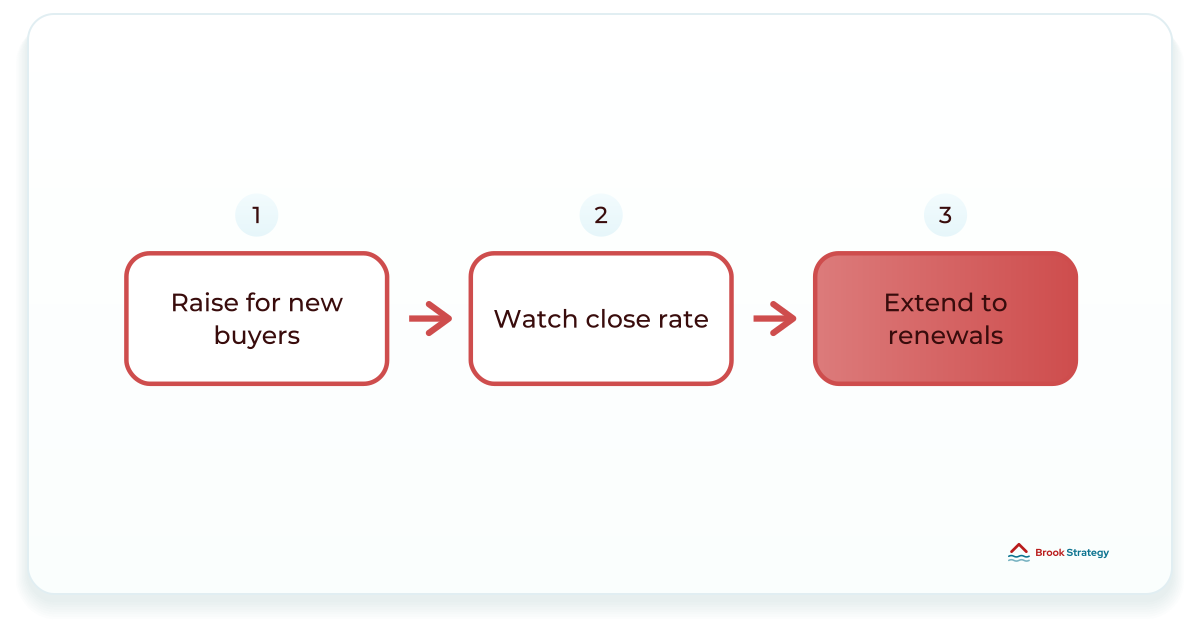
Try a modest increase for new customers first, such as five to ten percent, and watch the close rate for a month. Existing customers can follow with notice. I've seen small service firms add margin this way without losing a client, though the result depends on your market, so test before you commit. If you are unsure how to structure tiers, the same thinking sits behind pricing strategy consulting.
Win 2: Keep the Customers You Have
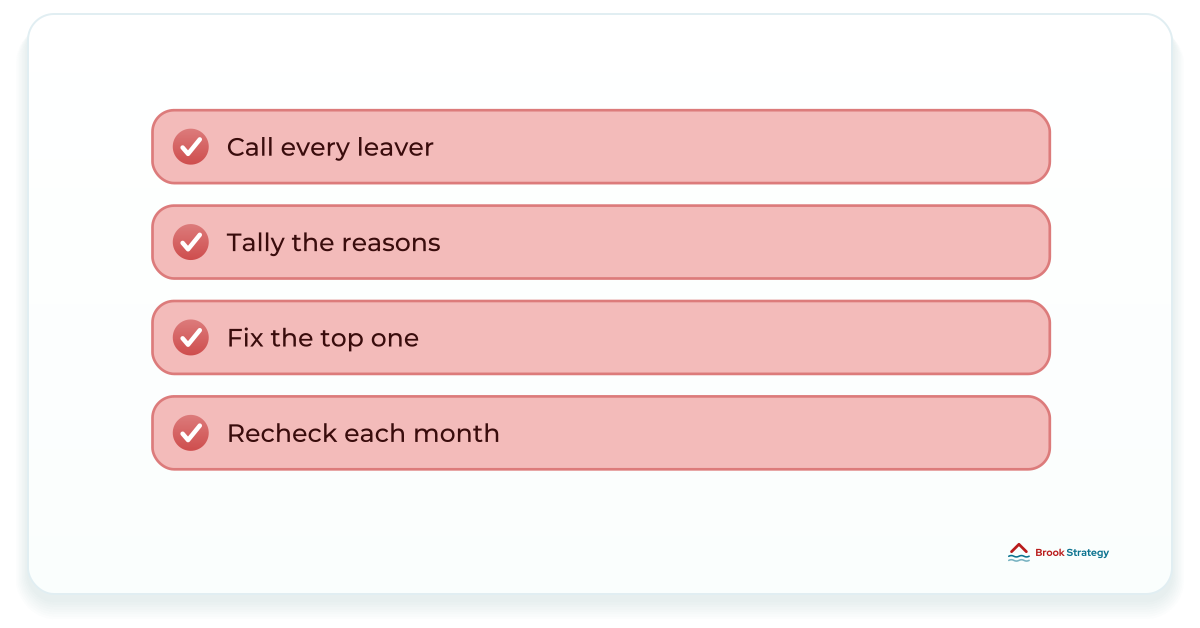
Every customer who leaves is revenue you have to win again at full acquisition cost. Call the last five customers who cancelled and ask why. In small businesses, the answers cluster fast: a missed handover, a slow reply, a feature gap or a price change nobody explained.
Fix the top reason first. Often that means a simple rule, such as a check-in call after day thirty or a reply within one business day. You can measure the effect in your cancellation rate within two or three billing cycles.
Win 3: Sell More to Customers You Already Have
Your current customers trust you and already know what you do. Ask which of them would use a second product or a larger package. Offer it to the ten you know best, in person or by phone, before you write any marketing.
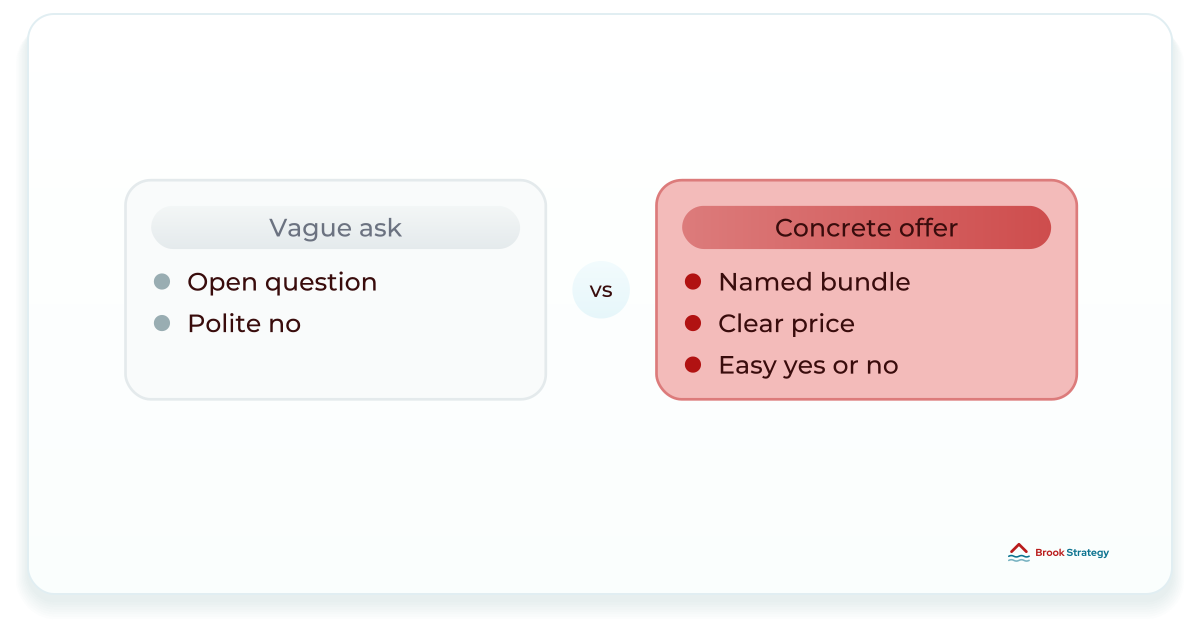
A simple expansion offer needs no new product. A maintenance plan, an extra seat, an annual contract with a small discount or a bundled service all count. Track the share of customers who buy a second item, because that number tells you how much unused value your base still holds.
Make the offer concrete. "Would you like more from us?" gets a polite no. "We now offer a quarterly review for a fixed fee, and I'd like you to try the first one at half price" gets an answer. Keep a short log of who said yes, who said no and the reason, because the reasons often point to your next product.
Win 4: Run One Acquisition Channel Well
Once your base is working, add new customers through a single channel. Choose where your best customers already look: referrals, local or industry search, a partner who serves the same buyers, or direct outreach. Look at your five best customers and ask how each found you, then back the most common answer.
Give it a full quarter with a written target, such as "twelve qualified conversations at a cost of no more than a set amount each." Review it monthly. If it misses by a wide margin after a quarter, change the channel, not the number.
Small teams often ask whether they should do everything at low effort. In my client work, the answer is no, because a half-effort channel produces a result too weak to read. If the channel works, you can invest more. If it fails, you have learned cheaply.
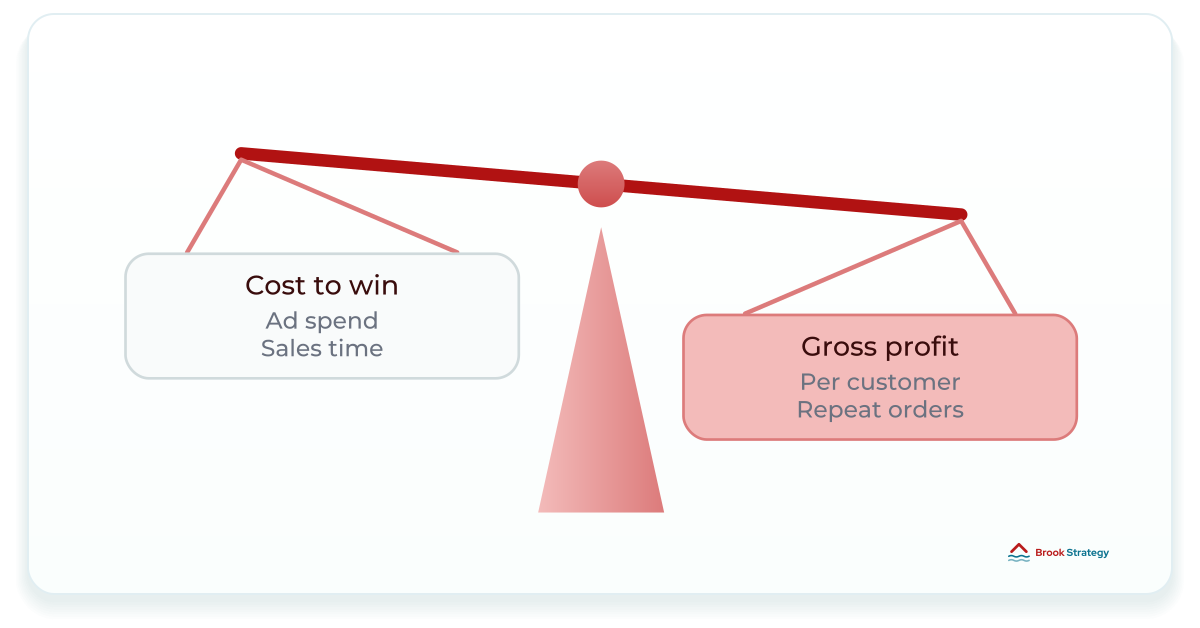
Before you invest more, work out the payback period for the channel. Divide the cost to win a customer by the monthly gross profit that customer brings. If the answer is longer than your cash runway allows, the channel can work and still sink you, so cut spend or raise prices first.
Track Five Numbers, Not Fifty
A small business needs a short dashboard it actually looks at. Use these five, on one page, reviewed on the same day each month:
| Number | How to calculate it | What you learn |
|---|---|---|
| New customers | Count per month | Whether acquisition is working |
| Revenue per customer | Revenue divided by active customers | Whether pricing and expansion work |
| Cancellation rate | Customers lost divided by customers at start of month | Whether you keep what you win |
| Cost to win a customer | Sales and marketing spend divided by new customers | Whether a channel pays back |
| Cash runway | Cash divided by average monthly burn | How long you can keep trying |
If you want to turn these into a quarterly plan with dates and owners, the growth strategy roadmap shows how to lay it out. For a structured way to pick between bigger options later, my growth strategy framework covers the full sequence.
A 90-Day Plan for a Five-Person Company
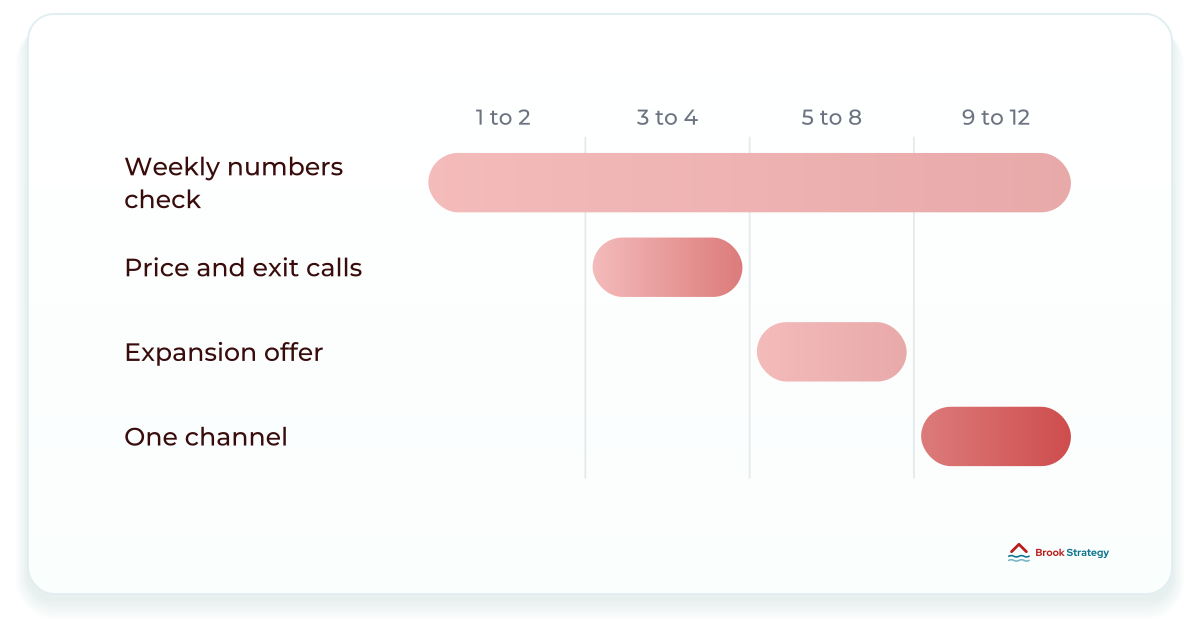
Here is how I'd sequence the moves for a small service or software business with about five people and no marketing hire. It assumes one owner who can spend roughly a day a week on growth. Adjust the dates to your billing cycle.
| Weeks | Focus | Deliverable |
|---|---|---|
| 1 to 2 | Baseline and five numbers | One-page dashboard with last six months of data |
| 3 to 4 | Pricing and cancellation calls | Five exit calls, one price test for new customers |
| 5 to 8 | Expansion offer to best customers | Ten conversations, one simple bundle |
| 9 to 12 | One acquisition channel | Written target and monthly checkpoint |
The owner's time is the scarcest input, which is why each block has one deliverable. At the end of week twelve, compare the five numbers with the baseline and decide whether to keep going, change the channel or add a second move. If a block produced nothing, find out why before you move on.
One agency owner I worked with followed a plan like this. Her pricing check showed that two of her three packages were priced well below what buyers had accepted in the last year. After a modest increase for new clients, the close rate stayed flat. She then spent the channel quarter on referrals from existing clients and added a partner who served the same buyers. Neither move needed a new hire, and she kept her cash runway intact the whole time.
Mistakes Small Teams Make
A few patterns come up again and again, and all are cheap to avoid.
- Starting three channels in the same month with one person to run them.
- Hiring a first salesperson before you know what a good sales process looks like.
- Discounting to close a deal instead of finding out why the buyer hesitates.
- Entering a new segment while the current one is only half served.
- Reviewing numbers only when cash is tight.
How to Choose Your First Move
Look at your last quarter. If new customers fell, start with the channel. If revenue per customer is low or flat, start with pricing and expansion. If you add customers but total revenue stays flat, retention is the leak. Choose one, set a target and a review date, and tell your team what you are leaving alone.
Bring in help when the cost of a wrong move is high: a first hire, a price change across the base or a new segment. A short engagement can test your assumptions with customer calls and a simple model before you commit cash. Keep the scope small and the decision yours.
Questions About Growth Strategy for Small Business
What Is the Best Growth Strategy for a Small Business?
The best one is the one you can run with the people and cash you have. For most small businesses that means selling more to existing customers, tightening one acquisition channel and fixing pricing before chasing a new market. These moves cost the least and show results within a quarter or two.
How Much Should a Small Business Spend on Growth?
There is no single percentage. Set the budget from what a new customer is worth to you. If a customer brings in a defined profit over their lifetime, you can spend a share of that to win them, as long as cash lasts until they pay back. Start small, measure payback and add budget only to what pays back.
Should a Small Business Focus on New Customers or Existing Ones?
Start with existing ones. Selling a second product, raising a price that is clearly too low or reducing cancellations usually costs less than winning a new customer. Once your current base is well served, put more effort into acquisition.
How Do I Pick a Growth Channel When I Have a Small Team?
Pick the one channel where your best customers already look for you, such as referrals, search, a partner or direct outreach. Run it for a full quarter with a clear target before you add a second. Spreading across five channels with a tiny team means none gets enough attention to work.
When Should a Small Business Hire a Growth Consultant?
Consider it when growth has stalled for more than two quarters and you can't name the cause, or when you plan a larger move such as a new segment, a price change or a first sales hire. A short, fixed-scope engagement costs far less than a wrong hire or a failed launch.
How Long Does It Take to See Results from a Growth Strategy?
Pricing and retention fixes can show up within one or two billing cycles. New channels usually need a quarter before you can read the signal, and new products or markets take longer. Set a review date at the start so you don't judge too early or too late.
What Numbers Should a Small Business Track for Growth?
Keep it to four or five: new customers per month, revenue per customer, cancellation rate, cost to win a customer and cash runway. Review them on one page every month. More metrics make it harder to see what changed.
Sources
Note: This article is general information, not legal, financial or tax advice. Figures and examples are estimates based on typical projects, so check current details with your providers and advisers before you decide.
Was this article helpful?
Thank you for letting us know.
Russell Tennant
Russell leads the Brook editorial team and works with our consultants to turn real client engagements into practical guides on roadmaps, go-to-market planning, growth and competitive strategy. Before joining Brook, he spent 11 years in strategy and product marketing roles at software and financial services companies. He has since edited more than 300 articles on strategy practice and drawn on roadmaps and growth plans from over 100 client projects. He is based in Denver, Colorado.