Key Takeaways
- A market entry framework turns one large bet into six small decisions, each with a clear output.
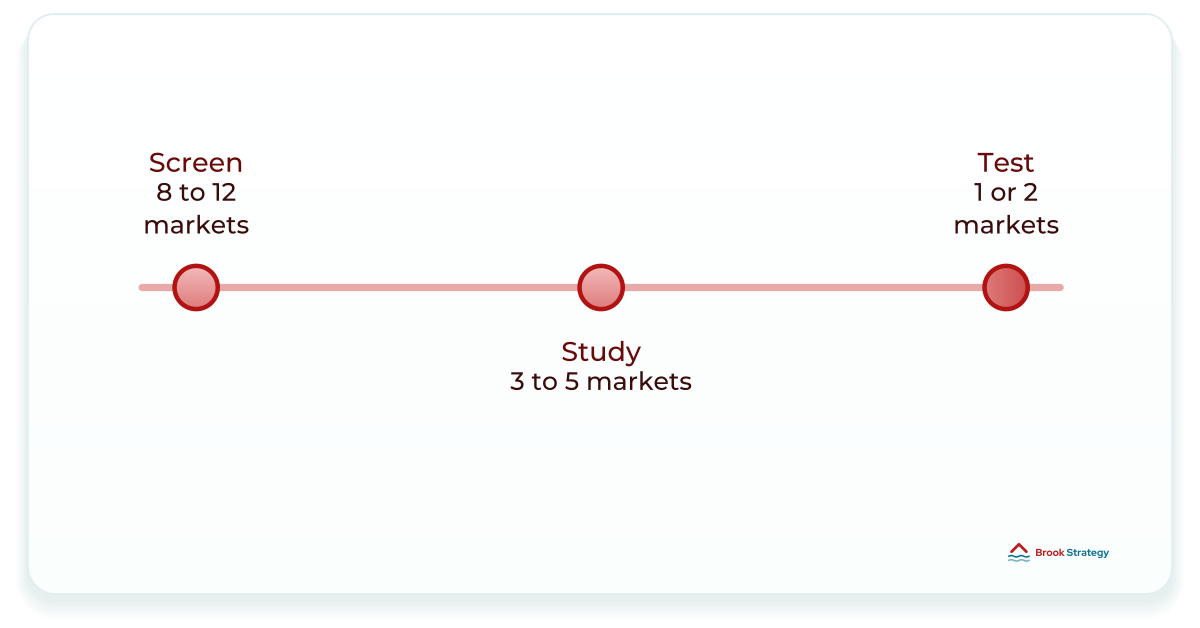
- Screen eight to twelve markets on one scorecard before you research any of them deeply.
- Buyer interviews and a pilot tell you more about demand than any market report.
- Write stop rules before launch, so a weak start gets paused instead of funded by habit.
Most expansion plans I review start with a market that someone on the leadership team already likes. The research then gets built to support it. This framework works the other way around. It starts with your goal and your limits, tests the options against the same questions and only then picks a market. If you work with market entry strategy consulting, this is the structure I use with clients, and you can run it on your own as well.
The framework has six phases. Each answers one question, produces one output and ends with a decision. I describe each phase, show a worked scoring example and finish with how to size the effort to your company.
Six Phases in Brief
Use the table as a checklist. If you cannot fill in the output column for a phase, you are not ready to move on.
| Phase | Question it answers | Output | Typical time |
|---|---|---|---|
| 1. Goal and limits | Why enter a new market, and what can you risk? | One-paragraph goal, budget cap, time limit | 3 to 5 days |
| 2. Screening | Which markets deserve real research? | Scored list of 8 to 12 markets, cut to 3 to 5 | 1 to 2 weeks |
| 3. Demand and competition | How big is each shortlisted market, and who is already there? | Sizing range and competitor map per market | 1 to 2 weeks |
| 4. Buyer tests | Would real buyers pay for your offer? | Interview findings and a go or no-go | 2 to 3 weeks |
| 5. Entry mode | How should you enter: direct, partner, acquire or pilot? | Mode comparison and a recommendation | 1 week |
| 6. Gated launch | What do you do first, and when do you stop? | 12-month plan with gates, budget and stop rules | 1 to 2 weeks |
Phase 1: Write Down the Goal and the Limits
Start with one paragraph that says why you want to enter a new market. The reason shapes every later choice. If the goal is revenue growth within 18 months, a large market with strong competitors may be wrong, and a smaller niche with weak incumbents may be right. If the goal is to follow a key customer abroad, the answer is already partly decided.
Then set three limits: how much money you can lose, how long you will wait for the first sign of traction and which markets are off the table for legal, strategic or personal reasons. I ask leaders to write these limits on their own and compare them. In my experience, the budget figures differ by a factor of two more often than people expect, and finding that out in week one saves a painful meeting in month four.
Phase 2: Screen Before You Study
A screening scorecard is a cheap way to avoid expensive research on the wrong markets. List eight to twelve candidates and score each one from 1 to 5 on five or six criteria that you can answer from public data in an hour or two per market.
The criteria I use most are market size and growth, fit with your product, competitive intensity, regulatory or licensing burden, ease of reaching buyers and how well your existing customers or partners already serve it. Weight them by your goal. If speed matters most, give ease of reaching buyers a double weight. The worked example further down shows how the numbers come out.
Phase 3: Size Demand and Map Who Is There
For the three to five markets that survive screening, build a market size two ways. The top-down figure starts from an industry total and narrows it by segment and region. The bottom-up figure counts the buyers you could realistically serve and multiplies by a price and an adoption rate you can defend. When the two figures sit within a factor of two, you have a usable range. When they do not, you have found the first question for your buyer interviews.
Competitor mapping asks four things about each rival: who they sell to, what they charge, how they sell and where buyers complain about them. Review sites, job posts, pricing pages and customer forums answer most of it. Add the local players that global research tools miss, because those are often the ones your first buyers already use. If you are weighing prices for the new market, my guide to pricing strategy consulting covers how to test willingness to pay.
Phase 4: Let Buyers Say No
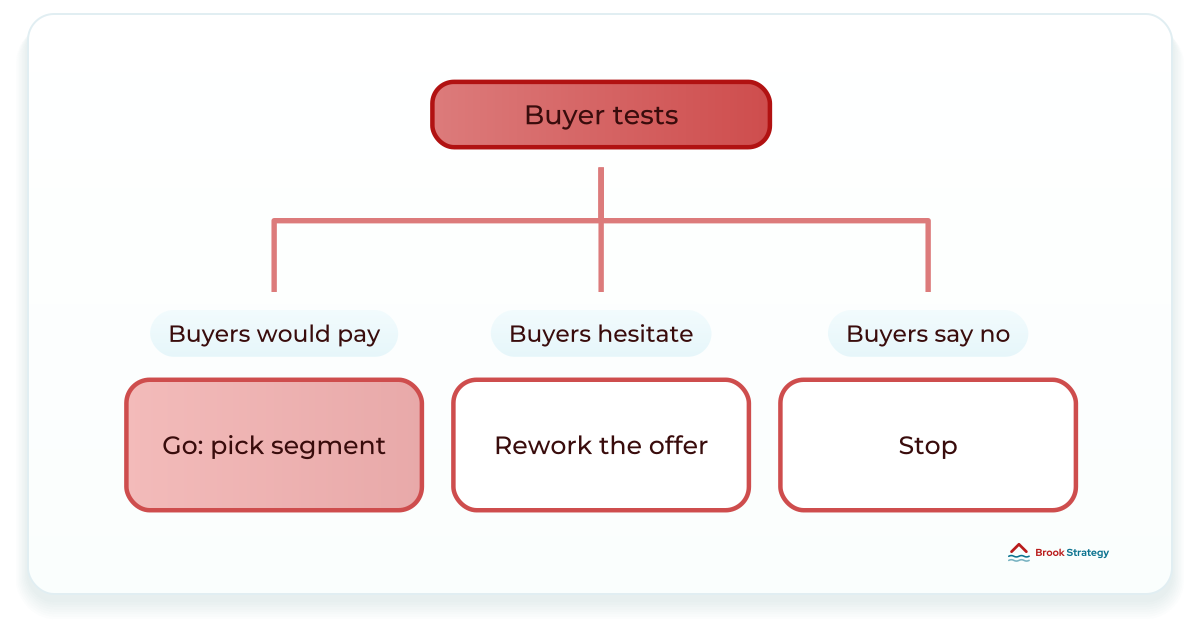
Desk research tells you about the market. Interviews tell you about your offer. Aim for eight to twelve conversations in each of your top one or two markets, with people who match your ideal customer. Ask how they solve the problem today, what it costs them, what they have tried and what would make them switch. Do not pitch. The aim is to hear the problem in their words and learn what they would pay to fix it.
At the end, write a go or no-go in one page. A go says which segment, which promise and which price. A no-go says what you learned and what would need to change. I have seen a clear no-go save a client a six-figure launch, and I count that as a win for the framework.
Phase 5: Choose How to Enter
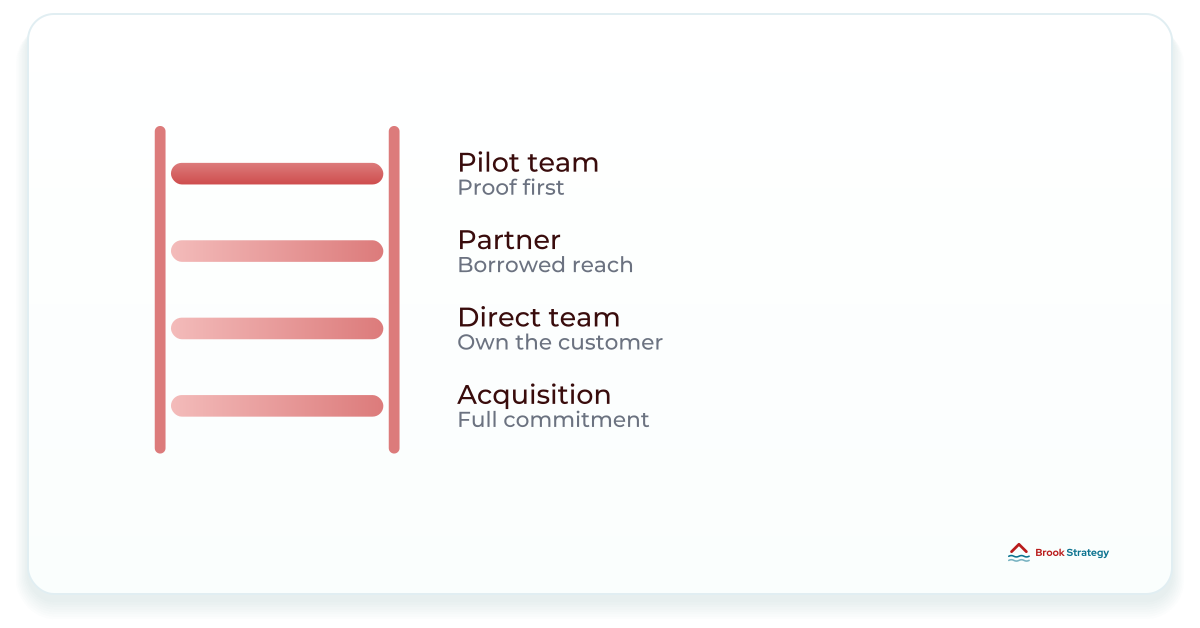
Igor Ansoff described market development, taking existing products to new markets, as moderately risky in his 1957 paper on diversification. Your entry mode decides how much of that risk you carry. The table compares the four common routes on the factors that usually decide the choice.
| Entry mode | Speed | Upfront cost | Control | Best when |
|---|---|---|---|---|
| Pilot with a small team | Fast | Low | High | You need proof before you commit |
| Partner or distributor | Fast | Low to medium | Low | Reach and local trust matter most |
| Direct sales and local team | Slow | High | High | Deal values are high and you own the customer |
| Acquisition | Fast once closed | Very high | High | You need customers, licenses or talent at once |
Most clients should start with a pilot or a single partner, even if the long-term plan is direct sales. You learn the real sales cycle, the real objections and the real cost per customer before hiring a local team. The one common exception is a regulated market where a license or partner bank is the entry ticket.
Phase 6: Plan the Launch in Gates
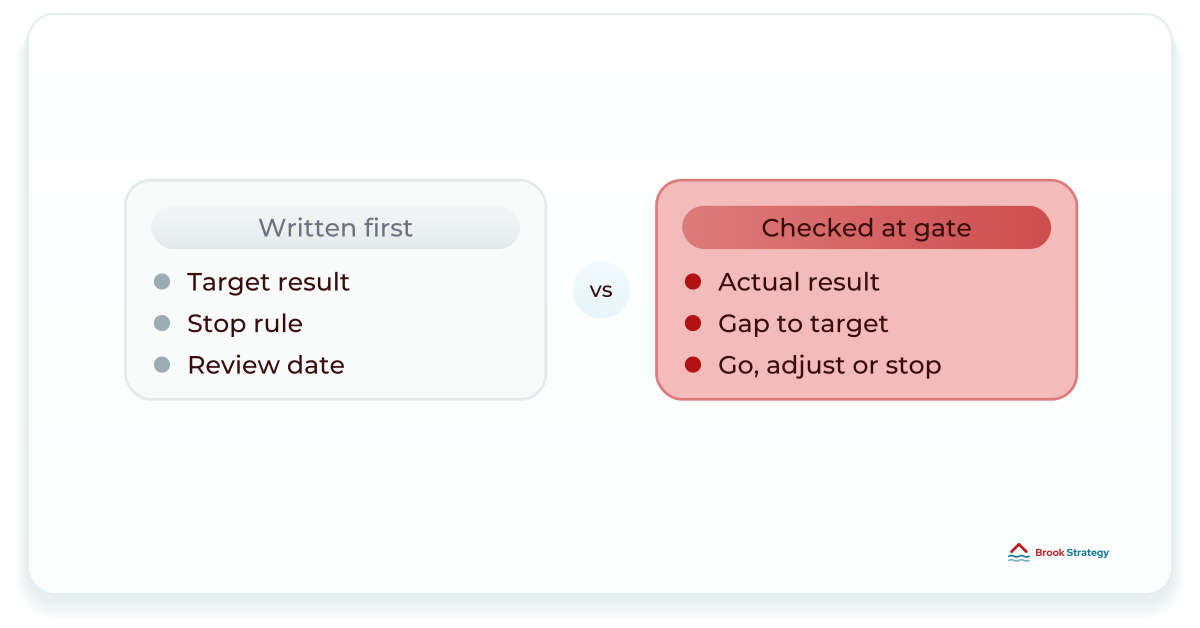
A gate is a point where you review evidence and decide whether to release the next block of money. A typical 12-month plan has three or four gates. The first might be ten qualified conversations in 60 days. The second might be three paying customers at your target price by month five. The third might be a repeatable sales cycle and a cost per customer below a set limit by month nine.
Write the stop rules at the same time. A stop rule is the result that pauses the plan: for example, fewer than five qualified conversations after 90 days, or a customer cost twice the planned figure. I ask the leadership team to sign the gates and stop rules before launch. When results come in weak, the conversation is about the evidence instead of about whose idea the market was.
Sales and marketing plans for the launch belong in the same document. My overview of go-to-market strategy consulting covers how to turn the chosen segment into messages, channels and a first-year sales motion.
A Worked Scoring Example
Take a B2B software company that wants a second market in the next 18 months. Its goal is revenue within a year, so ease of reaching buyers carries a weight of 2 and the other criteria carry 1. Here is a trimmed version of the screening scorecard with four of the candidates.
| Criterion (weight) | Market A | Market B | Market C | Market D |
|---|---|---|---|---|
| Size and growth (1) | 5 | 3 | 4 | 2 |
| Product fit (1) | 3 | 4 | 4 | 5 |
| Competitive intensity (1) | 2 | 4 | 3 | 4 |
| Regulation (1) | 3 | 4 | 2 | 4 |
| Ease of reaching buyers (2) | 2 | 4 | 3 | 4 |
| Weighted total (out of 30) | 19 | 23 | 20 | 24 |
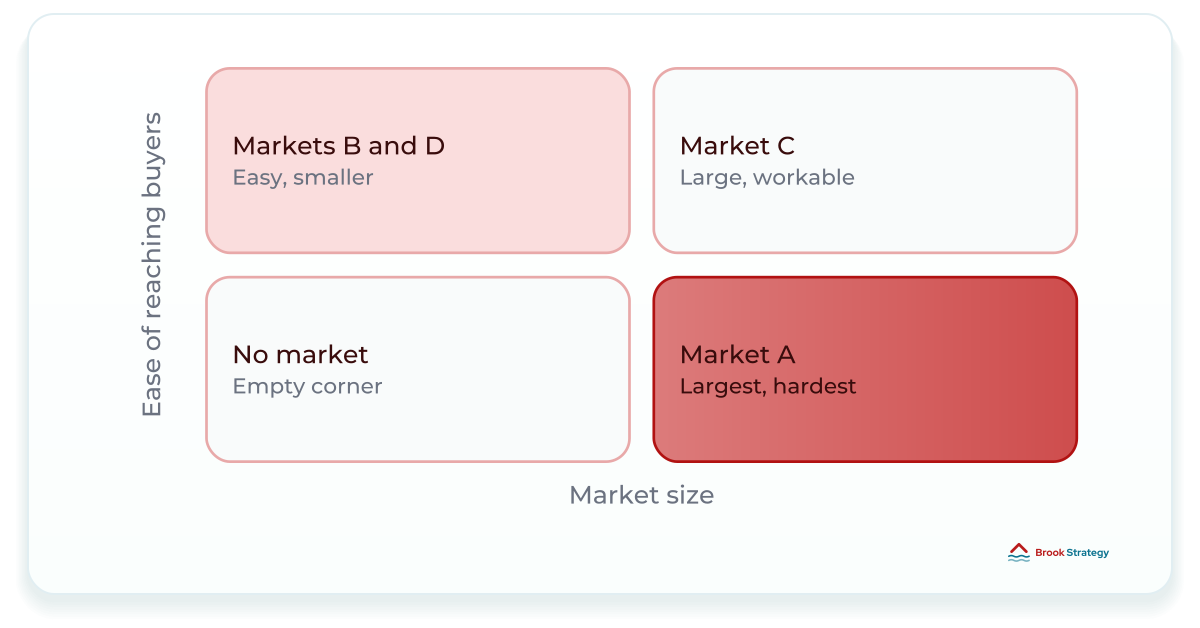
Market A has the largest size score and the lowest total. That is the pattern I see most often: the biggest market is also the hardest to enter. Markets B and D go to buyer interviews, and Market C is kept as a backup. The ranking is a starting point for the next phase, not a verdict, which is why the framework puts buyer tests right after it.
How to Match the Framework to Your Size
You can run every phase at three depths. The lightest version fits a team with a limited budget, and the fullest one fits a company committing to a new region.
- Light: one-page scorecard, five buyer calls, a single partner pilot and one gate at 90 days.
- Standard: scored shortlist, sizing two ways, eight to twelve buyer interviews and three gates.
- Full: local-language research, partner due diligence, a financial model and a board-level gate review.
Pick the depth by the size of the bet. If you would be comfortable losing the budget, run the light version. If a failed launch would hurt your plan for the year, run the standard version at a minimum. For companies still deciding on their wider direction, my growth strategy consulting page explains how market entry fits next to other growth options, such as selling more to existing customers.
Questions About Market Entry Frameworks
What Is a Market Entry Strategy Framework?
It is a repeatable structure for deciding whether to enter a new market and how. It breaks the decision into phases, such as setting the goal, screening markets, sizing demand, testing with buyers, choosing an entry mode and planning the launch. Each phase answers one question and produces one output, so your leaders can decide in steps instead of in one large leap.
How Many Markets Should I Screen at the Start?
I usually start with eight to twelve candidates on a simple scorecard, cut to three to five for deeper research and then to one or two for buyer interviews. Starting with fewer than eight risks missing a better option. Starting with more than fifteen burns time on markets you can rule out in an afternoon.
What Is the Best Way to Enter a New Market?
There is no single best mode. A pilot or partner suits you when you need to learn cheaply. A distributor suits a market where reach matters more than margin. Direct sales suit high-value products where you need to control the customer. An acquisition suits you when speed and local presence matter and you can afford the risk. The right choice follows from your goal, budget and risk limit.
How Long Does It Take to Build a Market Entry Strategy?
A desk-based screening takes two to three weeks. Adding buyer interviews and a business case usually takes five to seven weeks in total. A full plan with a 12-month launch schedule often takes eight to ten weeks. Delays almost always come from scheduling interviews, not from analysis.
How Do I Size a New Market Without Good Data?
Build the figure two ways and compare. A top-down estimate starts from an industry total and applies filters for segment and region. A bottom-up estimate counts the number of target buyers and multiplies by a realistic price and adoption rate. If the two land within a factor of two of each other, you can trust the range. If they do not, interviews usually explain the gap.
What Are Stop Rules in a Market Entry Plan?
A stop rule is a threshold you set before launch that tells you when to pause or change course, for example fewer than a set number of qualified conversations after 90 days or a cost per customer above a set limit. Writing them down in advance removes the pressure to keep funding a weak launch.
Can a Small Company Use This Framework?
Yes. A small team can run every phase with lighter tools: a one-page scorecard, five to ten buyer calls and a pilot with a single partner or a small paid test. The structure stays the same, only the depth of each phase changes.
Sources
Note: This article is general information, not legal, financial or tax advice. Figures and examples are estimates based on typical projects, so check current details with your providers and advisers before you decide.
Was this article helpful?
Thank you for letting us know.
Russell Tennant
Russell leads the Brook editorial team and works with our consultants to turn real client engagements into practical guides on roadmaps, go-to-market planning, growth and competitive strategy. Before joining Brook, he spent 11 years in strategy and product marketing roles at software and financial services companies. He has since edited more than 300 articles on strategy practice and drawn on roadmaps and growth plans from over 100 client projects. He is based in Denver, Colorado.